
 Промышленность
Похожие презентации:









Magneto-Impulse Processing of Metals (MPM)
1. Magnetic-pulse processing of metals (MPM)
Done by:student Babkin K.S.
Group:
FE25-04M
2. About me
Hello! My name is KirillNow I,m studying for a master's degree at Polytechnic institute.
The direction of my education is «Energy Saving and Energy Efficiency»
I also work at a thermal power plant.
The topic of my research study is magnetic pulse processing of metals
(MPM).
MPM is a modern surface treatment method that uses ultra-high
magnetic pulses to modify the properties of metals.
3. What is Magneto-Impulse Processing?
Magneto-Impulse Processing is a technology that involves exposingmaterials to ultra-high magnetic impulses lasting milliseconds or
microseconds, aimed at enhancing their operational characteristics.
Key features include:
•Utilization of high-voltage electromagnetic pulses.
•Based on the principle of generating a magnetic field that redistributes
internal stresses and modifies the material's microstructure.
4.
History and Development of the Method andProcess specification MPM
Development began in the 1970s-1980s.
Initially, it was used to increase the service life of
parts and reduce crack formation.
Today, the technology is actively implemented in
satellite construction, mechanical engineering,
aviation, energy, and others.
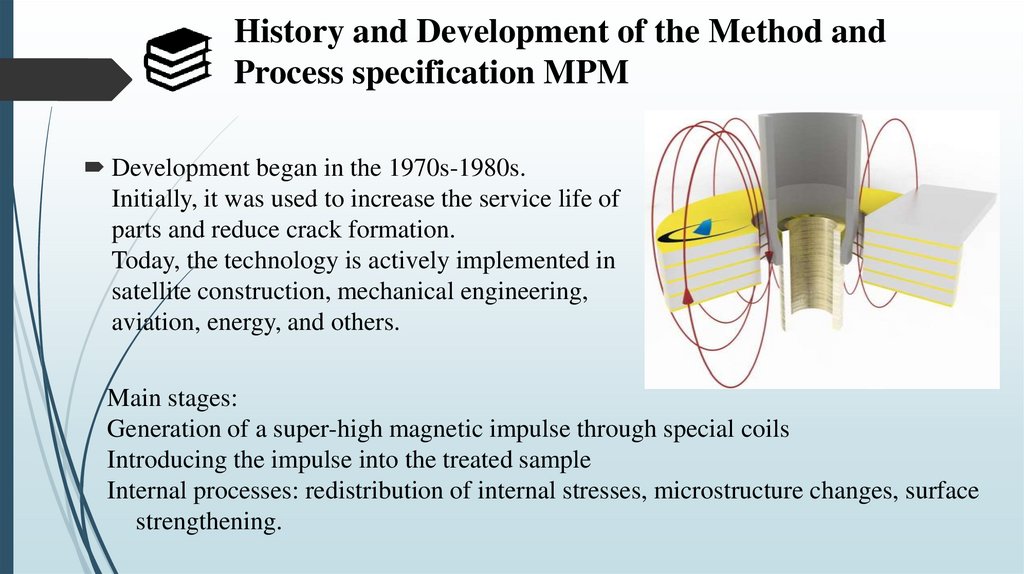
Main stages:
Generation of a super-high magnetic impulse through special coils
Introducing the impulse into the treated sample
Internal processes: redistribution of internal stresses, microstructure changes, surface
strengthening.
5.
Advantages of the Method1. Increased wear resistance and surface hardness
2. Reduced internal stress and crack formation
3. No need for heating, minimal deformations
4. High processing speed and automation
5. Environmental safety
6.
Connection Between Research Topic and ProfessionMagneto-Impulse Processing is used in satellite construction to enhance the
strength and wear resistance of parts, as well as to reduce internal stresses without
heating.
Specific examples of magneto-impulse application in satellite building include:
Reinforcing and strengthening metallic parts of rocket engines and structural
elements of satellites, increasing their durability and reliability in space conditions.
Processing alloys to reduce internal stresses, decreasing the risk of crack
formation, and ensuring stable operation at extreme temperatures.
Improving surface properties of critical elements like structural bodies and
fasteners to enhance their radiation resistance.
This technology enables high reliability and durability of satellite systems, which
is crucial for space missions.
7.
Research ObjectiveResearch goal:
Using magneto-impulse treatments to ensure magnetic cleaning of the gyroscope
shaft surface and perform spot magnetic treatment of the metal to improve its
properties (magnetic processing to increase wear resistance and stabilize magnetic
characteristics).
Notes:
Magneto-impulse impacts are short-term, intense magnetic pulses that influence the
shaft metal to change its magnetic properties or structure.
The gyroscope drive shaft is a vital component that transmits rotational movement
and torque, allowing a spacecraft to control its orientation precisely.
8.
Problems and PerspectivesProblems:
High equipment cost
Need for precise control of impulse parameters
Limitations regarding material thickness and types
Development prospects:
Combining with other processing methods
Mass adoption in industry
Developing new impulse systems and automation of processes
9.
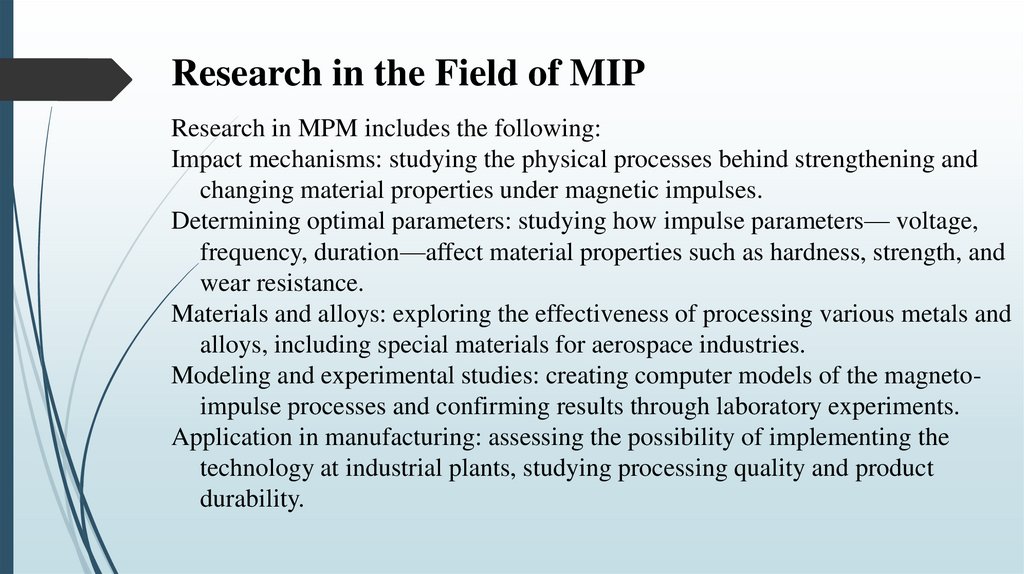
Research in the Field of MIPResearch in MPM includes the following:
Impact mechanisms: studying the physical processes behind strengthening and
changing material properties under magnetic impulses.
Determining optimal parameters: studying how impulse parameters— voltage,
frequency, duration—affect material properties such as hardness, strength, and
wear resistance.
Materials and alloys: exploring the effectiveness of processing various metals and
alloys, including special materials for aerospace industries.
Modeling and experimental studies: creating computer models of the magnetoimpulse processes and confirming results through laboratory experiments.
Application in manufacturing: assessing the possibility of implementing the
technology at industrial plants, studying processing quality and product
durability.
10. Conclusion
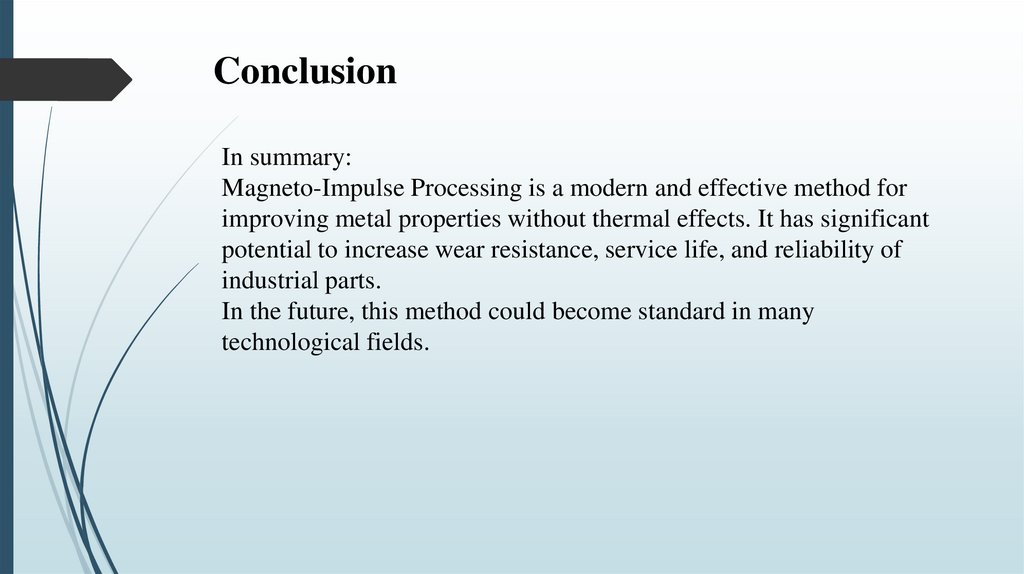
In summary:Magneto-Impulse Processing is a modern and effective method for
improving metal properties without thermal effects. It has significant
potential to increase wear resistance, service life, and reliability of
industrial parts.
In the future, this method could become standard in many
technological fields.
11. I hope I've managed to give you a clearer picture of MPM Thank you for your attention!
I hope I've managed to give you a clearer picture of MPMThank you for your attention!