 Экономика
Похожие презентации:




Price discrimination: a simple guide
1.
Price discrimination: a simpleguide
2.
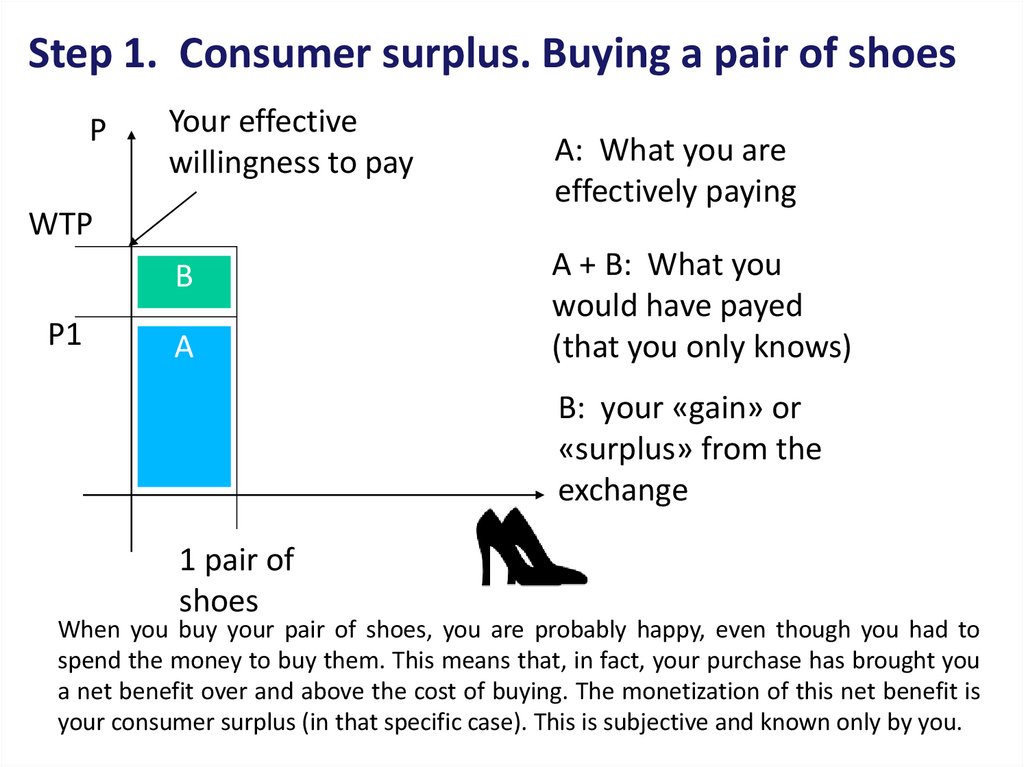
Step 1. Consumer surplus. Buying a pair of shoesP
Your effective
willingness to pay
WTP
B
P1
A
A: What you are
effectively paying
A + B: What you
would have payed
(that you only knows)
B: your «gain» or
«surplus» from the
exchange
1 pair of
shoes
When you buy your pair of shoes, you are probably happy, even though you had to
spend the money to buy them. This means that, in fact, your purchase has brought you
a net benefit over and above the cost of buying. The monetization of this net benefit is
your consumer surplus (in that specific case). This is subjective and known only by you.
3.
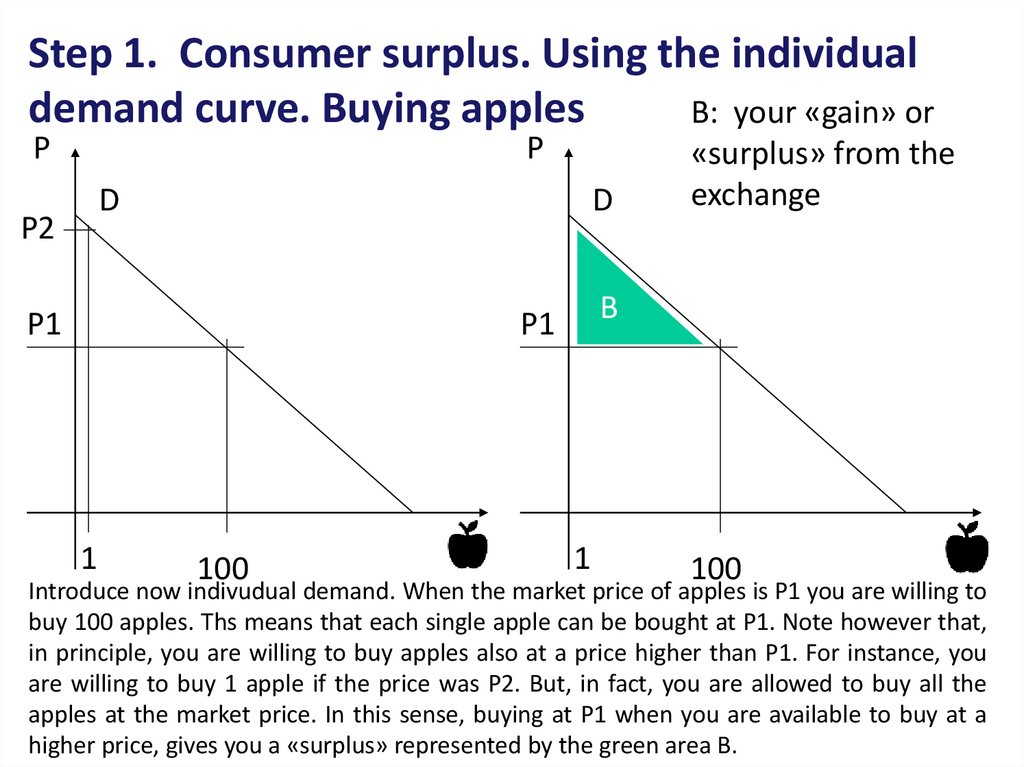
Step 1. Consumer surplus. Using the individualdemand curve. Buying apples
B: your «gain» or
P
P
D
P2
D
P1
B
P1
1
100
«surplus» from the
exchange
1
100
Introduce now indivudual demand. When the market price of apples is P1 you are willing to
buy 100 apples. Ths means that each single apple can be bought at P1. Note however that,
in principle, you are willing to buy apples also at a price higher than P1. For instance, you
are willing to buy 1 apple if the price was P2. But, in fact, you are allowed to buy all the
apples at the market price. In this sense, buying at P1 when you are available to buy at a
higher price, gives you a «surplus» represented by the green area B.
4.
Step 1. Consumer surplus. Using the aggregatedmarket demand
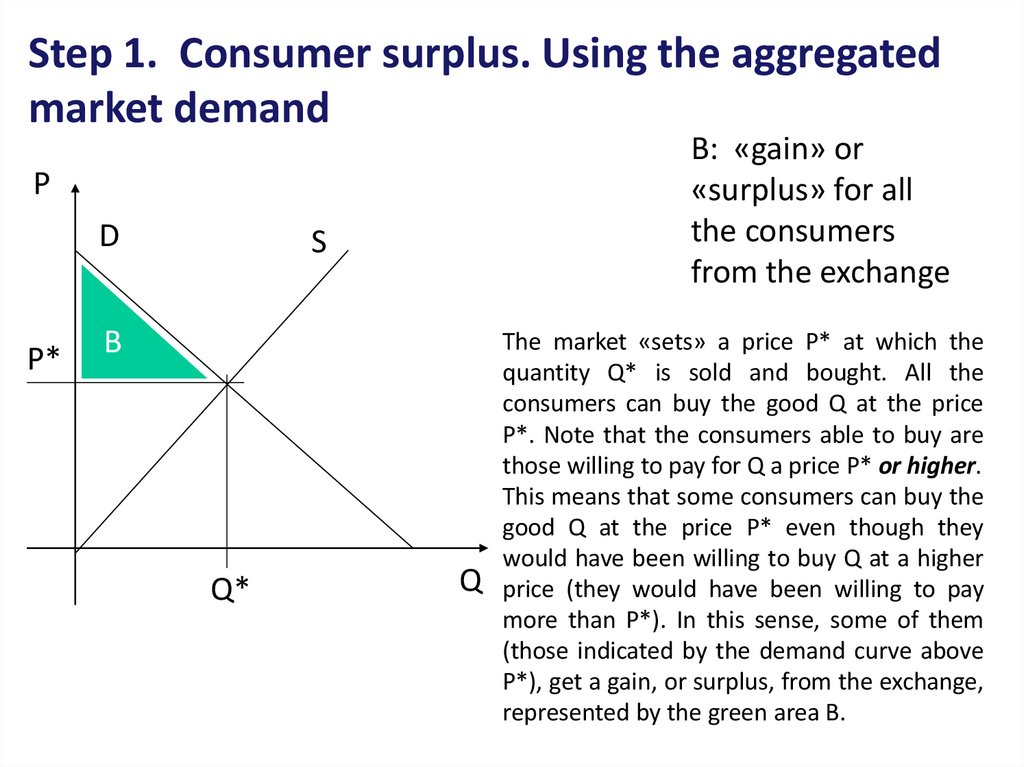
B: «gain» or
«surplus» for all
the consumers
from the exchange
P
D
P*
S
B
Q*
Q
The market «sets» a price P* at which the
quantity Q* is sold and bought. All the
consumers can buy the good Q at the price
P*. Note that the consumers able to buy are
those willing to pay for Q a price P* or higher.
This means that some consumers can buy the
good Q at the price P* even though they
would have been willing to buy Q at a higher
price (they would have been willing to pay
more than P*). In this sense, some of them
(those indicated by the demand curve above
P*), get a gain, or surplus, from the exchange,
represented by the green area B.
5.
Step 2. The “seller”: goal and problemThe goal of the «seller» is to extract as much as possibe (possibly
all) the consumer surplus from the consumers.
This can be done by differentiating the price across different
categories of consumers.
This implies that:
•Some control over prices is possible (firms have market power,
they are not «price takers»)
•Consumers cannot resell what they buy (can you guess why?)
•In some ways, the different categories (types) of consumers are
recognizable IF NOT, THEY HAVE TO BE INDUCED TO «REVEAL»
THEMSELVES (self-selection)
6.
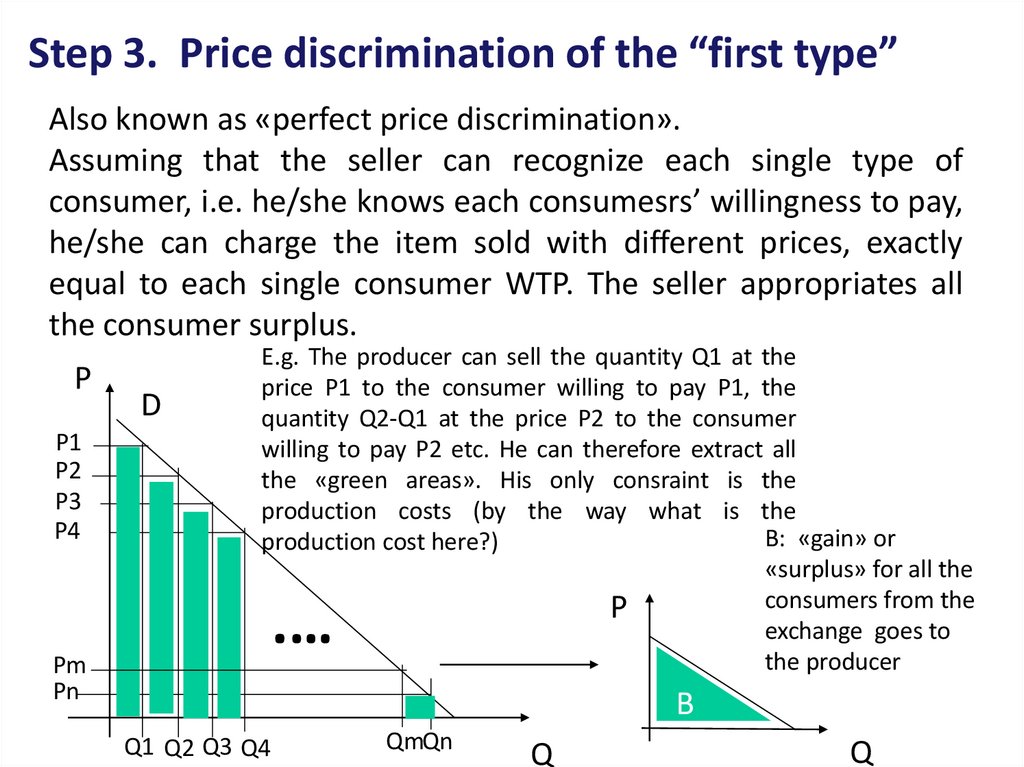
Step 3. Price discrimination of the “first type”Also known as «perfect price discrimination».
Assuming that the seller can recognize each single type of
consumer, i.e. he/she knows each consumesrs’ willingness to pay,
he/she can charge the item sold with different prices, exactly
equal to each single consumer WTP. The seller appropriates all
the consumer surplus.
P
P1
P2
P3
P4
Pm
Pn
D
E.g. The producer can sell the quantity Q1 at the
price P1 to the consumer willing to pay P1, the
quantity Q2-Q1 at the price P2 to the consumer
willing to pay P2 etc. He can therefore extract all
the «green areas». His only consraint is the
production costs (by the way what is the
B: «gain» or
production cost here?)
«surplus» for all the
consumers from the
P
exchange goes to
the producer
.…
B
Q1 Q2 Q3 Q4
QmQn
Q
Q
7.
Step 4. Price discrimination of the “second type”Goods are sold to different categories of consumers at different
unit prices based on the quantity bought (e.g. pay 2 take 3). It
works also with differentiated «qualities» (e.g. different prices for
business vs economy-class fares).
WHEN THE CONSUMER TYPE IS NOT RECOGNIZABLE, these price
discrimination strategies are meant to induce the consumer to
reveal her/his type – the richer with higher or the poorer with
lower WTP - and «exctract it».
8.
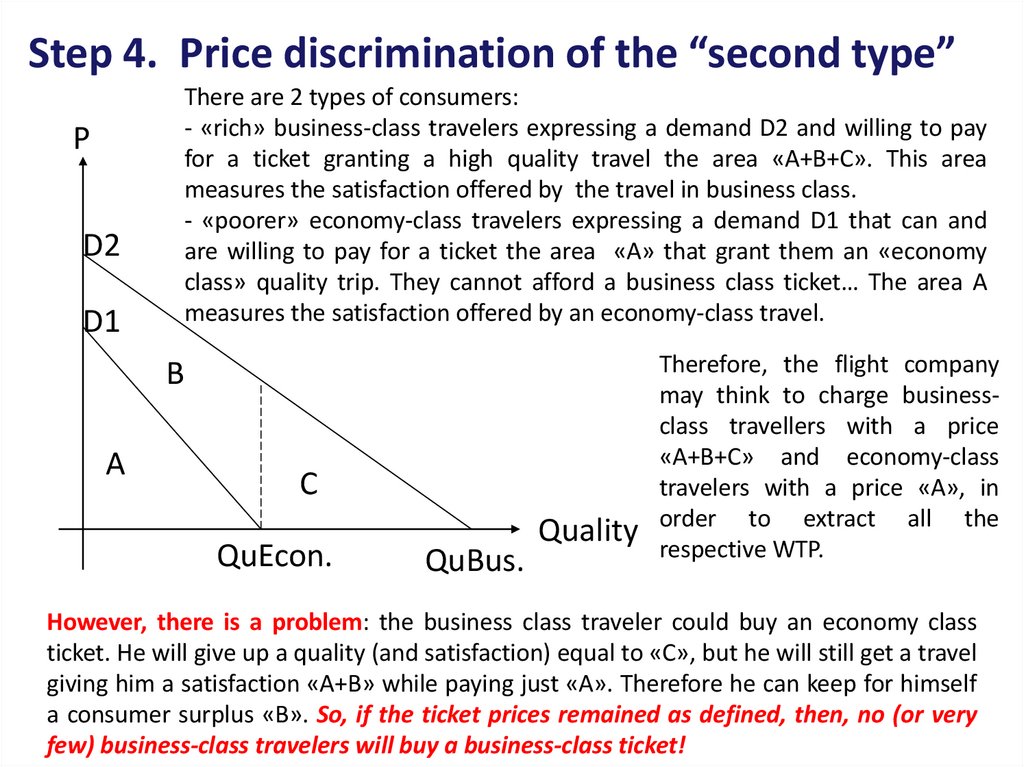
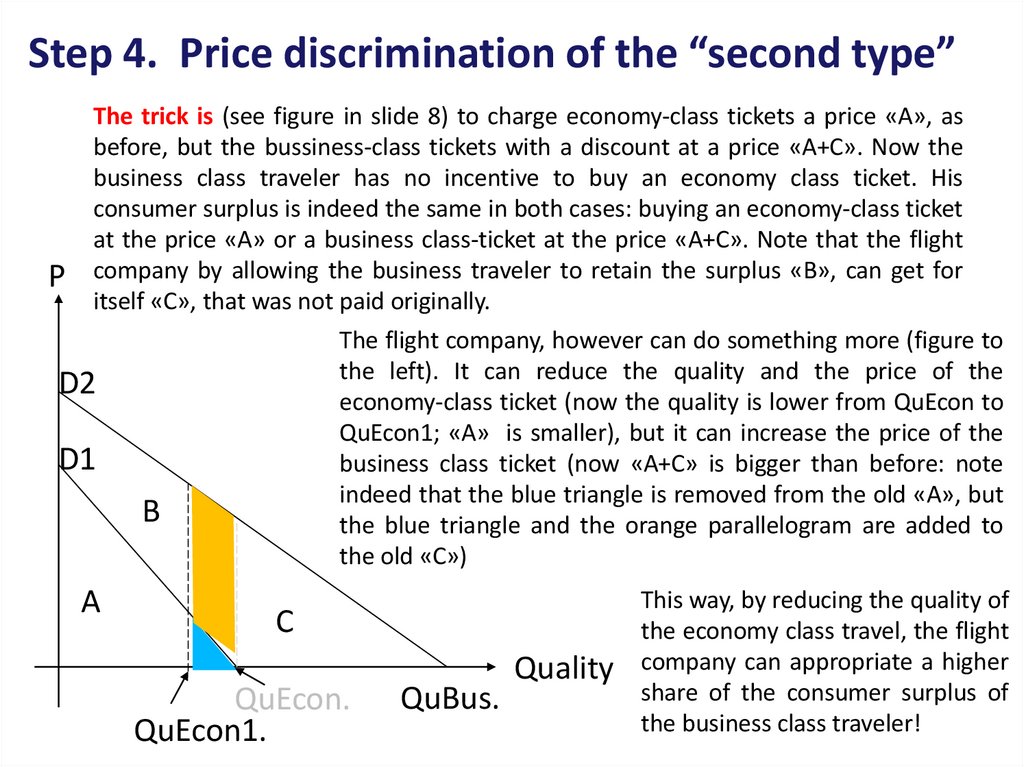
Step 4. Price discrimination of the “second type”P
D2
D1
There are 2 types of consumers:
- «rich» business-class travelers expressing a demand D2 and willing to pay
for a ticket granting a high quality travel the area «A+B+C». This area
measures the satisfaction offered by the travel in business class.
- «poorer» economy-class travelers expressing a demand D1 that can and
are willing to pay for a ticket the area «A» that grant them an «economy
class» quality trip. They cannot afford a business class ticket… The area A
measures the satisfaction offered by an economy-class travel.
B
A
C
QuEcon.
QuBus.
Quality
Therefore, the flight company
may think to charge businessclass travellers with a price
«A+B+C» and economy-class
travelers with a price «A», in
order to extract all the
respective WTP.
However, there is a problem: the business class traveler could buy an economy class
ticket. He will give up a quality (and satisfaction) equal to «C», but he will still get a travel
giving him a satisfaction «A+B» while paying just «A». Therefore he can keep for himself
a consumer surplus «B». So, if the ticket prices remained as defined, then, no (or very
few) business-class travelers will buy a business-class ticket!
9.
Step 4. Price discrimination of the “second type”P
The trick is (see figure in slide 8) to charge economy-class tickets a price «A», as
before, but the bussiness-class tickets with a discount at a price «A+C». Now the
business class traveler has no incentive to buy an economy class ticket. His
consumer surplus is indeed the same in both cases: buying an economy-class ticket
at the price «A» or a business class-ticket at the price «A+C». Note that the flight
company by allowing the business traveler to retain the surplus «B», can get for
itself «C», that was not paid originally.
The flight company, however can do something more (figure to
the left). It can reduce the quality and the price of the
economy-class ticket (now the quality is lower from QuEcon to
QuEcon1; «A» is smaller), but it can increase the price of the
business class ticket (now «A+C» is bigger than before: note
indeed that the blue triangle is removed from the old «A», but
the blue triangle and the orange parallelogram are added to
the old «C»)
D2
D1
B
A
C
QuEcon.
QuEcon1.
QuBus.
Quality
This way, by reducing the quality of
the economy class travel, the flight
company can appropriate a higher
share of the consumer surplus of
the business class traveler!
10.
Step 5. Price discrimination of the “third type”CONSUMER TYPES ARE RECOGNIZABLE Goods are sold to
different categories of consumers with different unit prices based
on the type (e.g. discount for students or elder retired people).
«Within the type» the same unit price is charged (all students
pay the same)
11.
Step 5. First: Understanding marginal revenues(MR) with market power
P
10
9
8
7
6
5
4
3
2
1
0
QD
0
1
2
3
4
5
6
7
8
9
10
TR
0
9
16
21
24
25
24
21
16
9
0
MR
0
9
7
5
3
1
-1
-3
-5
-7
-9
15
10
5
0
0
2
4
6
8
10
12
-5
-10
P&Demand Curve
MR
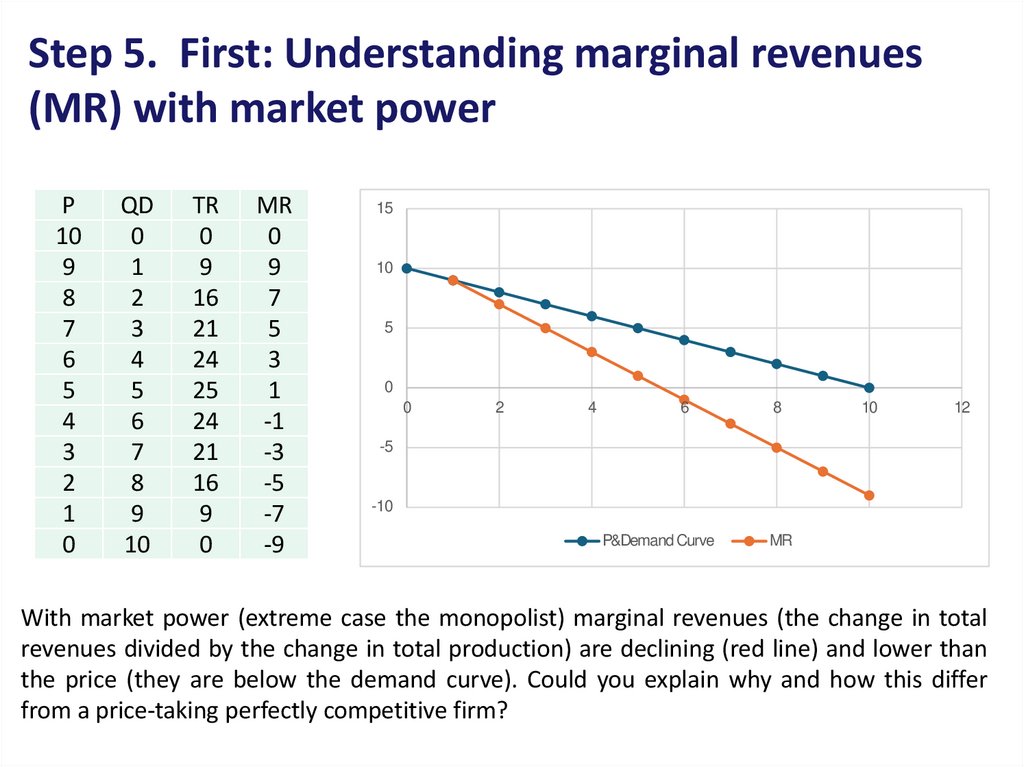
With market power (extreme case the monopolist) marginal revenues (the change in total
revenues divided by the change in total production) are declining (red line) and lower than
the price (they are below the demand curve). Could you explain why and how this differ
from a price-taking perfectly competitive firm?
12.
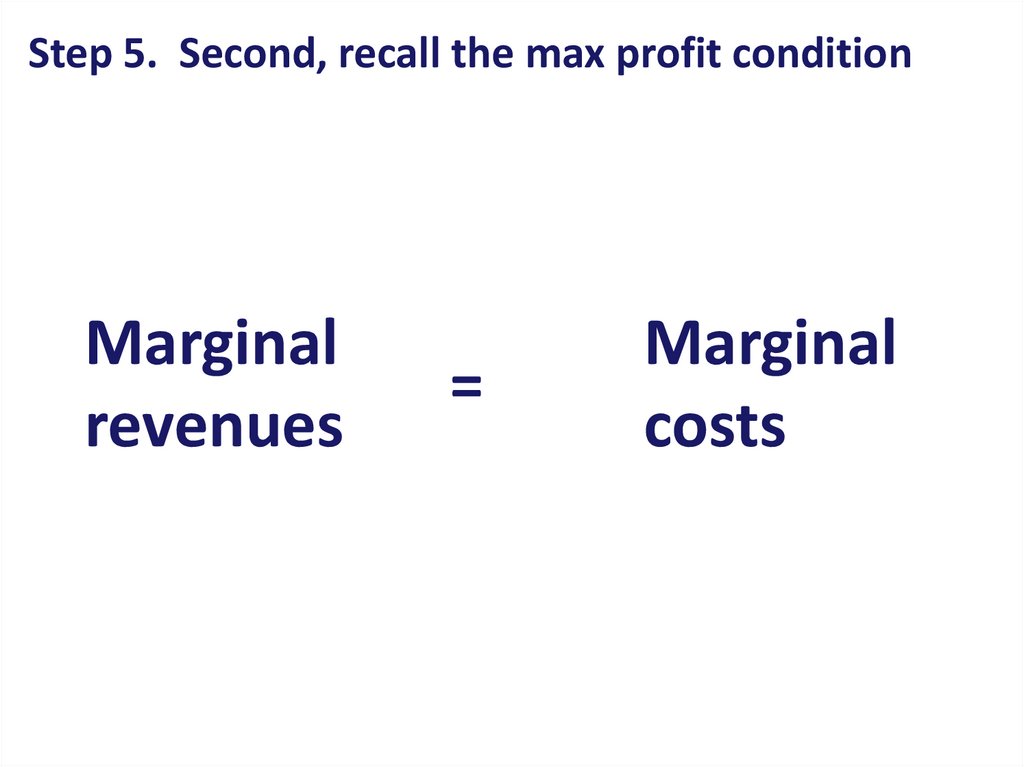
Step 5. Second, recall the max profit conditionMarginal
revenues
=
Marginal
costs
13.
Step 5. Third, apply it in one marketP
D
P*
MC
MR
Q*
Q
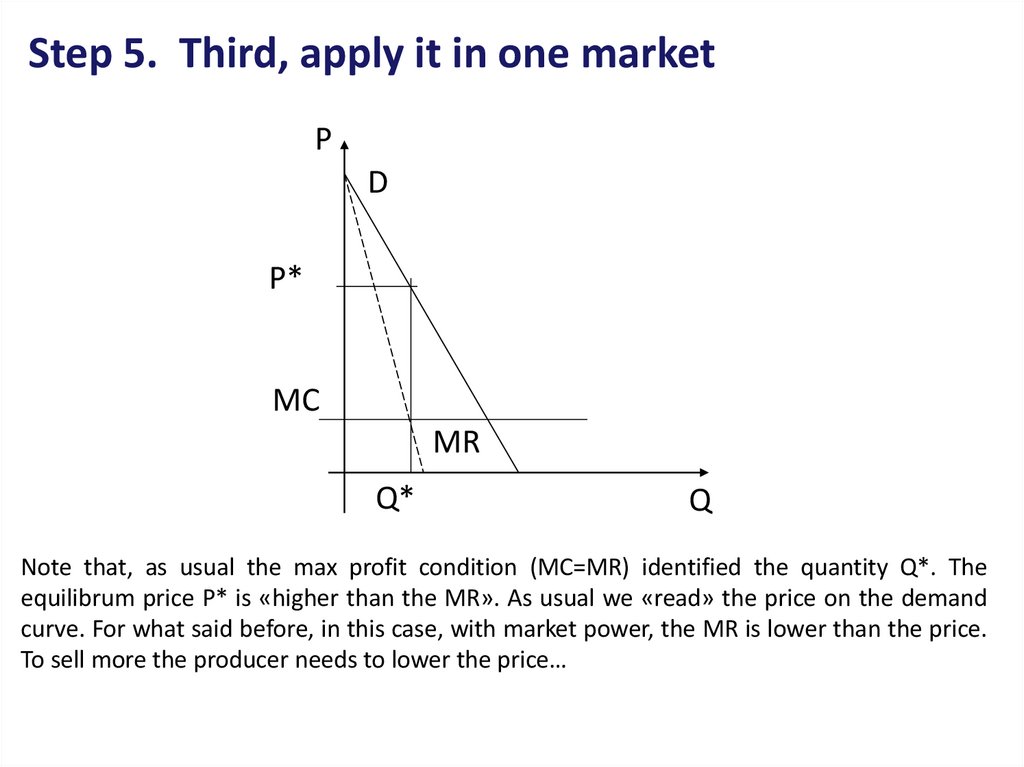
Note that, as usual the max profit condition (MC=MR) identified the quantity Q*. The
equilibrum price P* is «higher than the MR». As usual we «read» the price on the demand
curve. For what said before, in this case, with market power, the MR is lower than the price.
To sell more the producer needs to lower the price…
14.
Step 5. Fourth, apply it in two marketsP
Market 1 «workers»
P
Market 2 «students»
Dw
Pw*
Ds
Ps*
MC
MRw
Qw*
MRs
Q
Qs*
Q
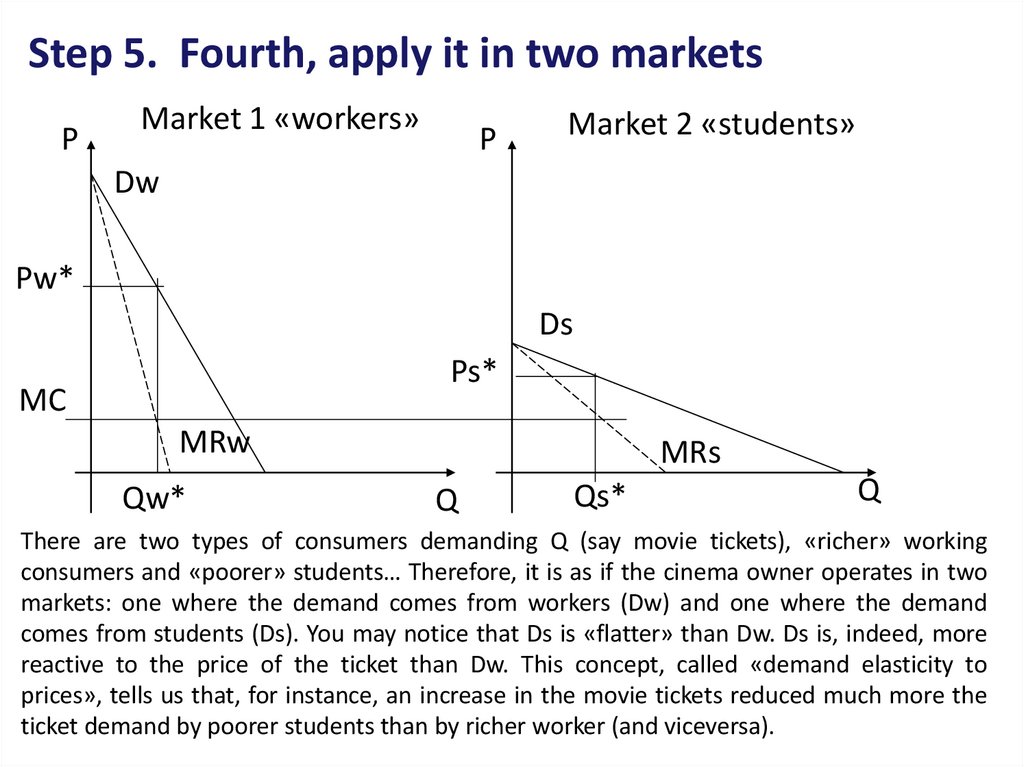
There are two types of consumers demanding Q (say movie tickets), «richer» working
consumers and «poorer» students… Therefore, it is as if the cinema owner operates in two
markets: one where the demand comes from workers (Dw) and one where the demand
comes from students (Ds). You may notice that Ds is «flatter» than Dw. Ds is, indeed, more
reactive to the price of the ticket than Dw. This concept, called «demand elasticity to
prices», tells us that, for instance, an increase in the movie tickets reduced much more the
ticket demand by poorer students than by richer worker (and viceversa).
15.
Step 5. Third, apply it in two marketsThis enables the cinema owner to charge differentiated prices to students and workers. But
why and how?
Firstly, notice that in this case consumers types are recognizable. If you claim you are a
student you should and can provide evidence (e.g. your student badge).
Then, the idea is that practicing a lower price to students and a higher prices to workers is
better than an undifferentiated price. Notice indeed that in both markets MR=MC. This
enables finding the quantities that maximize profits in total (Qw*+Qs*) and in both markets
(Qw* and Qs*). Then in the market where the demand shows a lower reactivity to prices
(the workers’ one) Pw* is higher, in the market where the demand shows a higher reactivity
to prices (the students’ one) Ps* is lower.
But why is this smart?
Higher prices would discourage some workers from buying the tickets. But the lower
quantities sold will be compensated by the higher prices (indeed quantities react less than
prices for workers).
Lower prices would encourage students to buy more tickets. Now higher quantities are
compensating the lower prices (indeed quantities react more than priced for students).