







 Педагогика
Похожие презентации:





Qualitative data collection methods
1.
Qualitative data collectionmethods
2.
Lesson objectives∙
∙
Analyze the text to determine potential benefits and
limitations of qualitative data collection methods .
Organize ideas coherently, using key points to talk
about qualitative data collection methods
3.
Assessment criteriaIdentify at least 3 benefits and limitations of qualitative data
collection methods
Provides at least 2 examples to support or explain the key points
of qualitative data collection methods
4.
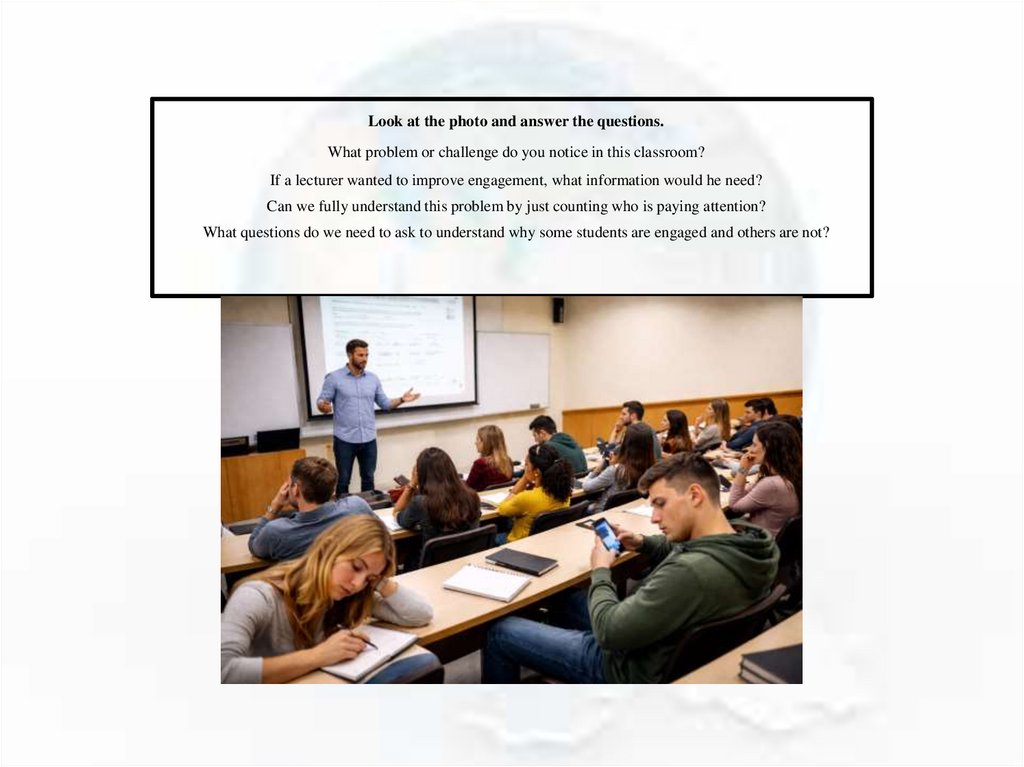
Look at the photo and answer the questions.What problem or challenge do you notice in this classroom?
If a lecturer wanted to improve engagement, what information would he need?
Can we fully understand this problem by just counting who is paying attention?
What questions do we need to ask to understand why some students are engaged and others are not?
5.
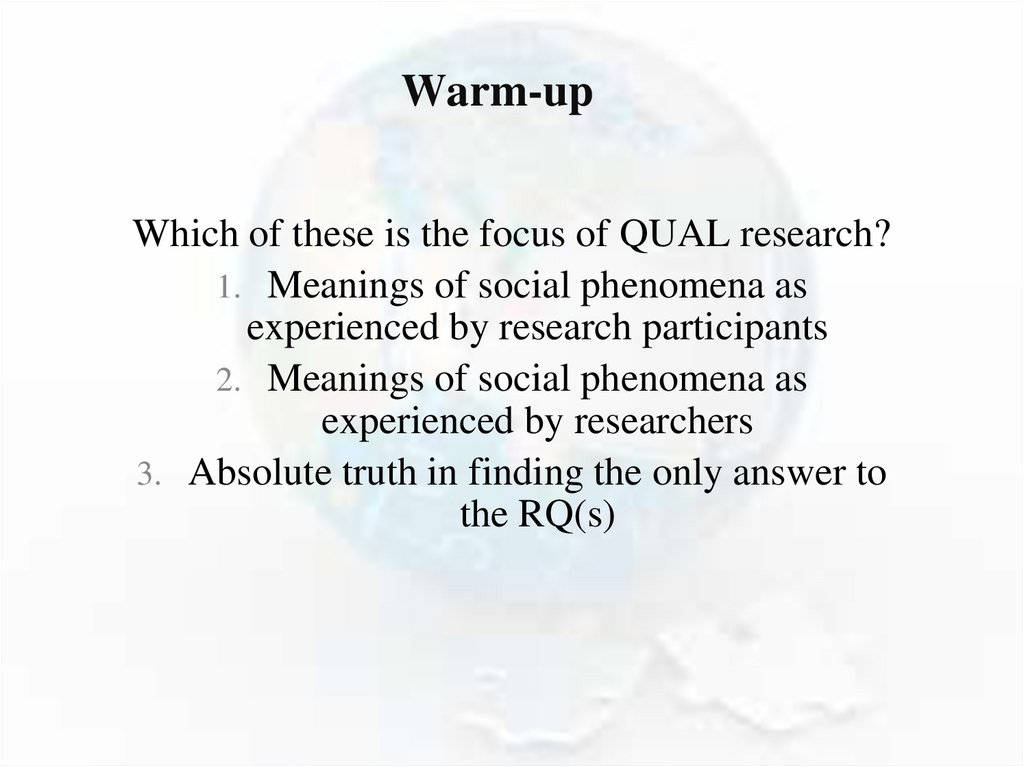
Warm-upWhich of these is the focus of QUAL research?
1. Meanings of social phenomena as
experienced by research participants
2. Meanings of social phenomena as
experienced by researchers
3. Absolute truth in finding the only answer to
the RQ(s)
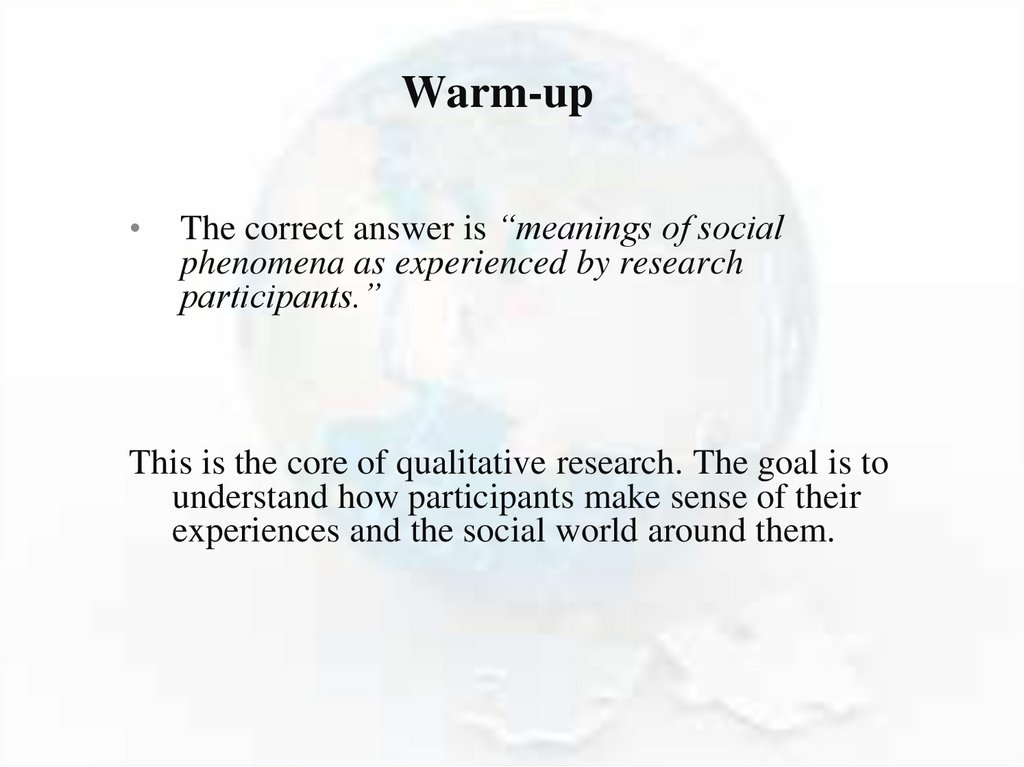
6.
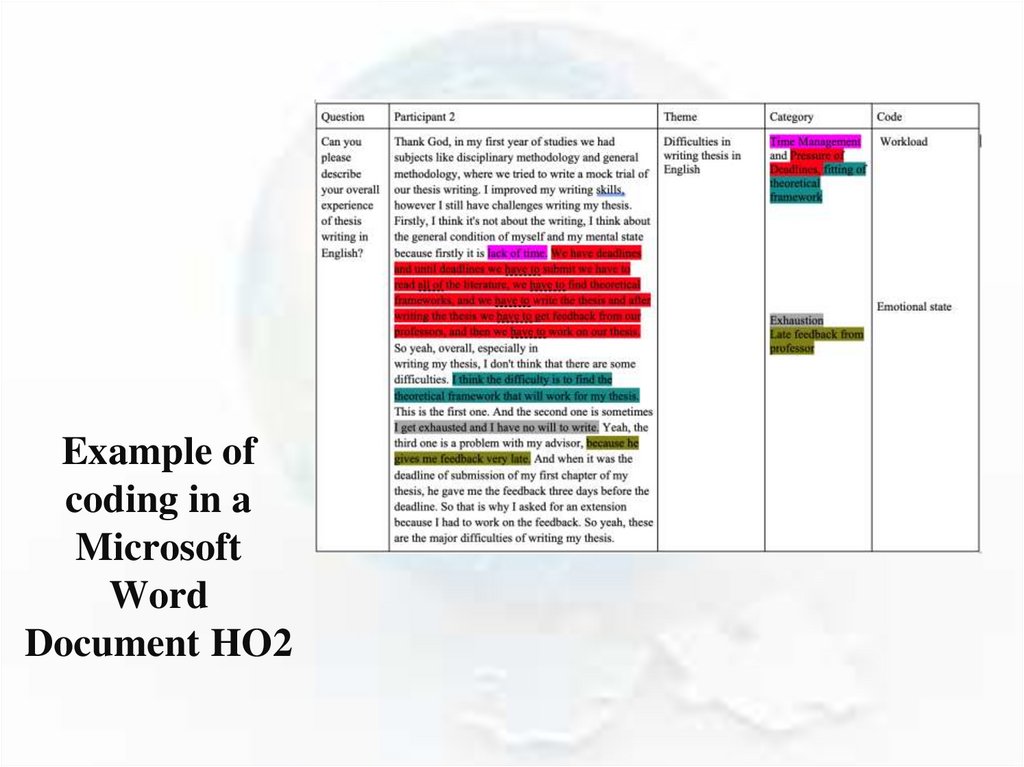
Warm-upThe correct answer is “meanings of social
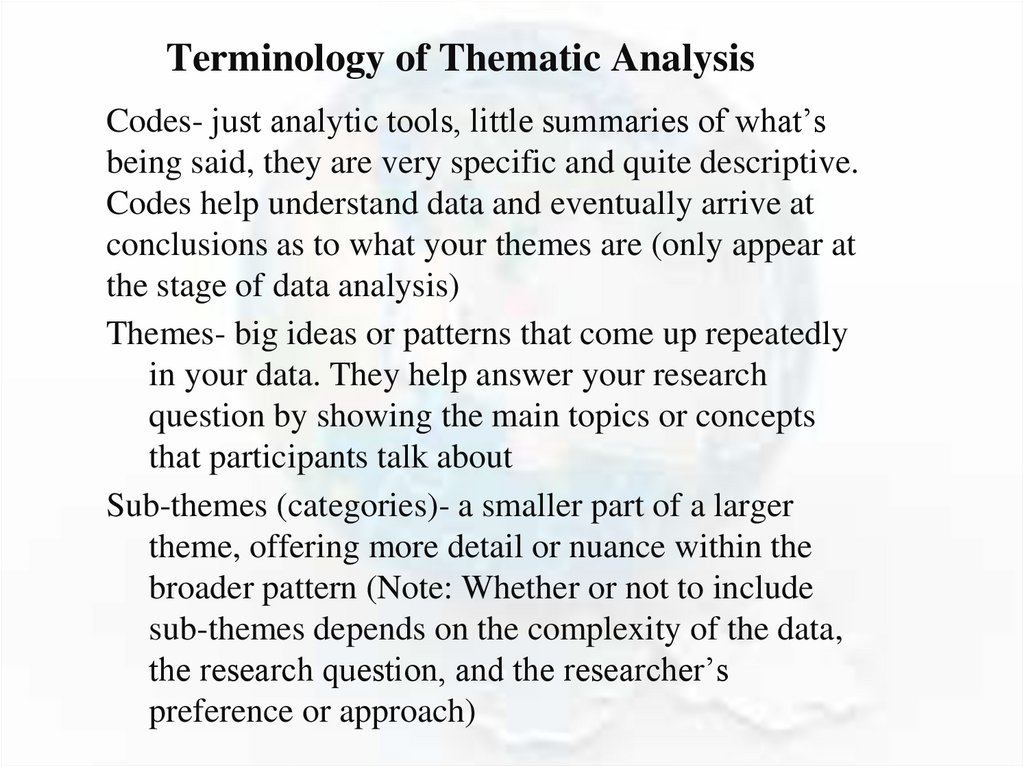
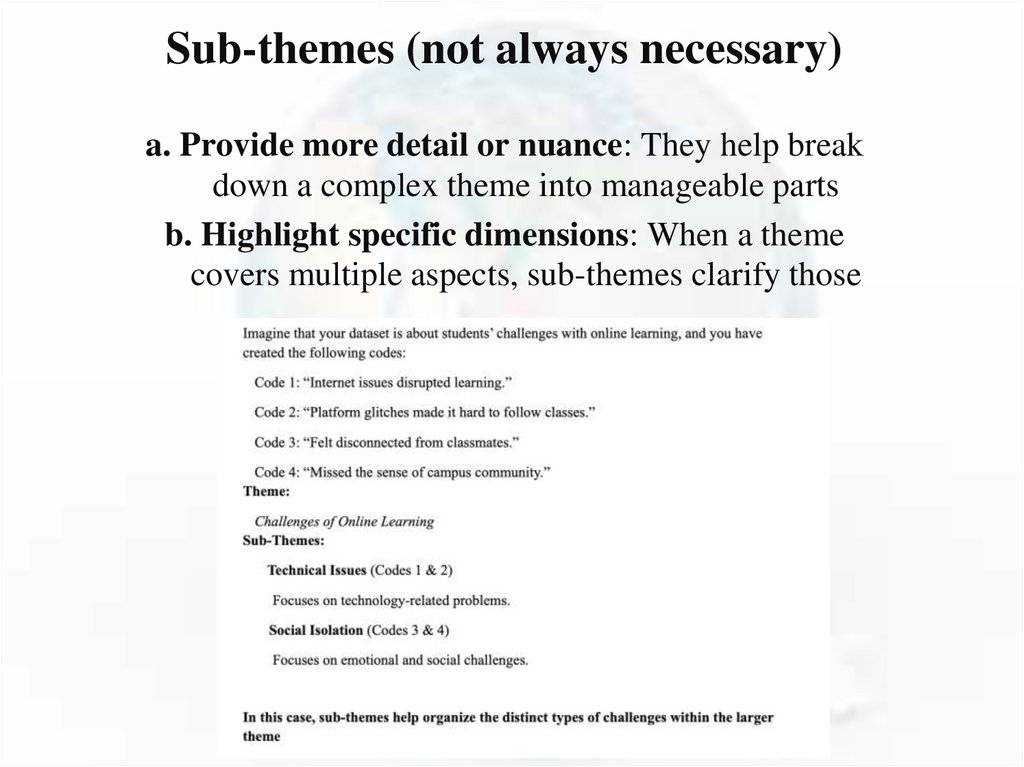
phenomena as experienced by research
participants.”
This is the core of qualitative research. The goal is to
understand how participants make sense of their
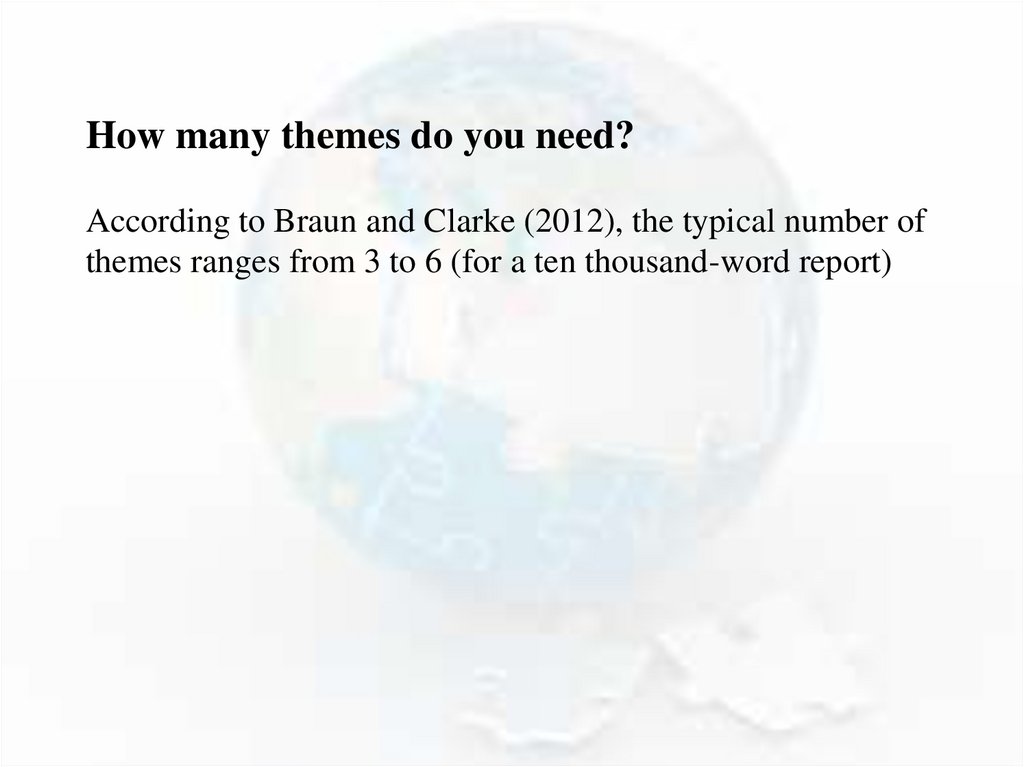
experiences and the social world around them.
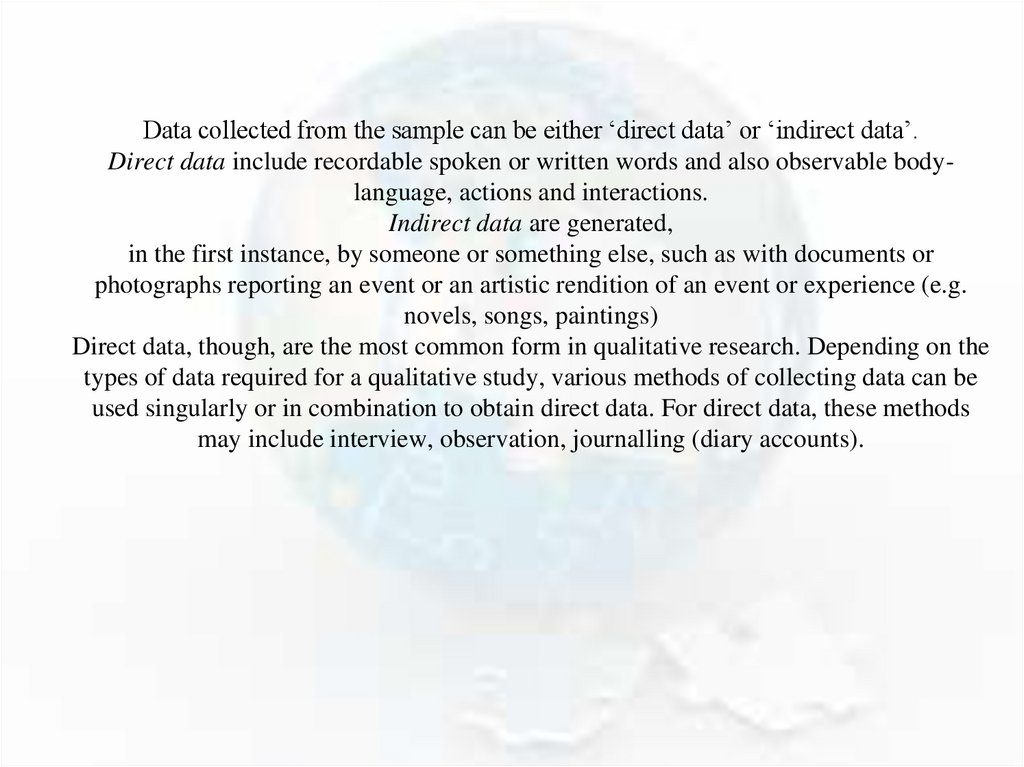
7.
Data collected from the sample can be either ‘direct data’ or ‘indirect data’.Direct data include recordable spoken or written words and also observable bodylanguage, actions and interactions.
Indirect data are generated,
in the first instance, by someone or something else, such as with documents or
photographs reporting an event or an artistic rendition of an event or experience (e.g.
novels, songs, paintings)
Direct data, though, are the most common form in qualitative research. Depending on the
types of data required for a qualitative study, various methods of collecting data can be
used singularly or in combination to obtain direct data. For direct data, these methods
may include interview, observation, journalling (diary accounts).
8.
HO1 Divide the students into three groups:Group A – Explainers of Interviews: This group will explain how to conduct an interview.
Group B – Explainers of Focus group interviews: This group will explain how to conduct
focus group interviews .
Group C – Explainers of Observations: This group will explain how to conduct an
observation.
Task: Group A explains how to conduct an interview while Group B fills in the table. Group
B explains how to conduct an observation while Group A fills in the table and etc.
9.
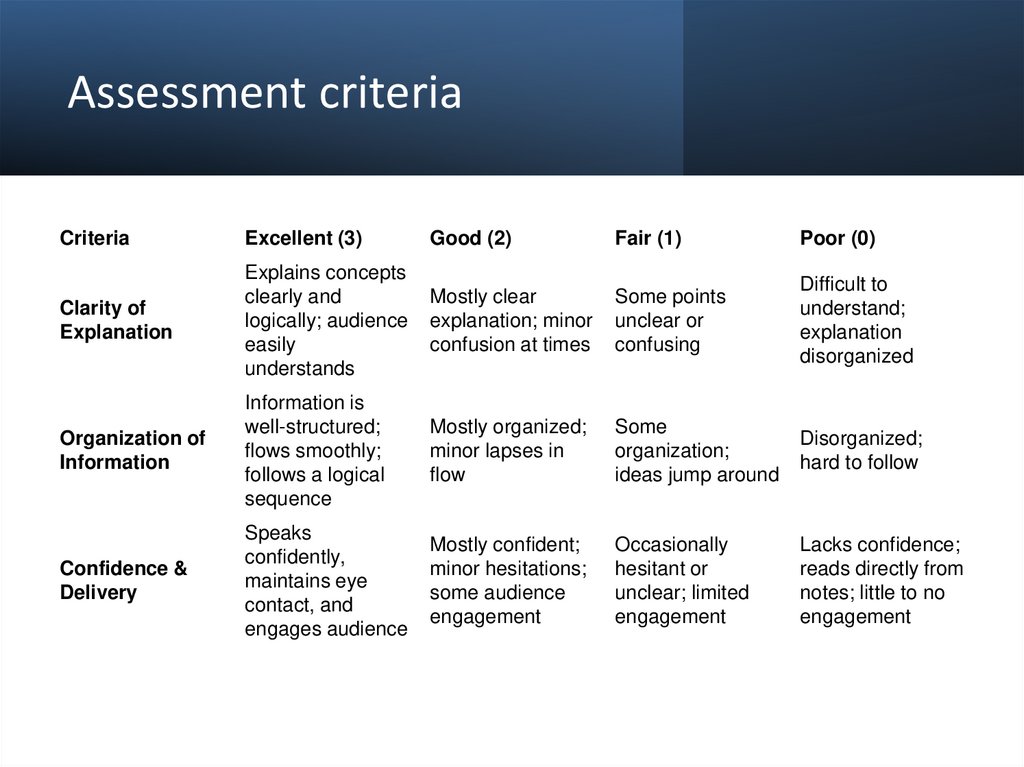
Assessment criteriaCriteria
Excellent (3)
Good (2)
Fair (1)
Poor (0)
Clarity of
Explanation
Explains concepts
clearly and
logically; audience
easily
understands
Mostly clear
explanation; minor
confusion at times
Some points
unclear or
confusing
Difficult to
understand;
explanation
disorganized
Organization of
Information
Information is
well-structured;
flows smoothly;
follows a logical
sequence
Mostly organized;
minor lapses in
flow
Some
organization;
ideas jump around
Disorganized;
hard to follow
Confidence &
Delivery
Speaks
confidently,
maintains eye
contact, and
engages audience
Mostly confident;
minor hesitations;
some audience
engagement
Occasionally
hesitant or
unclear; limited
engagement
Lacks confidence;
reads directly from
notes; little to no
engagement
10.
Qualitative data analysis(QDA)
11.
Lesson objectivesUnderstand the Concept of Thematic Analysis
Develop Practical Skills in Applying Thematic Analysis
12.
Assessment criteria- Identify relevant and specific codes from the data (minimum 3)
- Generate clear and logical themes from the codes (minimum 3)
13.
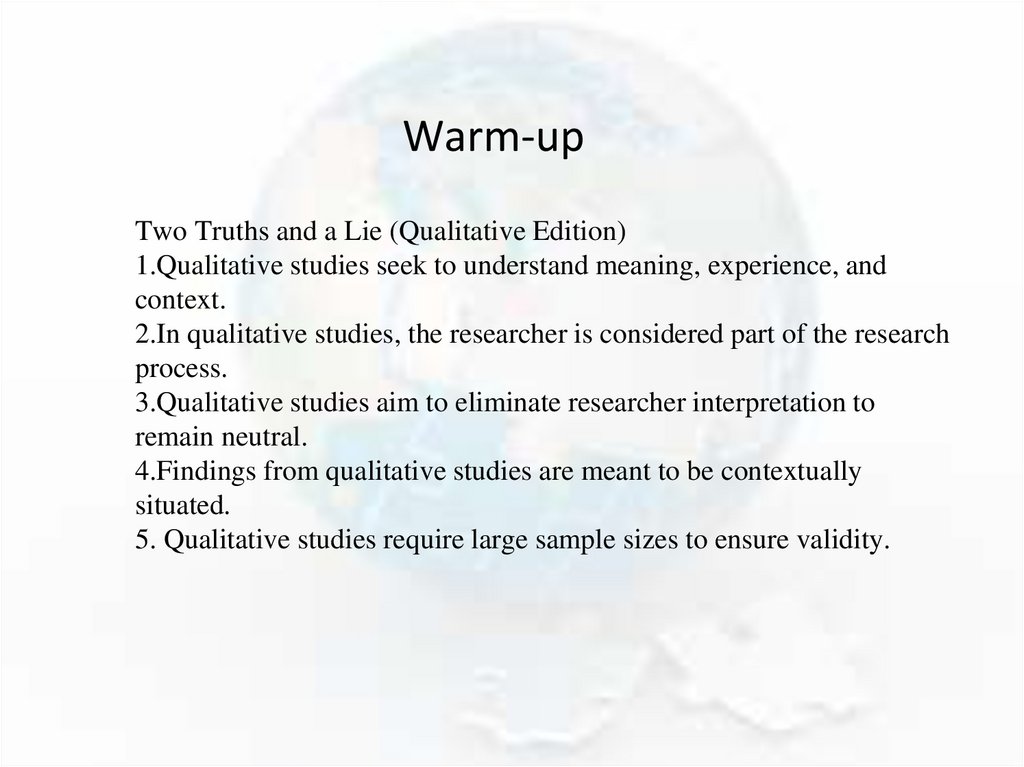
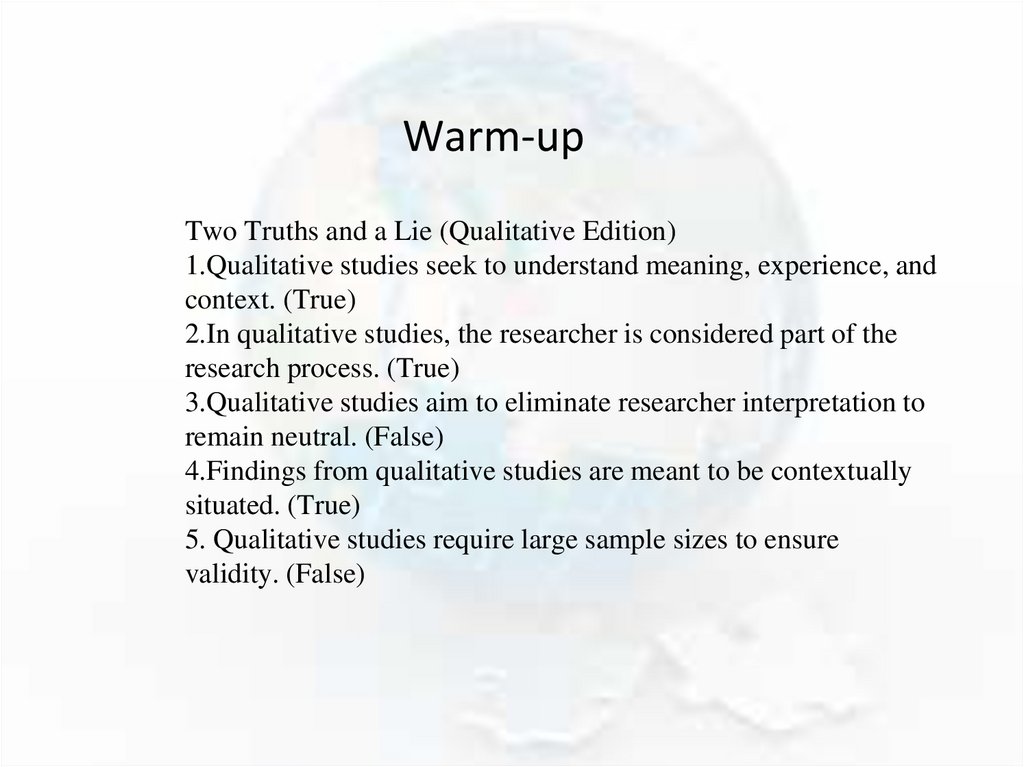
Warm-upTwo Truths and a Lie (Qualitative Edition)
1.Qualitative studies seek to understand meaning, experience, and
context.
2.In qualitative studies, the researcher is considered part of the research
process.
3.Qualitative studies aim to eliminate researcher interpretation to
remain neutral.
4.Findings from qualitative studies are meant to be contextually
situated.
5. Qualitative studies require large sample sizes to ensure validity.
14.
Warm-upTwo Truths and a Lie (Qualitative Edition)
1.Qualitative studies seek to understand meaning, experience, and
context. (True)
2.In qualitative studies, the researcher is considered part of the
research process. (True)
3.Qualitative studies aim to eliminate researcher interpretation to
remain neutral. (False)
4.Findings from qualitative studies are meant to be contextually
situated. (True)
5. Qualitative studies require large sample sizes to ensure
validity. (False)
15.
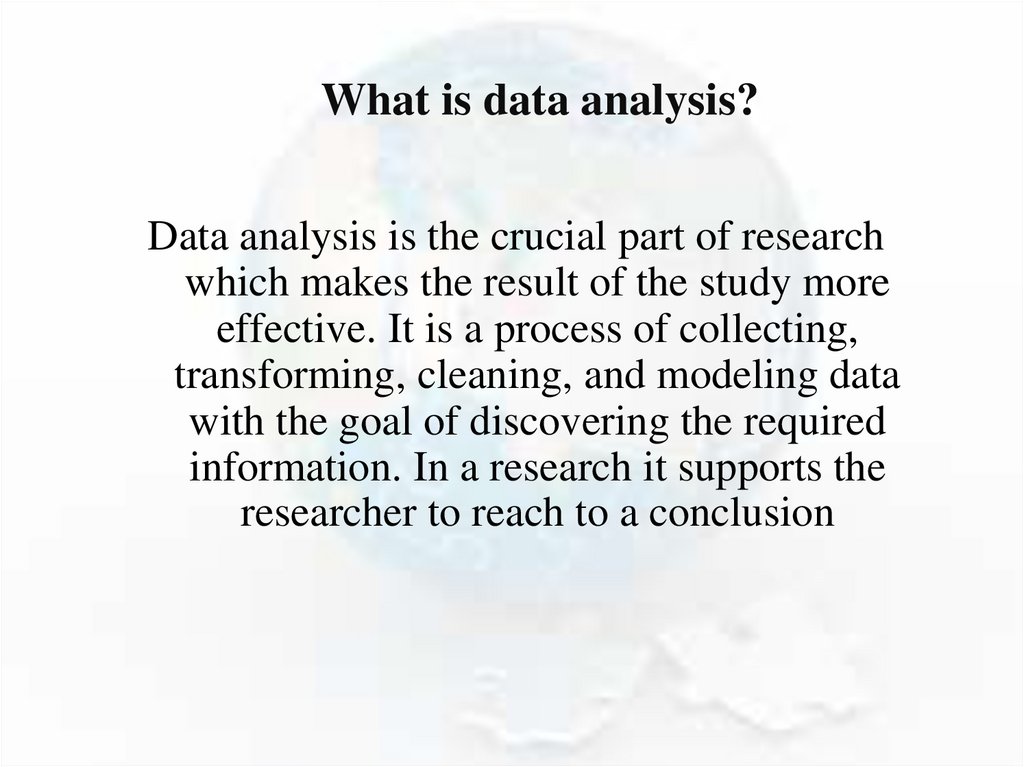
What is data analysis?Data analysis is the crucial part of research
which makes the result of the study more
effective. It is a process of collecting,
transforming, cleaning, and modeling data
with the goal of discovering the required
information. In a research it supports the
researcher to reach to a conclusion
16.
How to Analyze and Discuss the Informationyou Gather
• At this stage, you are analyzing and discussing the data
that you have collected, in whatever form
• But this week we will mainly focus on analyzing
words
17.
Before you begin: The Essentials1. Conduct Interviews:
Collect data through interviews, focus groups,
or other qualitative methods.
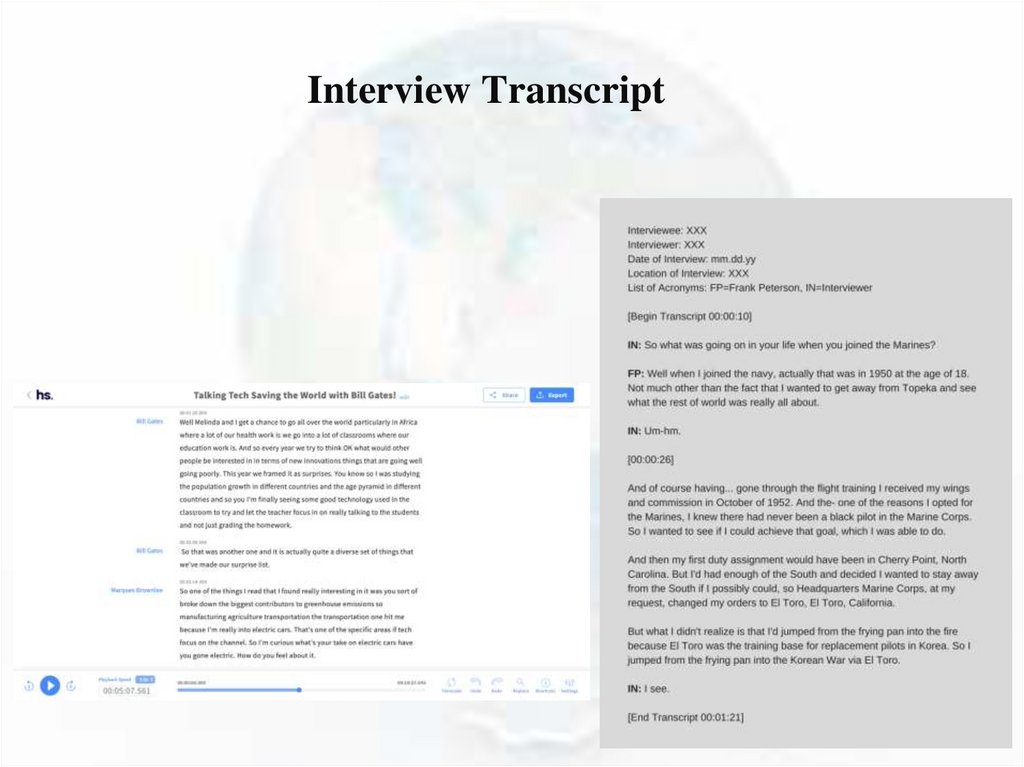
2. Transcribe the Data:
Convert audio recordings into written text for
analysis.
18.
Interview Transcript19.
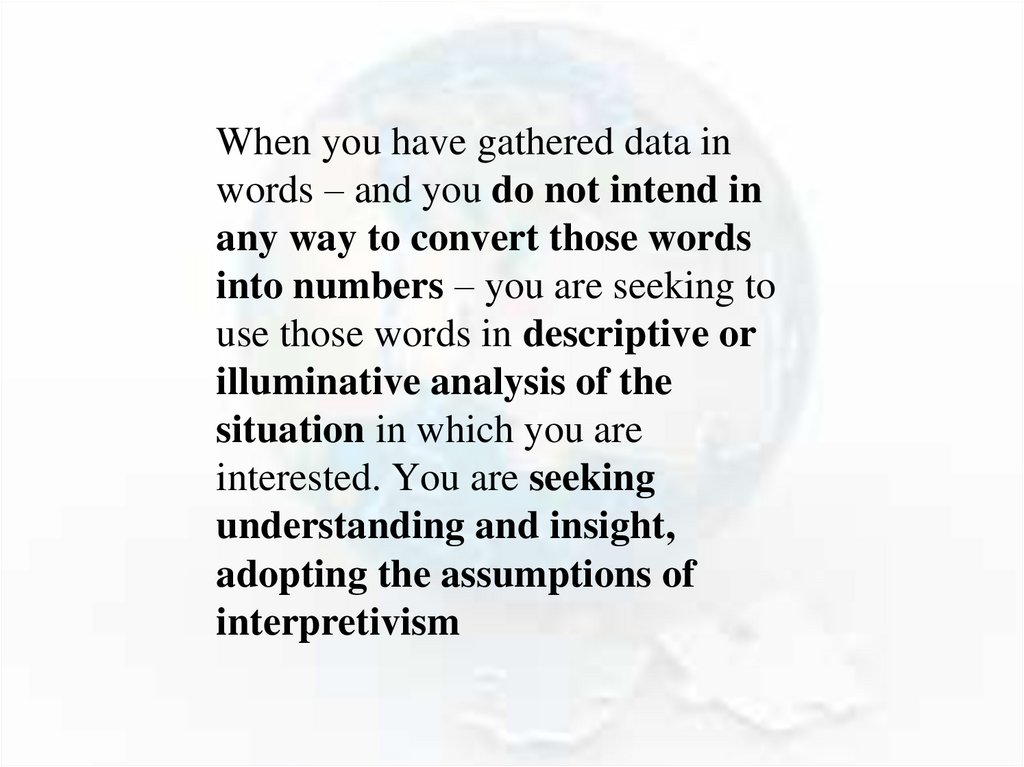
When you have gathered data inwords – and you do not intend in
any way to convert those words
into numbers – you are seeking to
use those words in descriptive or
illuminative analysis of the
situation in which you are
interested. You are seeking
understanding and insight,
adopting the assumptions of
interpretivism
20.
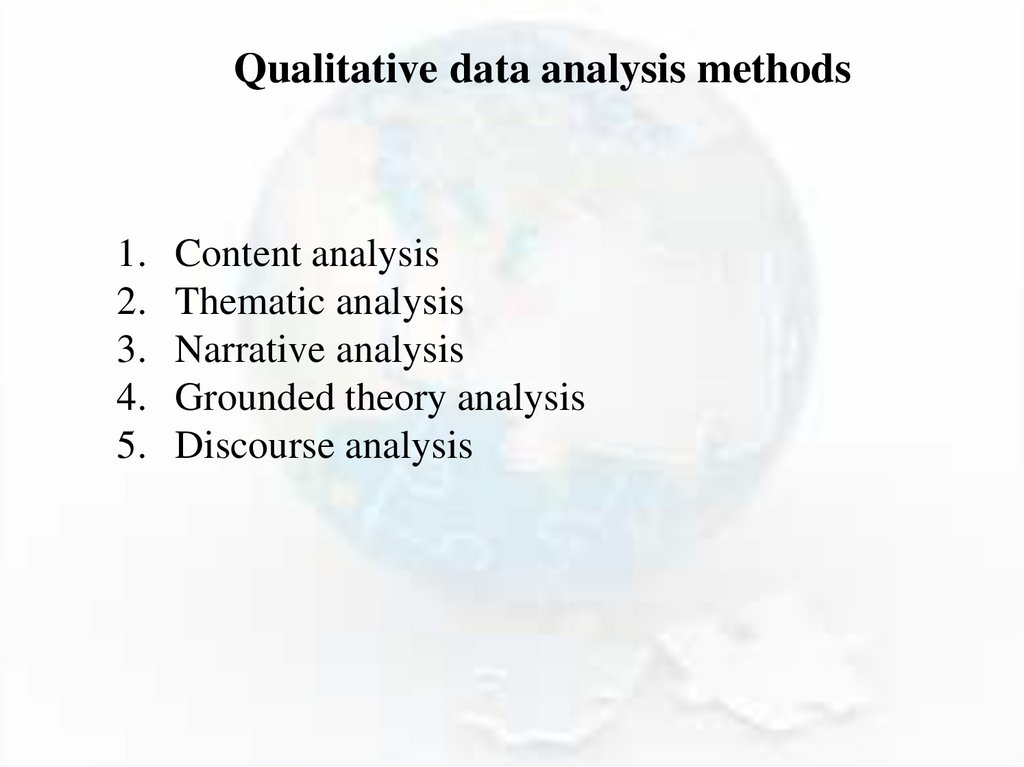
Qualitative data analysis methods1.
2.
3.
4.
5.
Content analysis
Thematic analysis
Narrative analysis
Grounded theory analysis
Discourse analysis
21.
Which data analysis methods to use?Option 1: You could study all the existing data
analysis techniques that you can get your hands on
and then apply the one(s) that you think are
appropriate to your data.
Option 2: You could analyze your data based on
pragmatism, logic and convenience and then
review the literature to give a name to the data
analysis techniques you have already used.
Option 3: Look at prior research studies in your
field similar to yours in aims and design and see if
you can apply the same data analysis techniques
(and maybe data presentation) they have used to
your own data.
22.
We’ll focus on thematic analysis todayWhy is thematic analysis?
Due to the clear, easy-to-follow processes outlined by
Braun and Clarke (2006, 2012, 2017), researchers have
suggested that thematic analysis is an ideal analytic
method for novice qualitative researchers (Nowell
et al., 2017)
23.
What if I asked you about the most commonly usedstrategies to achieve goals in Game of Thrones?
24.
Eventually, you would conclude that these strategiesare:
1. negotiation
2. treaties
3. battle
25.
1. Research question analogy:“What are the most commonly used strategies to
achieve goals in Game of Thrones?”
People naturally focus on patterns (negotiation,
treaties, battles) rather than specific episodes or events.
2. Key Point:
They identify overarching strategies (themes, in our
case) from a range of events across the series without
necessarily needing to analyze every single event in
detail.
26.
Based on the Game of Thrones analogy wejust discussed, how would you describe
thematic analysis?
27.
Thematic analysis is a qualitative researchmethod that researchers use to systematically
organize and analyze complex data sets. It is
a search for themes that can capture the
narratives available in the account of data sets.
It involves the identification of themes
through careful reading and re-reading of
the transcribed data (King, 2004; Rice &
Ezzy, 1999)
28.
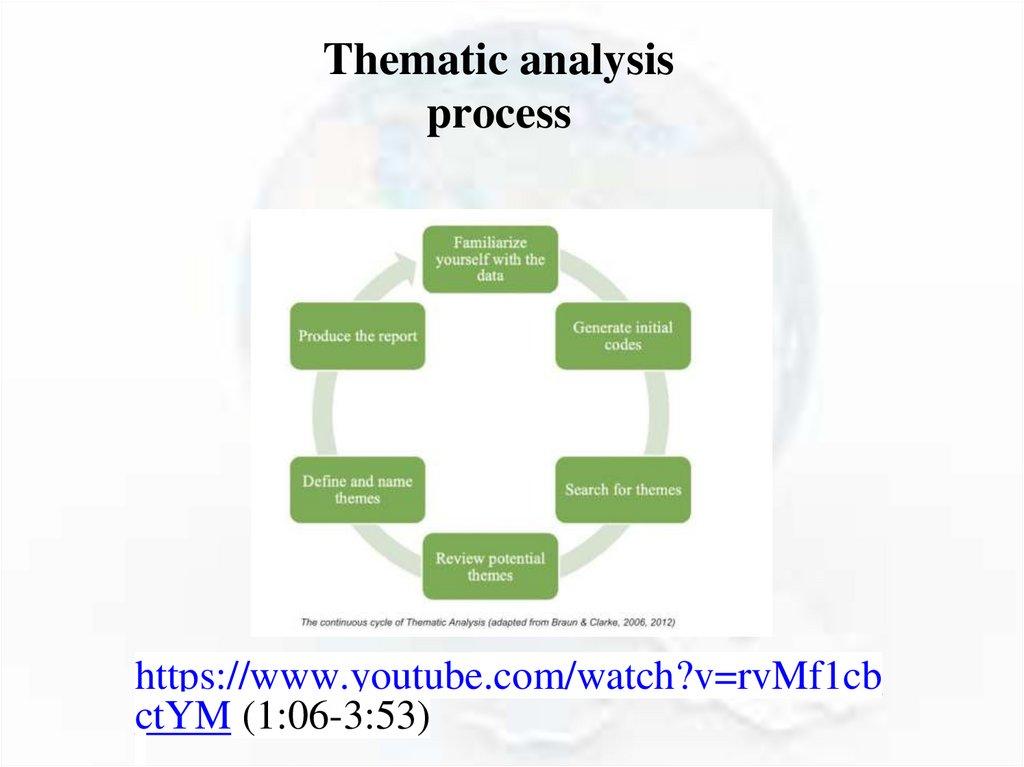
Thematic analysisprocess
https://www.youtube.com/watch?v=rvMf1cb
ctYM (1:06-3:53)
29.
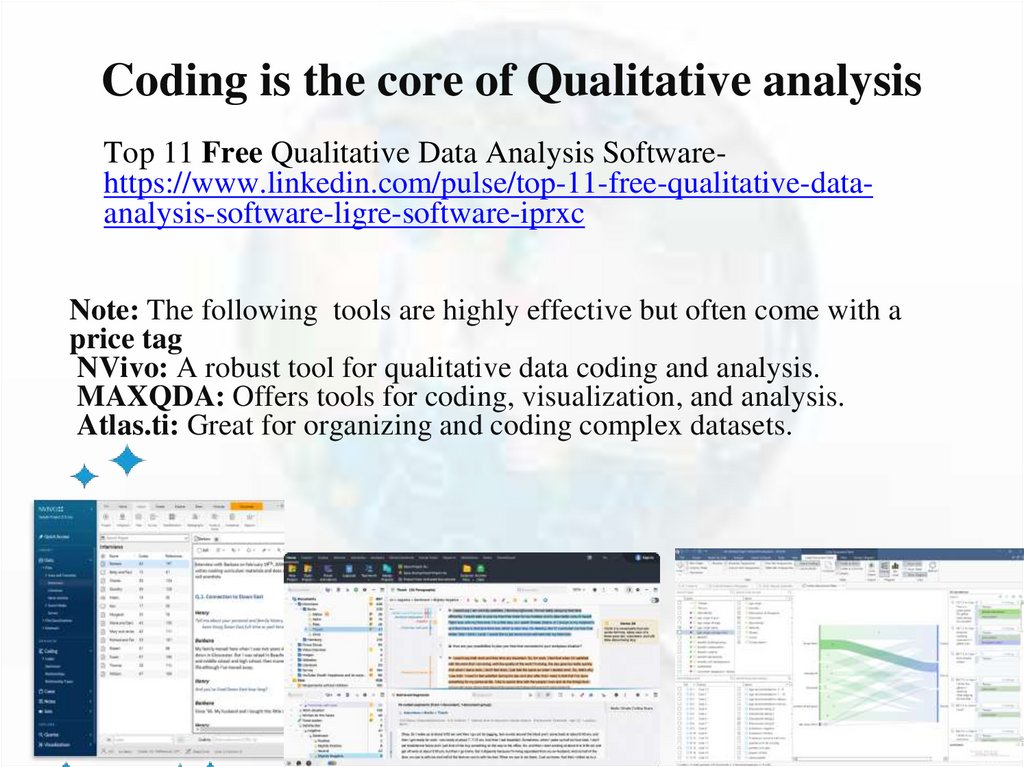
Coding is the core of Qualitative analysisTop 11 Free Qualitative Data Analysis Softwarehttps://www.linkedin.com/pulse/top-11-free-qualitative-dataanalysis-software-ligre-software-iprxc
Note: The following tools are highly effective but often come with a
price tag
NVivo: A robust tool for qualitative data coding and analysis.
MAXQDA: Offers tools for coding, visualization, and analysis.
Atlas.ti: Great for organizing and coding complex datasets.
30.
AnswersWell-known packages are NVivo and Atlas.ti, and your
choice should depend largely on the one favoured
by your institution
HOWEVER
Our institutions- whether universities or schools-typically
do not have contracts or agreements with these
companies to provide free or discounted licenses for
students or faculty
31.
This means that many of you will need to relyon manual coding methods using tool like
Microsoft Word
32.
Terminology of Thematic AnalysisCodes- just analytic tools, little summaries of what’s
being said, they are very specific and quite descriptive.
Codes help understand data and eventually arrive at
conclusions as to what your themes are (only appear at
the stage of data analysis)
Themes- big ideas or patterns that come up repeatedly
in your data. They help answer your research
question by showing the main topics or concepts
that participants talk about
Sub-themes (categories)- a smaller part of a larger
theme, offering more detail or nuance within the
broader pattern (Note: Whether or not to include
sub-themes depends on the complexity of the data,
the research question, and the researcher’s
preference or approach)
33.
34.
Sub-themes (not always necessary)a. Provide more detail or nuance: They help break
down a complex theme into manageable parts
b. Highlight specific dimensions: When a theme
covers multiple aspects, sub-themes clarify those
35.
Example ofcoding in a
Microsoft
Word
Document HO2
36.
How many themes do you need?According to Braun and Clarke (2012), the typical number of
themes ranges from 3 to 6 (for a ten thousand-word report)
37.
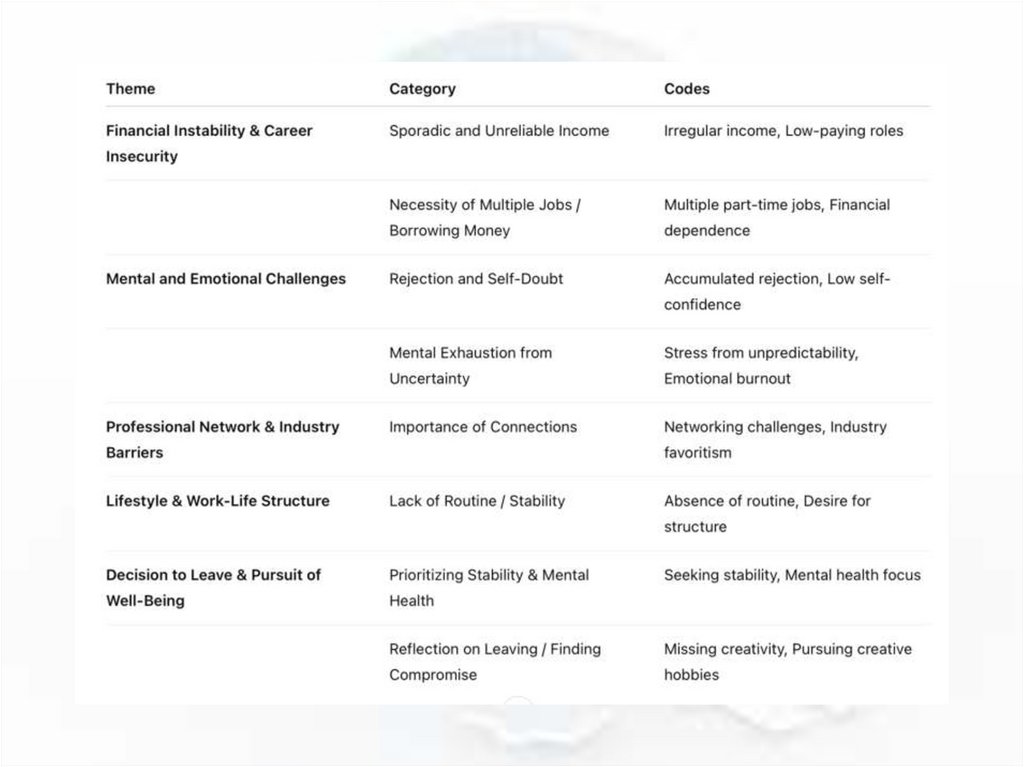
As you can see, thematic analysis results can bepresented in various forms. Therefore, before
finalizing the presentation of your results, it is
advisable to consult with your GPPW teacher for
guidance, ensuring alignment with your research
objectives and expectations
38.
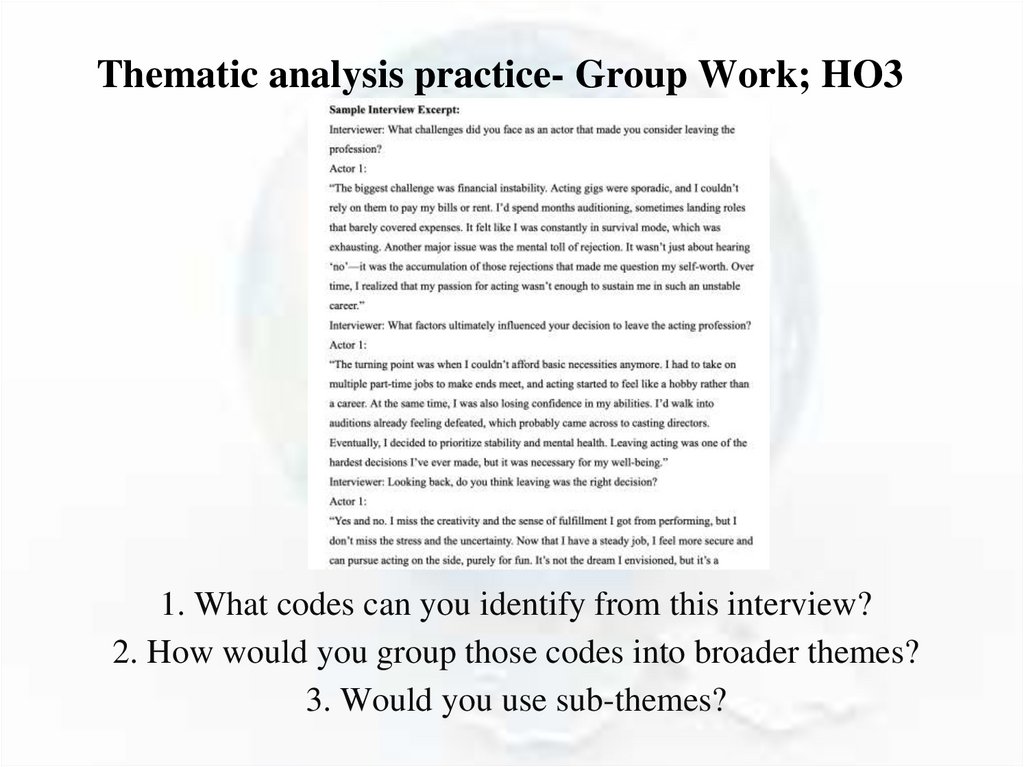
Thematic analysis practice- Group Work; HO31. What codes can you identify from this interview?
2. How would you group those codes into broader themes?
3. Would you use sub-themes?
39.
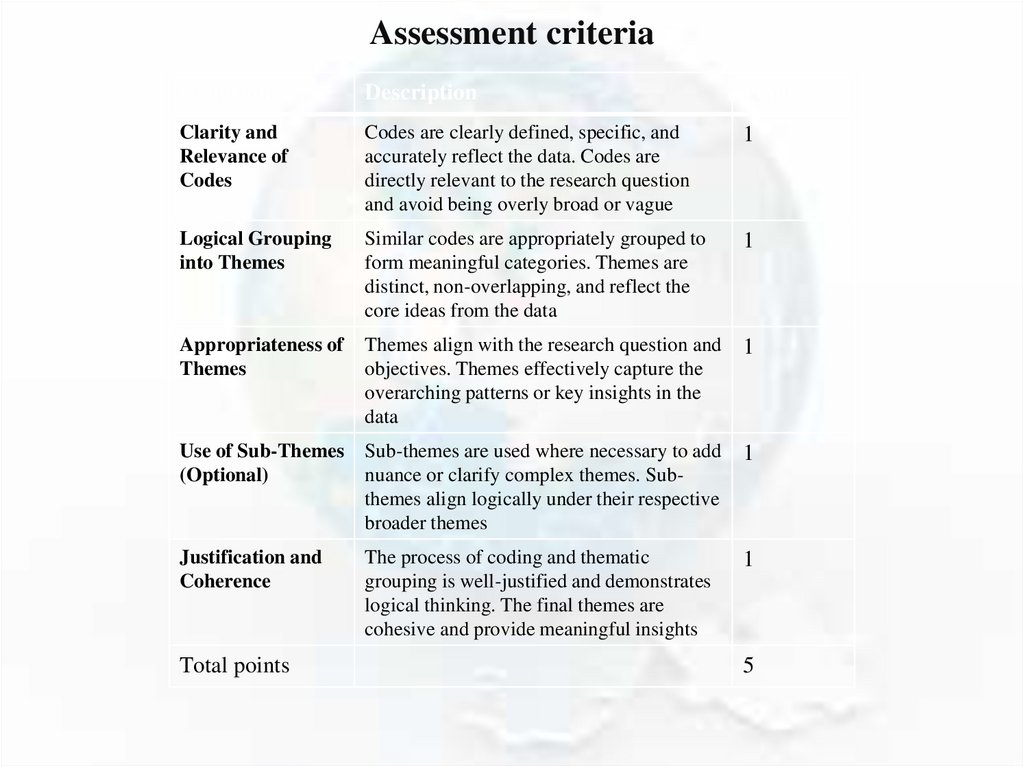
Assessment criteriaCriterion
Description
Points
Clarity and
Relevance of
Codes
Codes are clearly defined, specific, and
accurately reflect the data. Codes are
directly relevant to the research question
and avoid being overly broad or vague
1
Logical Grouping
into Themes
Similar codes are appropriately grouped to
form meaningful categories. Themes are
distinct, non-overlapping, and reflect the
core ideas from the data
1
Appropriateness of
Themes
Themes align with the research question and
objectives. Themes effectively capture the
overarching patterns or key insights in the
data
1
Use of Sub-Themes
(Optional)
Sub-themes are used where necessary to add
nuance or clarify complex themes. Subthemes align logically under their respective
broader themes
1
Justification and
Coherence
The process of coding and thematic
grouping is well-justified and demonstrates
logical thinking. The final themes are
cohesive and provide meaningful insights
1
Total points
5
40.
41.
Reflection1.Which qualitative data analysis method do you feel most
comfortable using, and why?
2. What was the most challenging aspect of qualitative data
analysis, and why?
3. What improvements or strategies would you suggest to make
qualitative data analysis more effective?
42.
Essential Resources for Thematic Analysis of Qualitative InterviewsArticle: Maguire, Moira, and Brid Delahunt. "Doing a thematic analysis: A practical, step-bystep guide for learning and teaching scholars." All Ireland Journal of Higher Education 9.3
(2017).
Article: Braun, V., & Clarke, V. (2006). Using thematic analysis in psychology. Qualitative
research in psychology, 3(2), 77-101.
Book: Braun, V., & Clarke, V. (2022). Thematic Analysis. A Practical Guide.
Book: Saldaña, J. (2015). The coding manual for qualitative researchers 3rd ed.
Authoritative scholars in qualitative interviews: Svend Brinkmann, Irving Seidman, and
Steinar Kvale.