

 Интернет
 Программирование
Похожие презентации:







Writing Linux FS
1. Writing Linux FS
WRITING LINUX FS4 FUN
2. Outline
■ Why■ Main Concepts and bit of history
– Earlier design decisions
– On disk layout
■ Implementing own FS
■ On disk layout
■ Code Fragments:
– Kernel Implementation
– Other tools mkfs, fsdb
3. Why this talk?!
■ Cons– Writing FS is quite time consuming (approx. 10 years…)
– Just few production ready FS, many abandoned or not
truly maintained
■ Pros
– Learning: Address specific gap
– Solving other complicated problems
■
■
Storage stack is complicated and usually became a
bottleneck
Data is foundation of most todays application
4. Early days: 6th ed. of UNIX
Early days:th
6
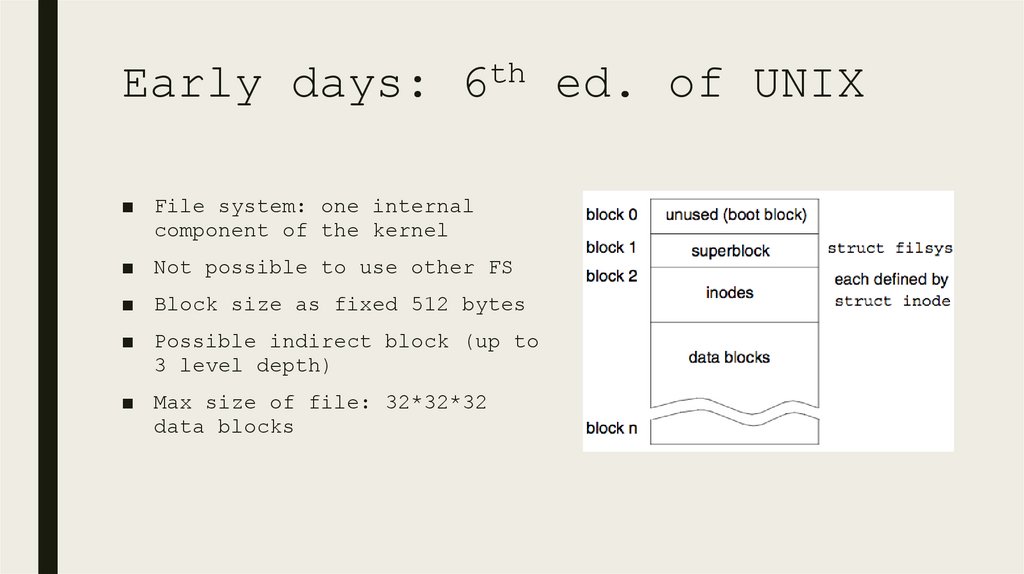
■ File system: one internal
component of the kernel
■ Not possible to use other FS
■ Block size as fixed 512 bytes
■ Possible indirect block (up to
3 level depth)
■ Max size of file: 32*32*32
data blocks
ed. of UNIX
5. Early days: 6th ed. of UNIX
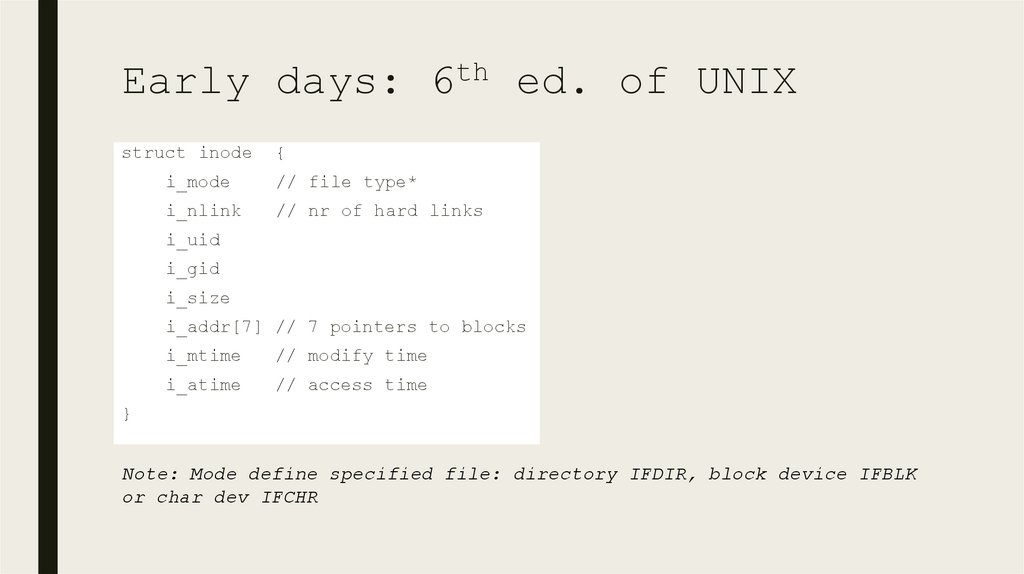
struct inode{
i_mode
// file type*
i_nlink
// nr of hard links
i_uid
i_gid
i_size
i_addr[7] // 7 pointers to blocks
i_mtime
// modify time
i_atime
// access time
}
Note: Mode define specified file: directory IFDIR, block device IFBLK
or char dev IFCHR
6. File System Switch
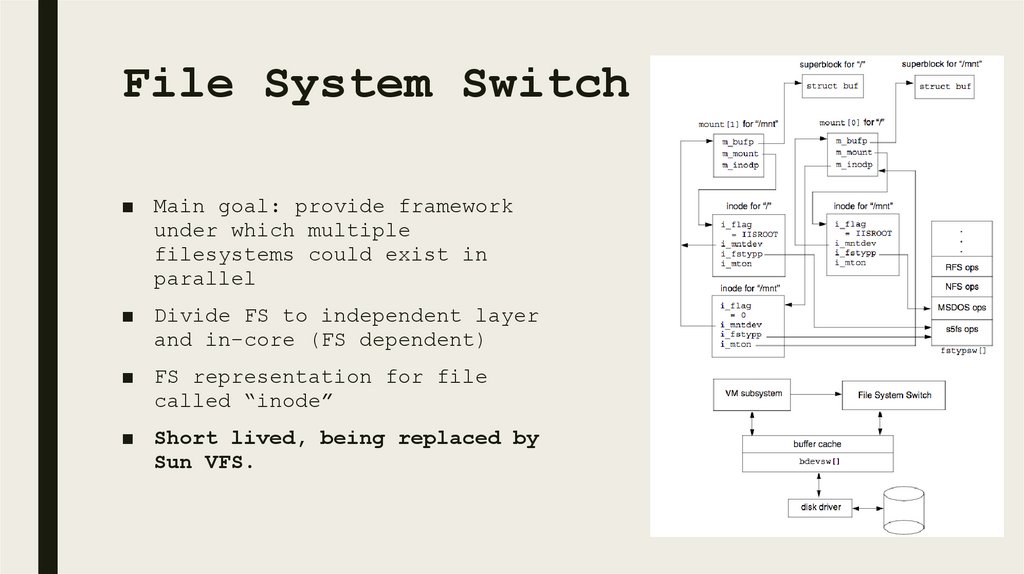
■ Main goal: provide frameworkunder which multiple
filesystems could exist in
parallel
■ Divide FS to independent layer
and in-core (FS dependent)
■ FS representation for file
called “inode”
■ Short lived, being replaced by
Sun VFS.
7. SunOS VFS/vnode
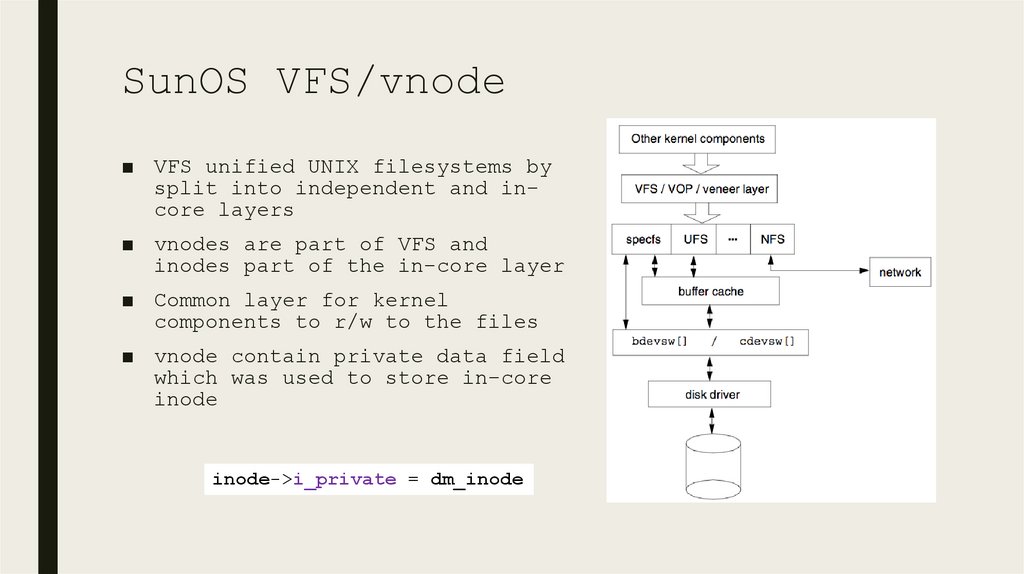
■ VFS unified UNIX filesystems bysplit into independent and incore layers
■ vnodes are part of VFS and
inodes part of the in-core layer
■ Common layer for kernel
components to r/w to the files
■ vnode contain private data field
which was used to store in-core
inode
inode->i_private = dm_inode
8. On Disk Layout: UFS
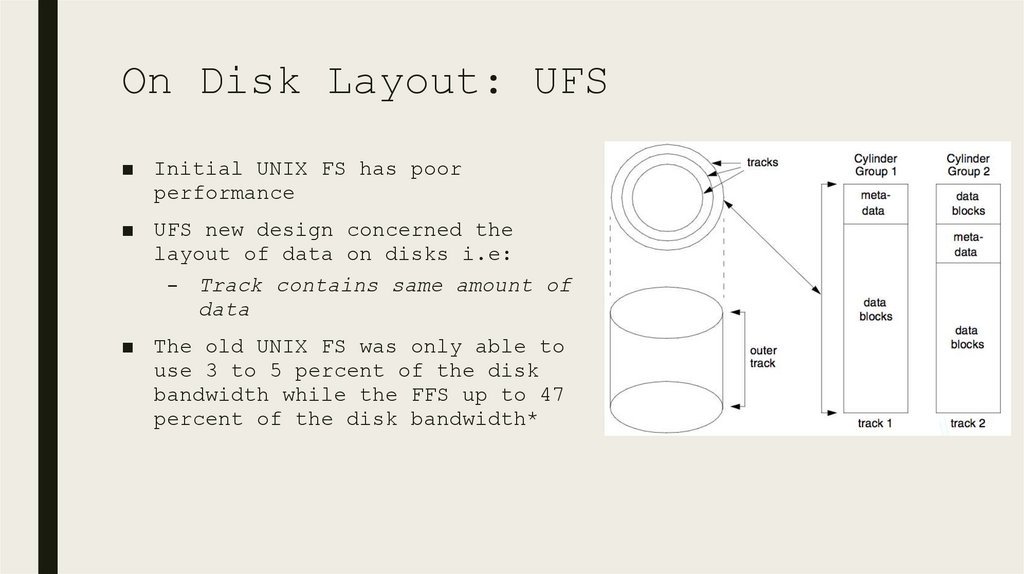
■ Initial UNIX FS has poorperformance
■ UFS new design concerned the
layout of data on disks i.e:
– Track contains same amount of
data
■ The old UNIX FS was only able to
use 3 to 5 percent of the disk
bandwidth while the FFS up to 47
percent of the disk bandwidth*
9. On Disk layout: EXT2
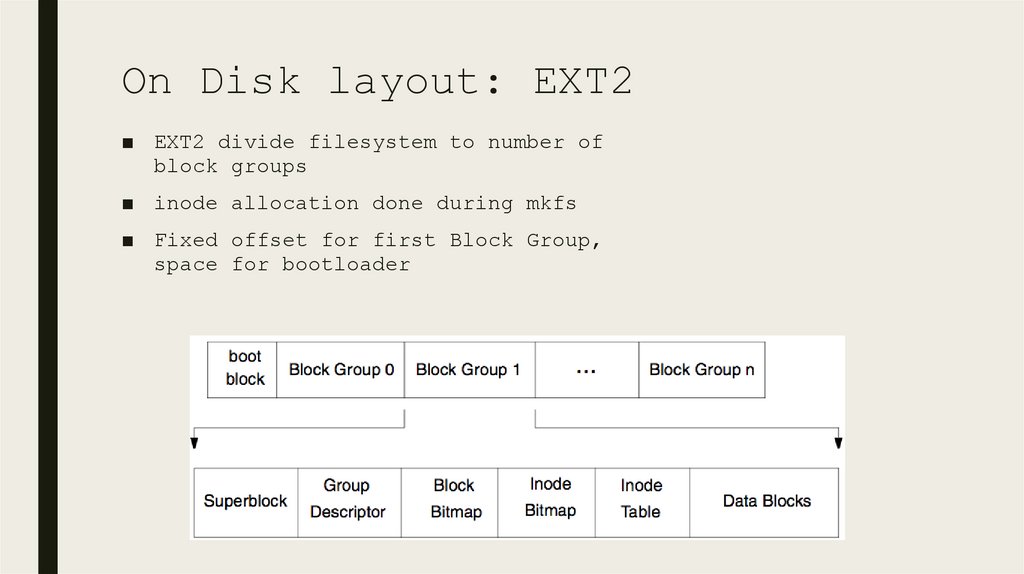
■ EXT2 divide filesystem to number ofblock groups
■ inode allocation done during mkfs
■ Fixed offset for first Block Group,
space for bootloader
10. Sample implementation dummyfs
■Implemented as in kernel module (possible to implement in user
space using FuseFS)
■
Provide basic functionality necessary to mount read write files to
the disk
■
Pseudo modern on disk layout
■
Good starting point to learn internal/implementing more advanced
features
■
Not using kernel caching mechanisms
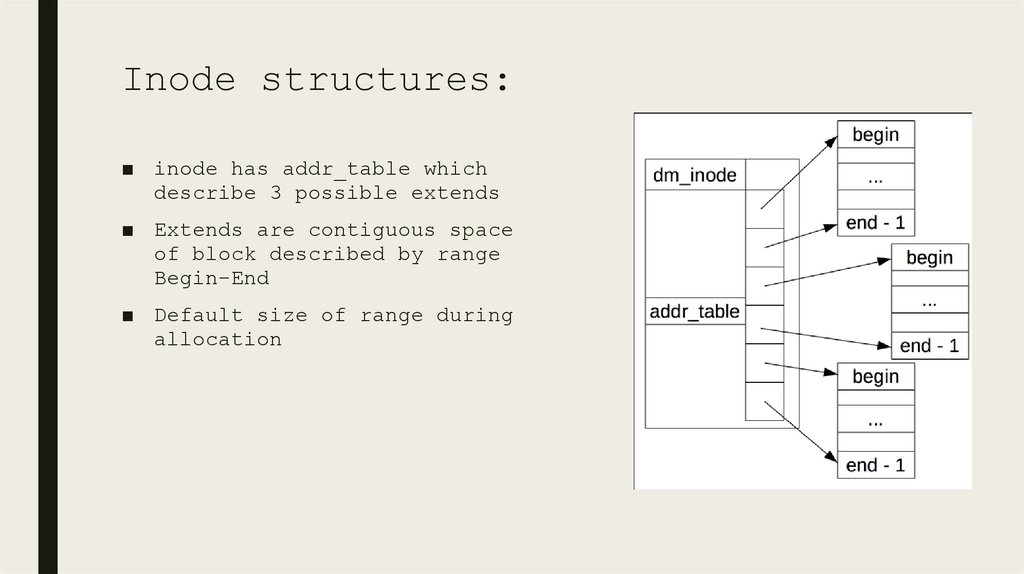
11. Inode structures:
■ inode has addr_table whichdescribe 3 possible extends
■ Extends are contiguous space
of block described by range
Begin-End
■ Default size of range during
allocation
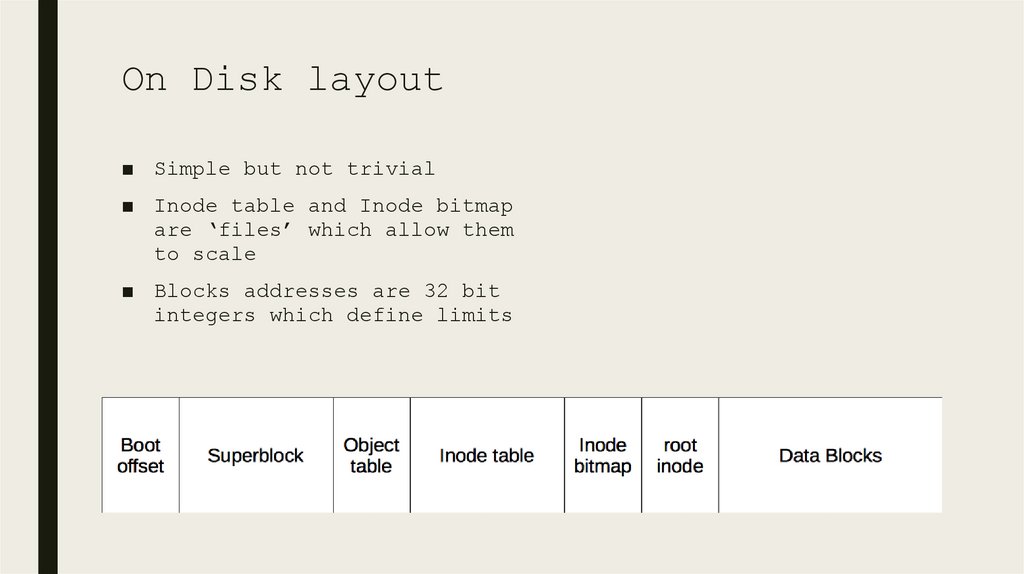
12. On Disk layout
■ Simple but not trivial■ Inode table and Inode bitmap
are ‘files’ which allow them
to scale
■ Blocks addresses are 32 bit
integers which define limits
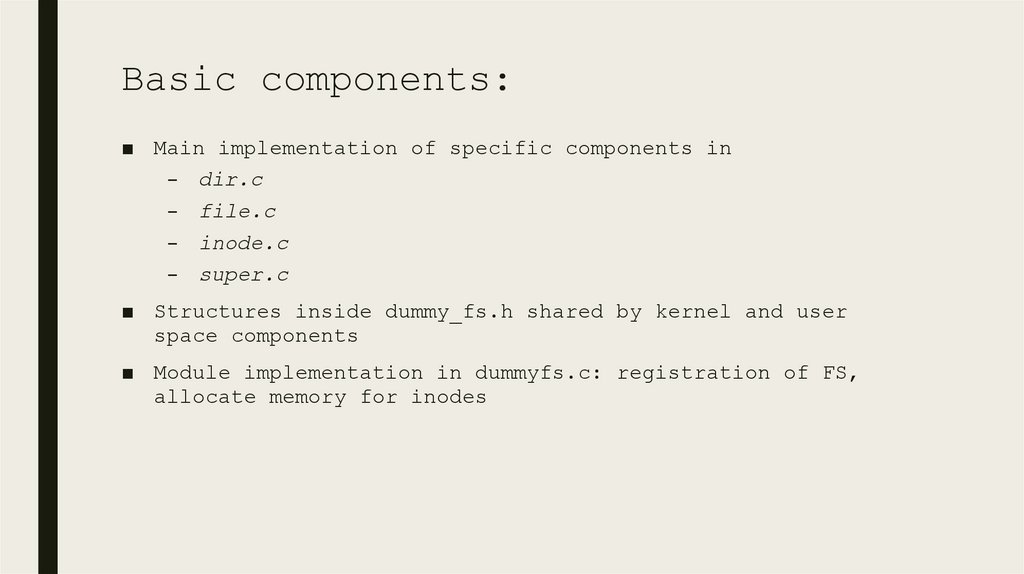
13. Basic components:
■ Main implementation of specific components in– dir.c
– file.c
– inode.c
– super.c
■ Structures inside dummy_fs.h shared by kernel and user
space components
■ Module implementation in dummyfs.c: registration of FS,
allocate memory for inodes
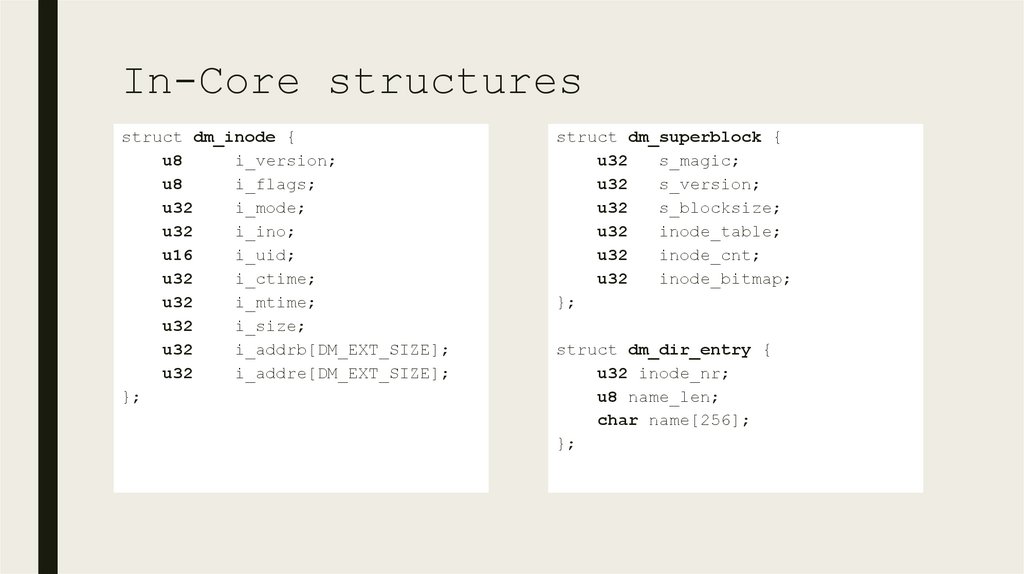
14. In-Core structures
struct dm_inode {u8
i_version;
u8
i_flags;
u32
i_mode;
u32
i_ino;
u16
i_uid;
u32
i_ctime;
u32
i_mtime;
u32
i_size;
u32
i_addrb[DM_EXT_SIZE];
u32
i_addre[DM_EXT_SIZE];
};
struct dm_superblock {
u32
s_magic;
u32
s_version;
u32
s_blocksize;
u32
inode_table;
u32
inode_cnt;
u32
inode_bitmap;
};
struct dm_dir_entry {
u32 inode_nr;
u8 name_len;
char name[256];
};
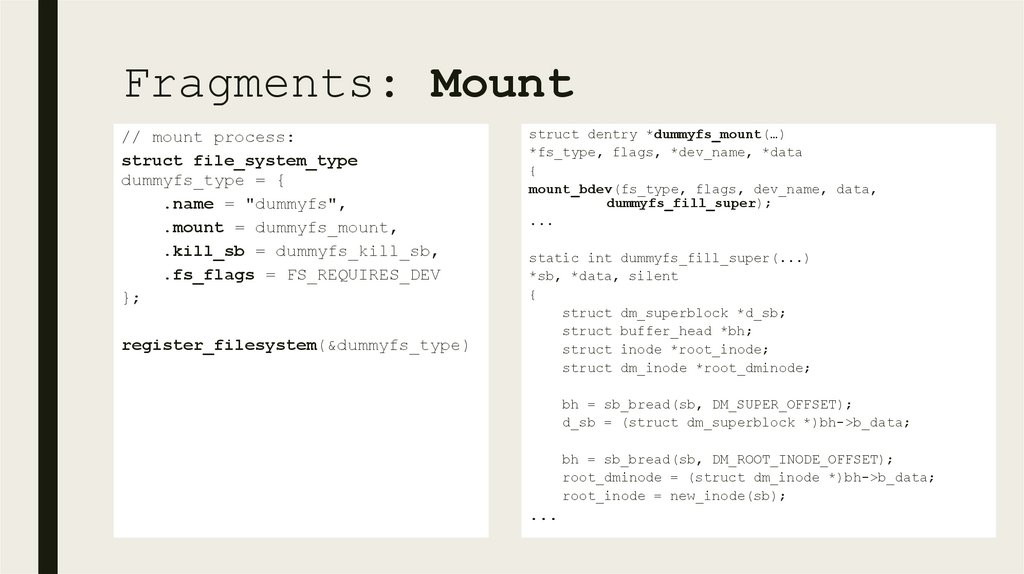
15. Fragments: Mount
// mount process:struct file_system_type
dummyfs_type = {
.name = "dummyfs",
.mount = dummyfs_mount,
.kill_sb = dummyfs_kill_sb,
.fs_flags = FS_REQUIRES_DEV
};
register_filesystem(&dummyfs_type)
struct dentry *dummyfs_mount(…)
*fs_type, flags, *dev_name, *data
{
mount_bdev(fs_type, flags, dev_name, data,
dummyfs_fill_super);
...
static int dummyfs_fill_super(...)
*sb, *data, silent
{
struct dm_superblock *d_sb;
struct buffer_head *bh;
struct inode *root_inode;
struct dm_inode *root_dminode;
bh = sb_bread(sb, DM_SUPER_OFFSET);
d_sb = (struct dm_superblock *)bh->b_data;
bh = sb_bread(sb, DM_ROOT_INODE_OFFSET);
root_dminode = (struct dm_inode *)bh->b_data;
root_inode = new_inode(sb);
...
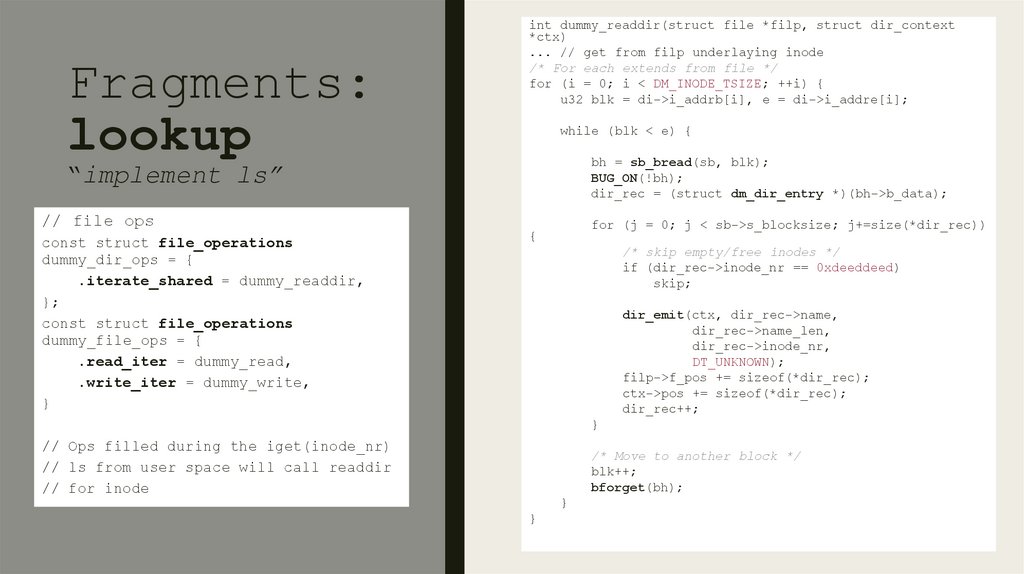
16. Fragments: lookup “implement ls”
Fragments:lookup
int dummy_readdir(struct file *filp, struct dir_context
*ctx)
... // get from filp underlaying inode
/* For each extends from file */
for (i = 0; i < DM_INODE_TSIZE; ++i) {
u32 blk = di->i_addrb[i], e = di->i_addre[i];
while (blk < e) {
bh = sb_bread(sb, blk);
BUG_ON(!bh);
dir_rec = (struct dm_dir_entry *)(bh->b_data);
“implement ls”
// file ops
const struct file_operations
dummy_dir_ops = {
.iterate_shared = dummy_readdir,
};
const struct file_operations
dummy_file_ops = {
.read_iter = dummy_read,
.write_iter = dummy_write,
}
for (j = 0; j < sb->s_blocksize; j+=size(*dir_rec))
{
/* skip empty/free inodes */
if (dir_rec->inode_nr == 0xdeeddeed)
skip;
dir_emit(ctx, dir_rec->name,
dir_rec->name_len,
dir_rec->inode_nr,
DT_UNKNOWN);
filp->f_pos += sizeof(*dir_rec);
ctx->pos += sizeof(*dir_rec);
dir_rec++;
}
// Ops filled during the iget(inode_nr)
// ls from user space will call readdir
// for inode
/* Move to another block */
blk++;
bforget(bh);
}
}
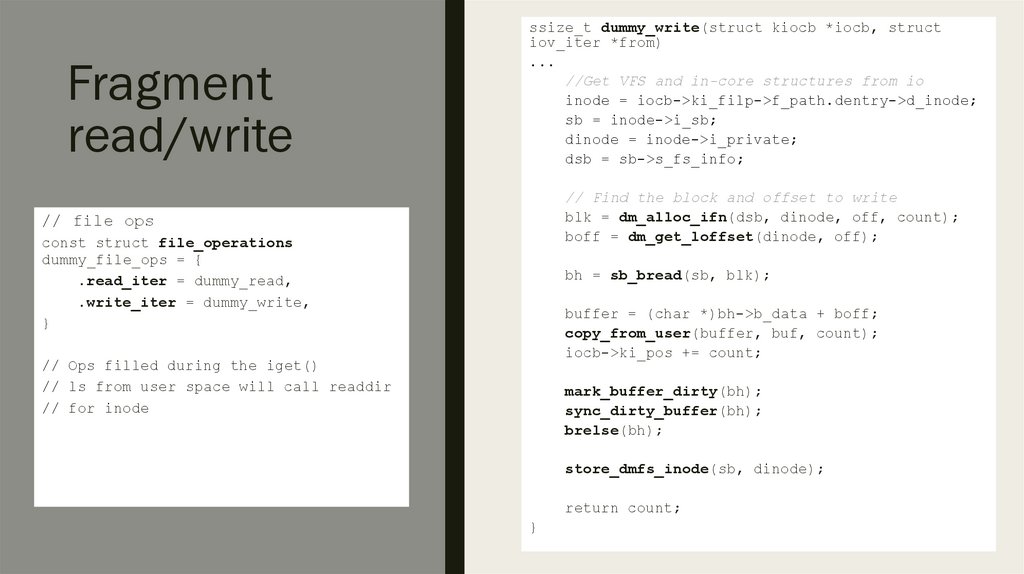
17. Fragment read/write
ssize_t dummy_write(struct kiocb *iocb, structiov_iter *from)
...
//Get VFS and in-core structures from io
inode = iocb->ki_filp->f_path.dentry->d_inode;
sb = inode->i_sb;
dinode = inode->i_private;
dsb = sb->s_fs_info;
// Find the block and offset to write
blk = dm_alloc_ifn(dsb, dinode, off, count);
boff = dm_get_loffset(dinode, off);
// file ops
const struct file_operations
dummy_file_ops = {
.read_iter = dummy_read,
.write_iter = dummy_write,
}
bh = sb_bread(sb, blk);
buffer = (char *)bh->b_data + boff;
copy_from_user(buffer, buf, count);
iocb->ki_pos += count;
// Ops filled during the iget()
// ls from user space will call readdir
// for inode
mark_buffer_dirty(bh);
sync_dirty_buffer(bh);
brelse(bh);
store_dmfs_inode(sb, dinode);
return count;
}
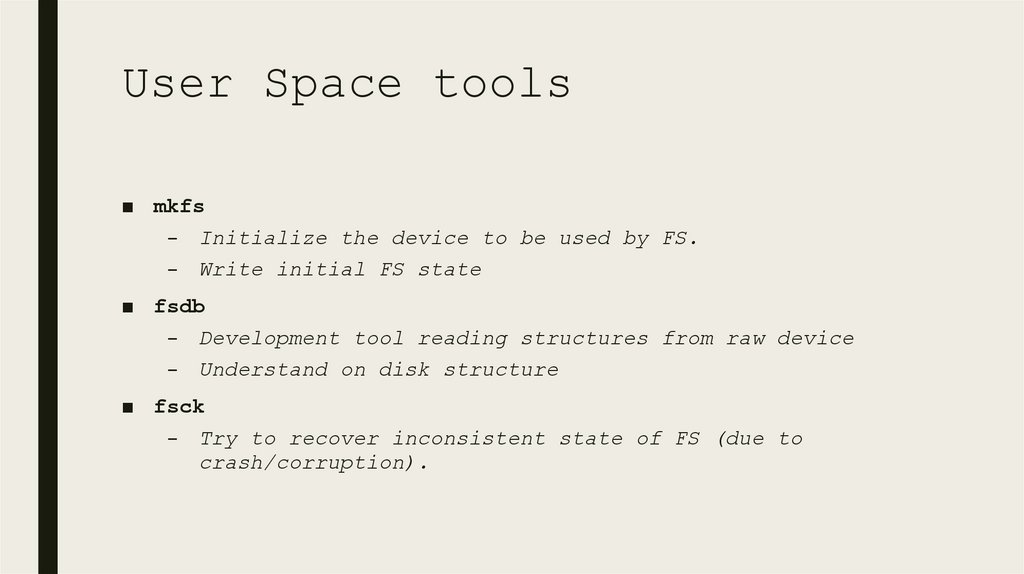
18. User Space tools
■ mkfs– Initialize the device to be used by FS.
– Write initial FS state
■ fsdb
– Development tool reading structures from raw device
– Understand on disk structure
■ fsck
– Try to recover inconsistent state of FS (due to
crash/corruption).
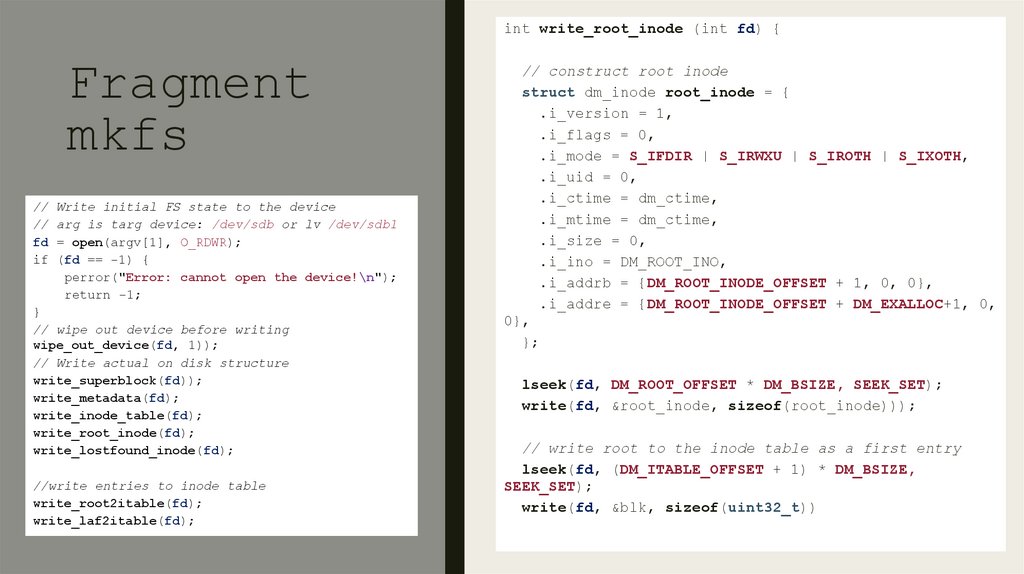
19. Fragment mkfs
int write_root_inode (int fd) {Fragment
mkfs
//
//
fd
if
Write initial FS state to the device
arg is targ device: /dev/sdb or lv /dev/sdb1
= open(argv[1], O_RDWR);
(fd == -1) {
perror("Error: cannot open the device!\n");
return -1;
}
// wipe out device before writing
wipe_out_device(fd, 1));
// Write actual on disk structure
write_superblock(fd));
write_metadata(fd);
write_inode_table(fd);
write_root_inode(fd);
write_lostfound_inode(fd);
//write entries to inode table
write_root2itable(fd);
write_laf2itable(fd);
// construct root inode
struct dm_inode root_inode = {
.i_version = 1,
.i_flags = 0,
.i_mode = S_IFDIR | S_IRWXU | S_IROTH | S_IXOTH,
.i_uid = 0,
.i_ctime = dm_ctime,
.i_mtime = dm_ctime,
.i_size = 0,
.i_ino = DM_ROOT_INO,
.i_addrb = {DM_ROOT_INODE_OFFSET + 1, 0, 0},
.i_addre = {DM_ROOT_INODE_OFFSET + DM_EXALLOC+1, 0,
0},
};
lseek(fd, DM_ROOT_OFFSET * DM_BSIZE, SEEK_SET);
write(fd, &root_inode, sizeof(root_inode)));
// write root to the inode table as a first entry
lseek(fd, (DM_ITABLE_OFFSET + 1) * DM_BSIZE,
SEEK_SET);
write(fd, &blk, sizeof(uint32_t))
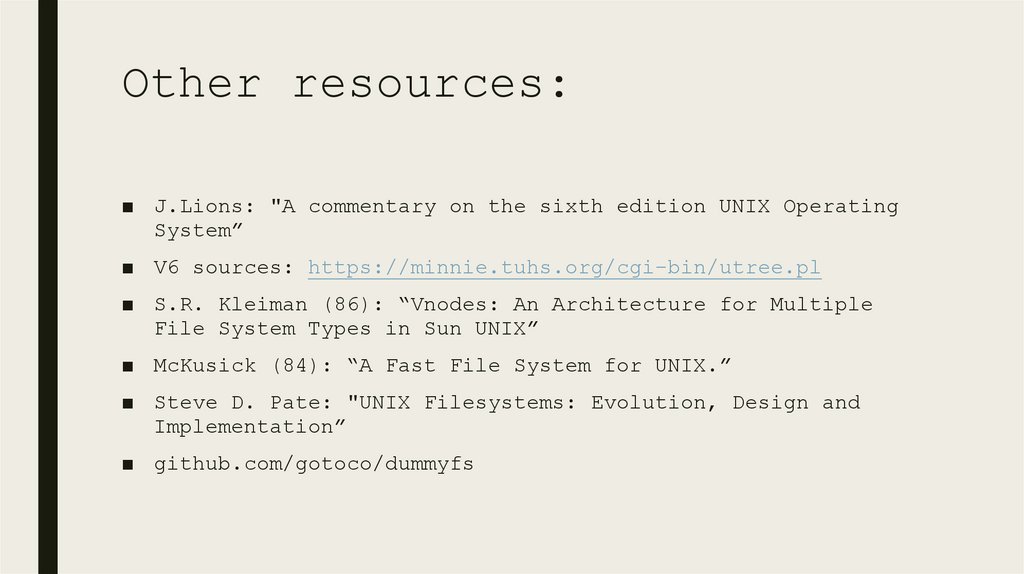
20. Other resources:
■ J.Lions: "A commentary on the sixth edition UNIX OperatingSystem”
■ V6 sources: https://minnie.tuhs.org/cgi-bin/utree.pl
■ S.R. Kleiman (86): “Vnodes: An Architecture for Multiple
File System Types in Sun UNIX”
■ McKusick (84): “A Fast File System for UNIX.”
■ Steve D. Pate: "UNIX Filesystems: Evolution, Design and
Implementation”
■ github.com/gotoco/dummyfs