 Экономика
Похожие презентации:


What are the key themes of microeconomics? What is a market? What is the difference between real and nominal prices?
1. Chapter 1
Preliminaries2. Introduction
What are the key themes ofmicroeconomics?
What is a market?
What is the difference between real and
nominal prices?
Why study microeconomics?
©2005 Pearson Education, Inc.
Chapter 1
2
3. Themes of Microeconomics
Microeconomics deals with limitsLimited budgets
Limited time
Limited ability to produce
How do we make the most of limits?
How do we allocate scarce resources?
©2005 Pearson Education, Inc.
Chapter 1
3
4. Themes of Microeconomics
Workers, firms and consumers mustmake trade-offs
Do I work or go on vacation?
Do I purchase a new car or save my money?
Do we hire more workers or buy new
machinery?
How are these trade-offs best made?
©2005 Pearson Education, Inc.
Chapter 1
4
5. Themes of Microeconomics
ConsumersLimited incomes
Consumer theory – describes how
consumers maximize their well-being, using
their preferences, to make decisions about
trade-offs
How do consumers make decisions about
consumption and savings?
©2005 Pearson Education, Inc.
Chapter 1
5
6. Themes of Microeconomics
WorkersIndividuals decide when and if to enter the
workforce
Trade-offs of working now or obtaining more
education/training
What choices do individuals make in terms of
jobs or workplaces?
How many hours do individuals choose to
work?
Trade-off of labor and leisure
©2005 Pearson Education, Inc.
Chapter 1
6
7. Themes of Microeconomics
FirmsWhat types of products do firms produce?
Constraints on production capacity and financial
resources create needs for trade-offs
Theory of the Firm – describes how these
trade-offs are best made
©2005 Pearson Education, Inc.
Chapter 1
7
8. Themes of Microeconomics
PricesTrade-offs are often based on prices faced
by consumers and producers
Workers make decisions based on prices for
labor – wages
Firms make decisions based on wages and
prices for inputs and on prices for the goods
they produce
©2005 Pearson Education, Inc.
Chapter 1
8
9. Themes of Microeconomics
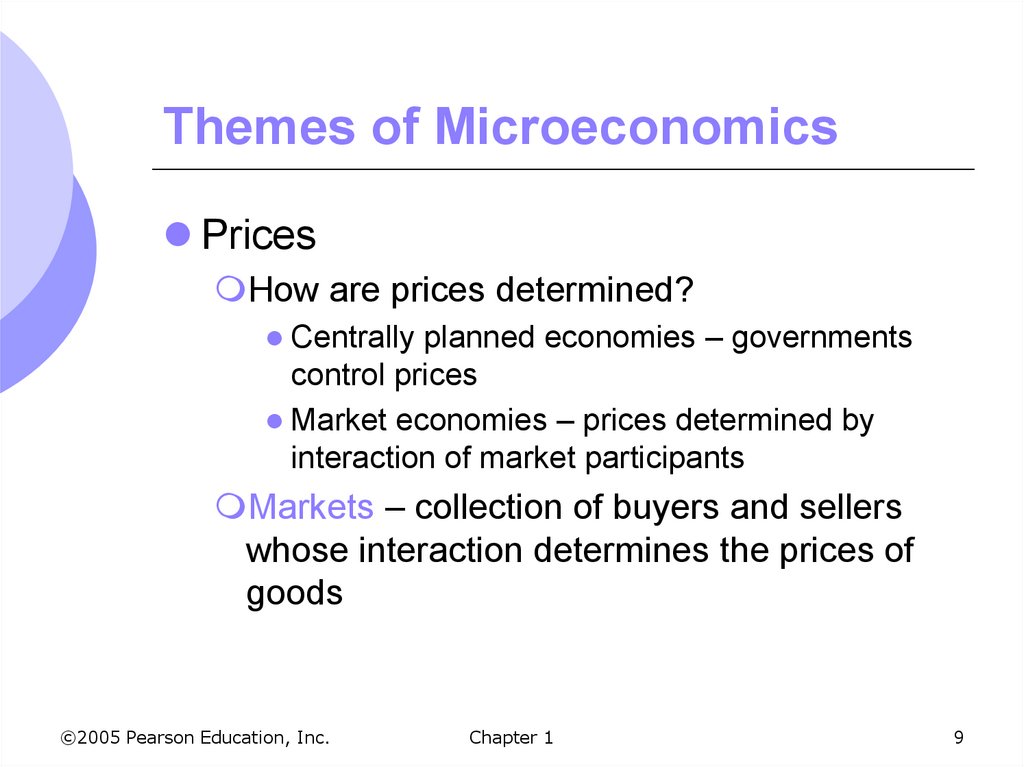
PricesHow are prices determined?
Centrally planned economies – governments
control prices
Market economies – prices determined by
interaction of market participants
Markets – collection of buyers and sellers
whose interaction determines the prices of
goods
©2005 Pearson Education, Inc.
Chapter 1
9
10. Theories and Models
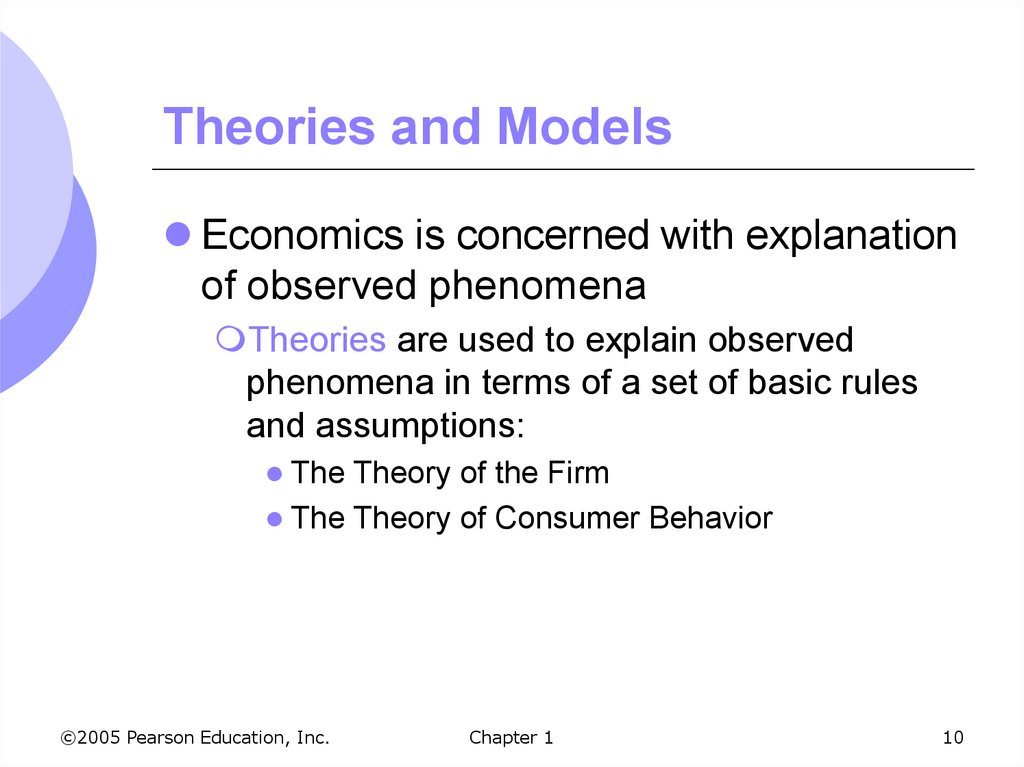
Economics is concerned with explanationof observed phenomena
Theories are used to explain observed
phenomena in terms of a set of basic rules
and assumptions:
The Theory of the Firm
The Theory of Consumer Behavior
©2005 Pearson Education, Inc.
Chapter 1
10
11. Theories and Models
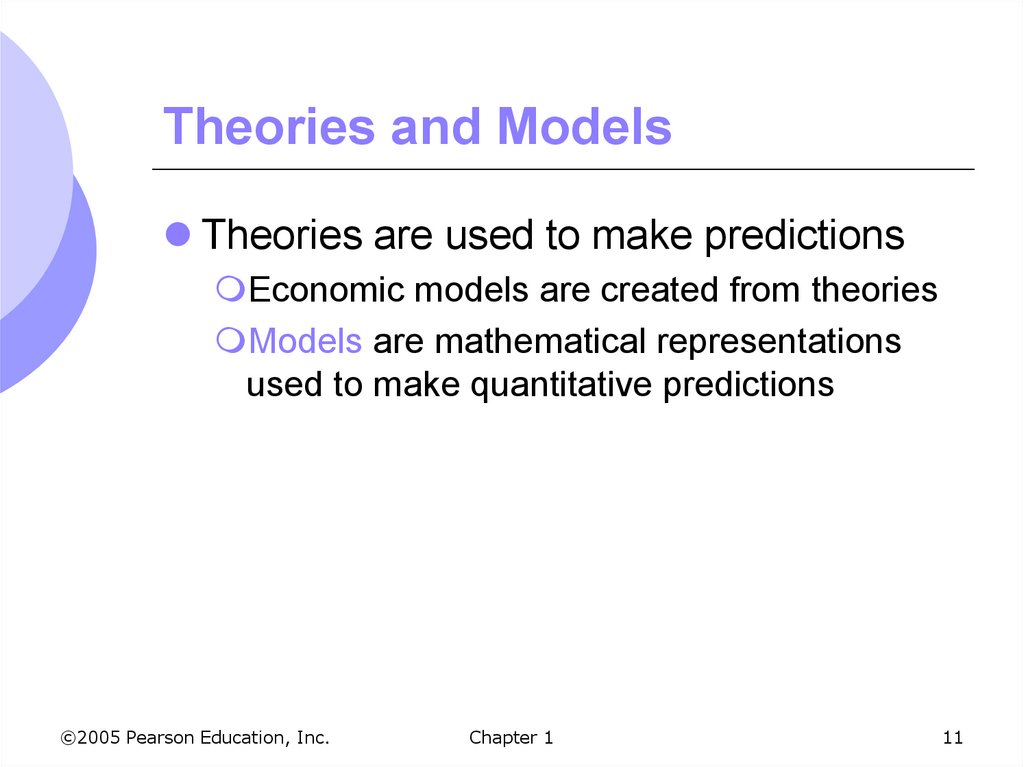
Theories are used to make predictionsEconomic models are created from theories
Models are mathematical representations
used to make quantitative predictions
©2005 Pearson Education, Inc.
Chapter 1
11
12. Theories and Models
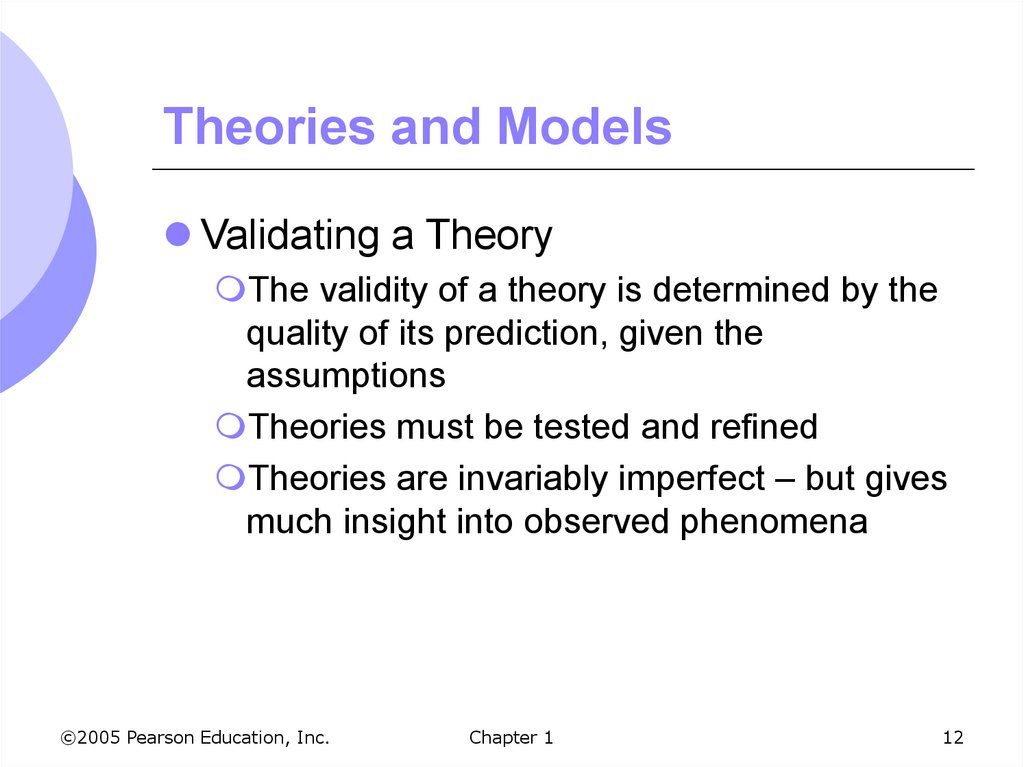
Validating a TheoryThe validity of a theory is determined by the
quality of its prediction, given the
assumptions
Theories must be tested and refined
Theories are invariably imperfect – but gives
much insight into observed phenomena
©2005 Pearson Education, Inc.
Chapter 1
12
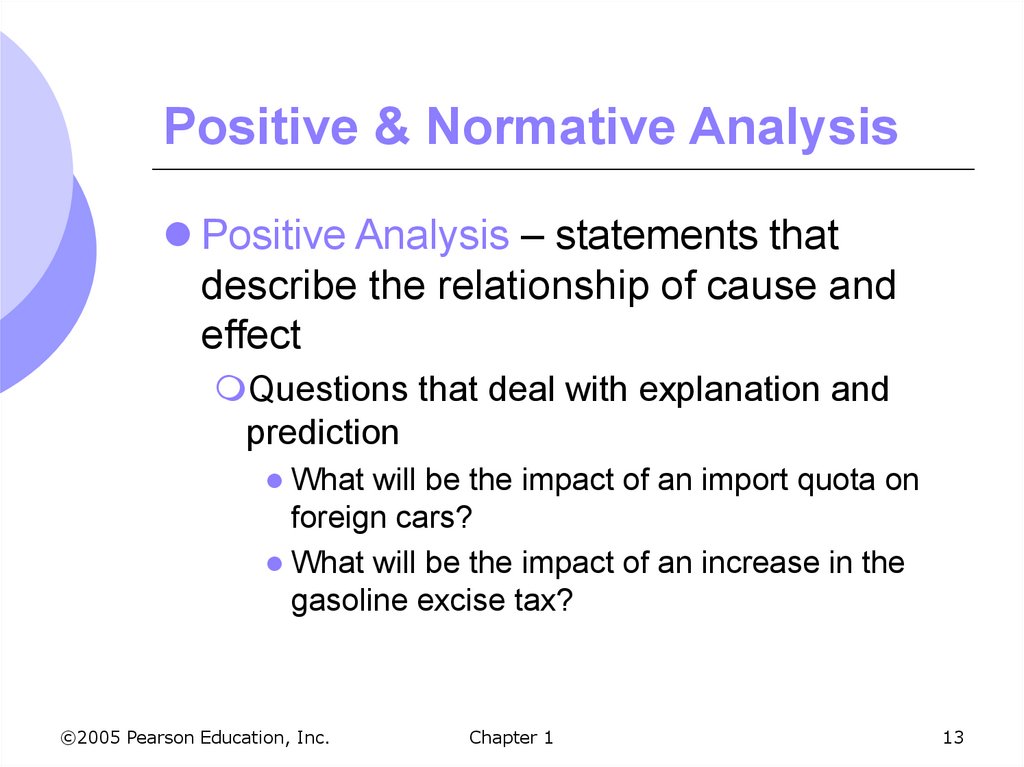
13. Positive & Normative Analysis
Positive & Normative AnalysisPositive Analysis – statements that
describe the relationship of cause and
effect
Questions that deal with explanation and
prediction
What will be the impact of an import quota on
foreign cars?
What will be the impact of an increase in the
gasoline excise tax?
©2005 Pearson Education, Inc.
Chapter 1
13
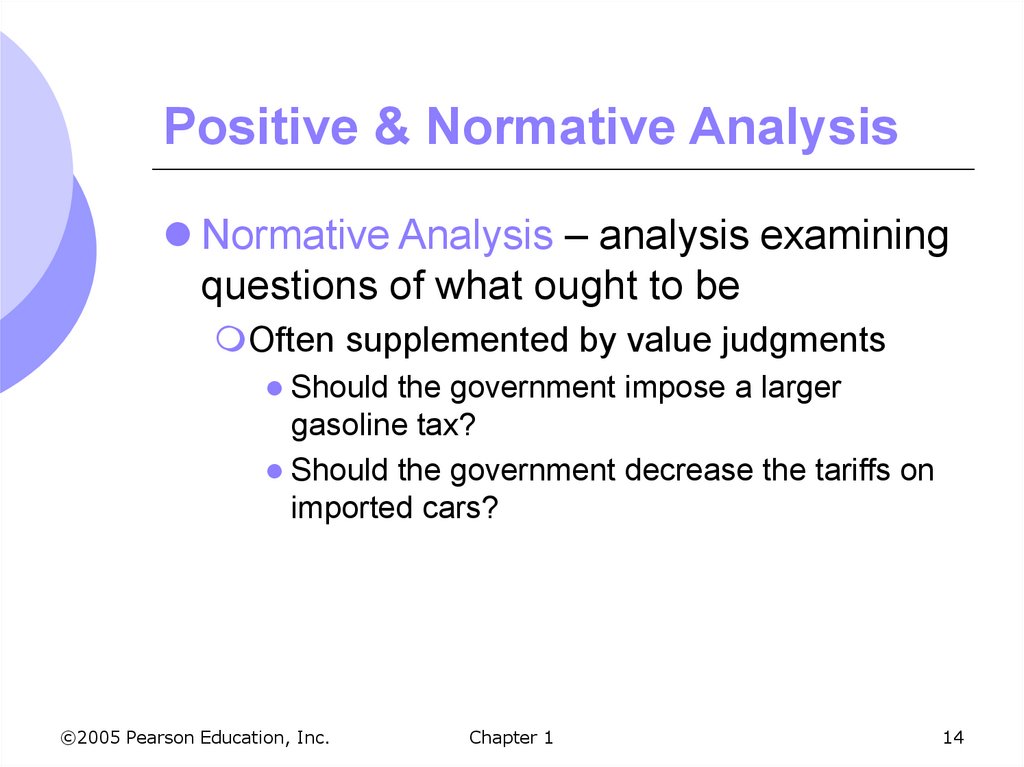
14. Positive & Normative Analysis
Positive & Normative AnalysisNormative Analysis – analysis examining
questions of what ought to be
Often supplemented by value judgments
Should the government impose a larger
gasoline tax?
Should the government decrease the tariffs on
imported cars?
©2005 Pearson Education, Inc.
Chapter 1
14
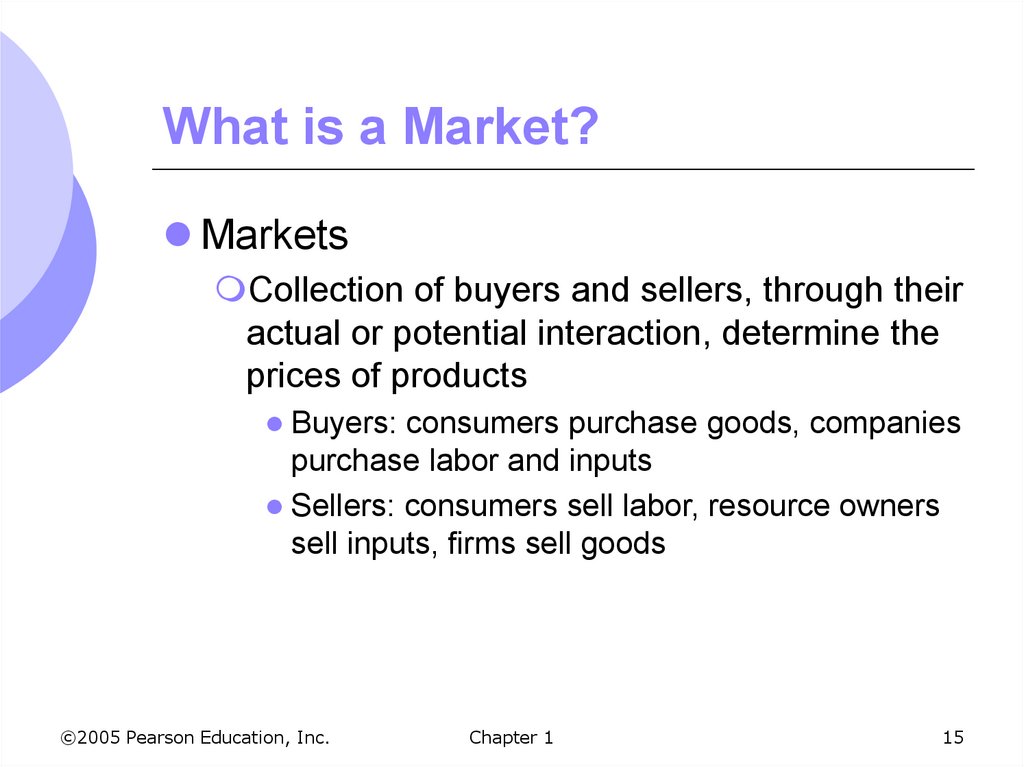
15. What is a Market?
MarketsCollection of buyers and sellers, through their
actual or potential interaction, determine the
prices of products
Buyers: consumers purchase goods, companies
purchase labor and inputs
Sellers: consumers sell labor, resource owners
sell inputs, firms sell goods
©2005 Pearson Education, Inc.
Chapter 1
15
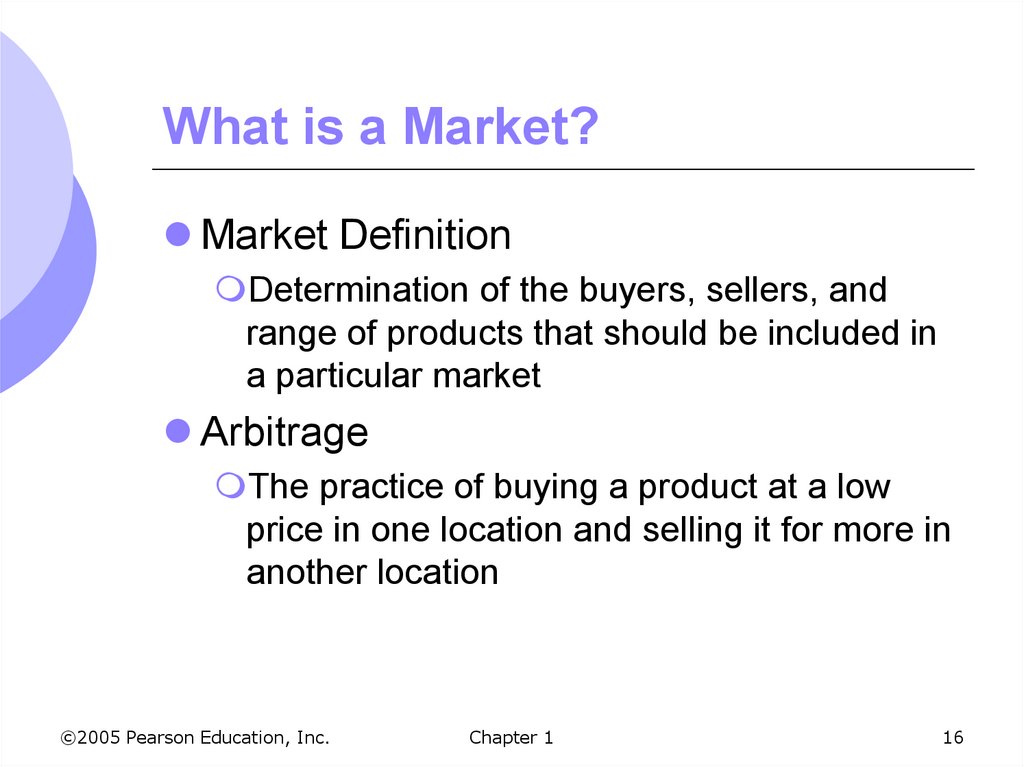
16. What is a Market?
Market DefinitionDetermination of the buyers, sellers, and
range of products that should be included in
a particular market
Arbitrage
The practice of buying a product at a low
price in one location and selling it for more in
another location
©2005 Pearson Education, Inc.
Chapter 1
16
17. What is a Market?
Defining the MarketMany of the most interesting questions in
economics concern the functioning of
markets
Why are there a lot of firms in some markets
and not in others?
Are consumers better off with many firms?
Should the government intervene in markets?
©2005 Pearson Education, Inc.
Chapter 1
17
18. Types of Markets
Perfectly competitive marketsBecause of the large number of buyers and
sellers, no individual buyer or seller can
influence the price
Example: Most agricultural markets
Fierce competition among firms can create a
competitive market
©2005 Pearson Education, Inc.
Chapter 1
18
19. Types of Markets
Noncompetitive MarketsMarkets where individual producers can
influence the price
Cartels – groups of producers who act
collectively
Example: OPEC dominates with world oil
market
©2005 Pearson Education, Inc.
Chapter 1
19
20. Market Price
Transactions between buyers and sellersare exchanges of goods for a certain
price
Market price – price prevailing in a
competitive market
Some markets have one price: price of gold
Some markets have more than one price: price
of Tide versus Wisk
©2005 Pearson Education, Inc.
Chapter 1
20
21. Market Definition
Market DefinitionWhich buyers and sellers should be included
in a given market?
This depends on the extent of the market –
boundaries, geographical and by range of
products, to be included in it
Market for housing in New York or Indianapolis
Market for all cameras or digital cameras
©2005 Pearson Education, Inc.
Chapter 1
21
22. Market Definition
Importance of market definitionIn order to set price, make budgeting
decisions, etc., companies must know
Their competitors
Product-characteristic and geographic
boundaries of the market
Important for public policy decisions
Should government allow a merger between
companies in same market?
©2005 Pearson Education, Inc.
Chapter 1
22
23. Real Versus Nominal Prices
Comparing prices across time requiresmeasuring prices relative to some overall
price level
Nominal price is the absolute or current
dollar price of a good or service when it is
sold
Real price is the price relative to an
aggregate measure of prices or constant
dollar price
©2005 Pearson Education, Inc.
Chapter 1
23
24. Real Versus Nominal Prices
Consumer Price Index (CPI) is oftenused as a measure of aggregate prices
Records the prices of a large market basket
of goods purchased by a “typical” consumer
over time
Percent changes in CPI measure the rate of
inflation
©2005 Pearson Education, Inc.
Chapter 1
24
25. Real Versus Nominal Prices
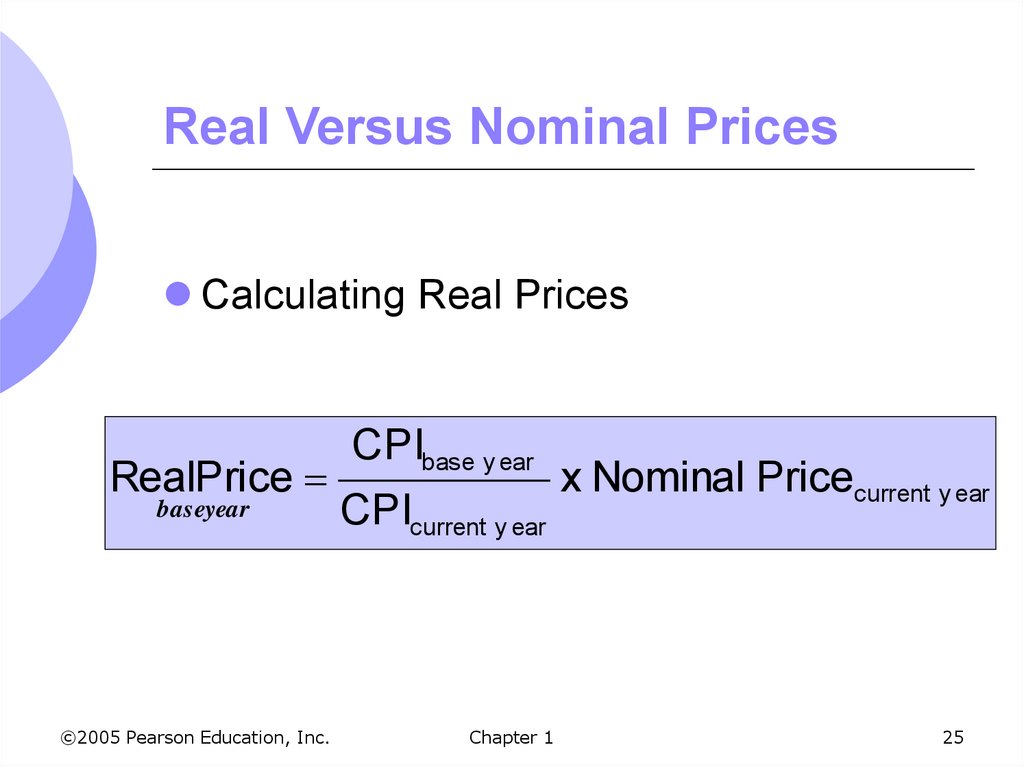
Calculating Real PricesRealPrice
baseyear
©2005 Pearson Education, Inc.
CPIbase y ear
CPIcurrent y ear
Chapter 1
x Nominal Pricecurrent y ear
25
26. Real Price of College
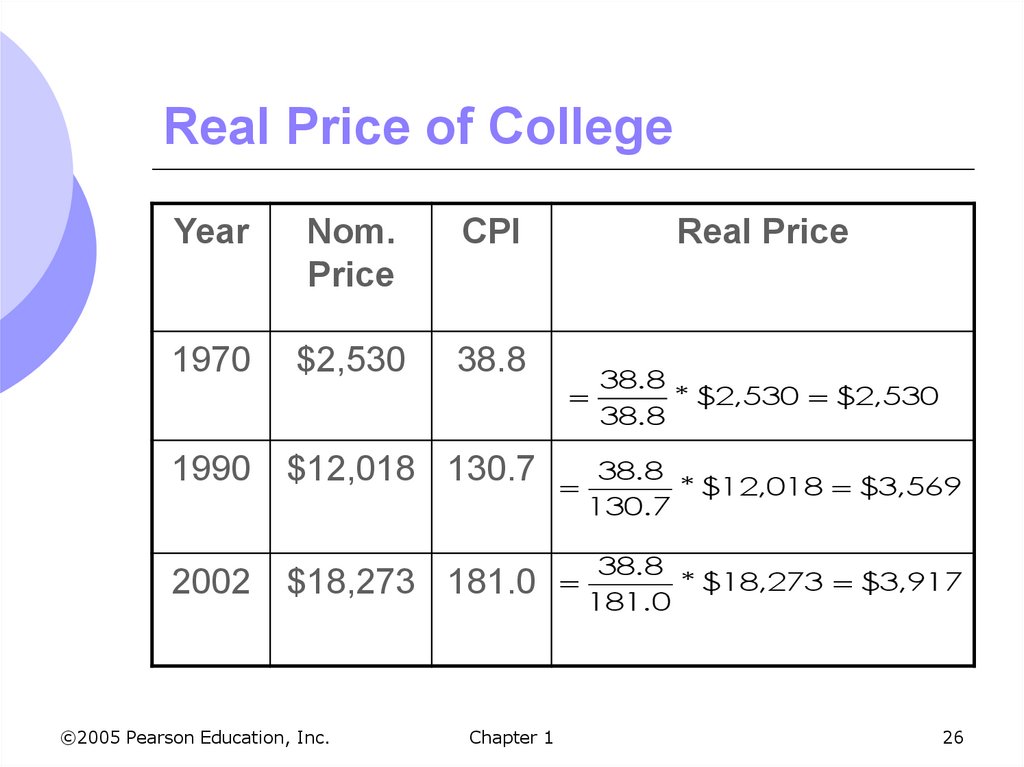
YearNom.
Price
CPI
1970
$2,530
38.8
Real Price
38.8
* $2,530 $2,530
38.8
1990 $12,018 130.7 38.8 * $12,018 $3,569
130.7
38.8
2002 $18,273 181.0 181.0 * $18,273 $3,917
©2005 Pearson Education, Inc.
Chapter 1
26
27. Real Price of Wages
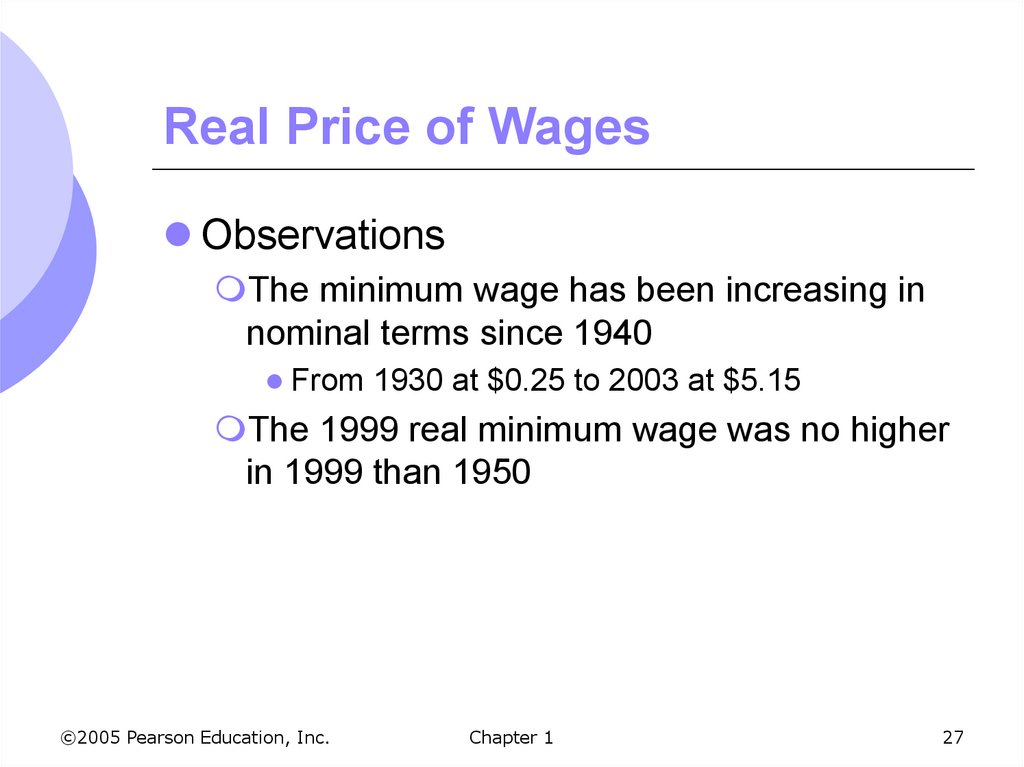
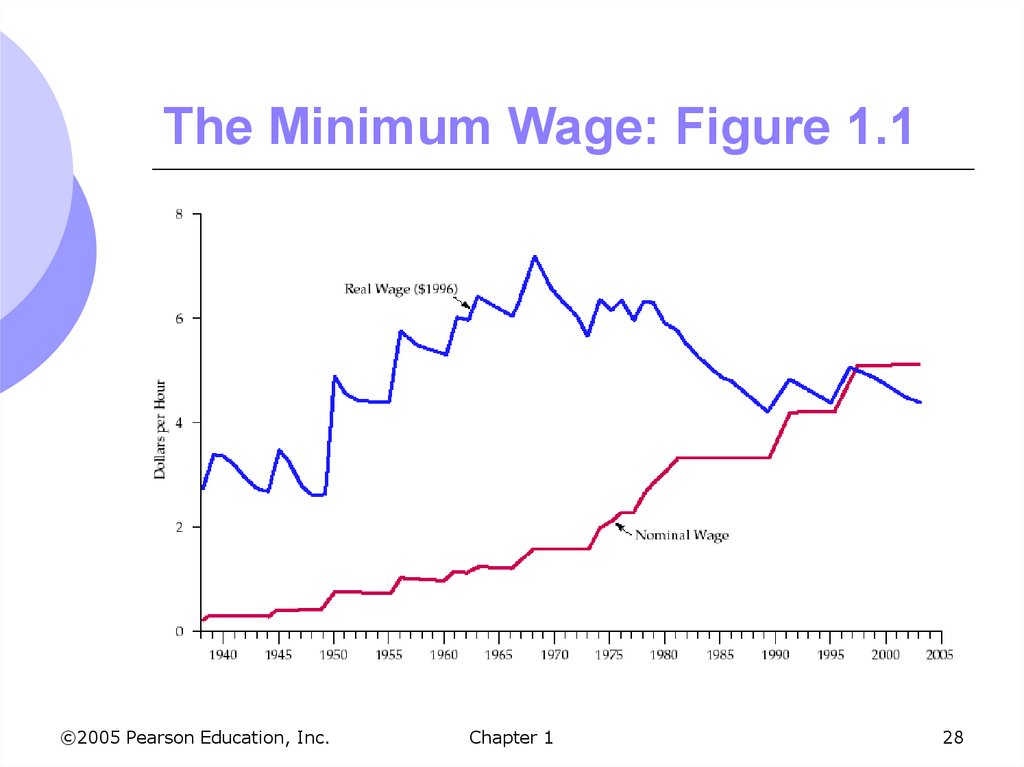
ObservationsThe minimum wage has been increasing in
nominal terms since 1940
From 1930 at $0.25 to 2003 at $5.15
The 1999 real minimum wage was no higher
in 1999 than 1950
©2005 Pearson Education, Inc.
Chapter 1
27
28. The Minimum Wage: Figure 1.1
©2005 Pearson Education, Inc.Chapter 1
28
29. Why Study Microeconomics?
Microeconomic concepts are used byeveryone to assist them in making
choices as consumers and producers
Examples show the numerous levels of
microeconomic questions necessary in
many decisions
©2005 Pearson Education, Inc.
Chapter 1
29
30. Ford SUV’s
Built Ford Explorer in 1991, FordExpedition in 1997 and Ford Excursion
in 1999
In each of these cases, Ford had to
consider many aspects of the economy
to ensure their introduction was a sound
investment
©2005 Pearson Education, Inc.
Chapter 1
30
31. Ford SUV’s
QuestionsHow strong is demand and how quickly will it
grow?
Must understand consumer preferences and
trade-offs
What are the costs of manufacturing?
Given all costs of production, how many should
be produced each year?
©2005 Pearson Education, Inc.
Chapter 1
31
32. Ford SUV’s
Questions (cont.)Ford had to develop pricing strategy and
determine competitors’ reactions
Risk analysis
Uncertainty of future prices: gas, wages
Organizational decisions
Integration of all divisions of production
Government regulation
Emissions standards
©2005 Pearson Education, Inc.
Chapter 1
32
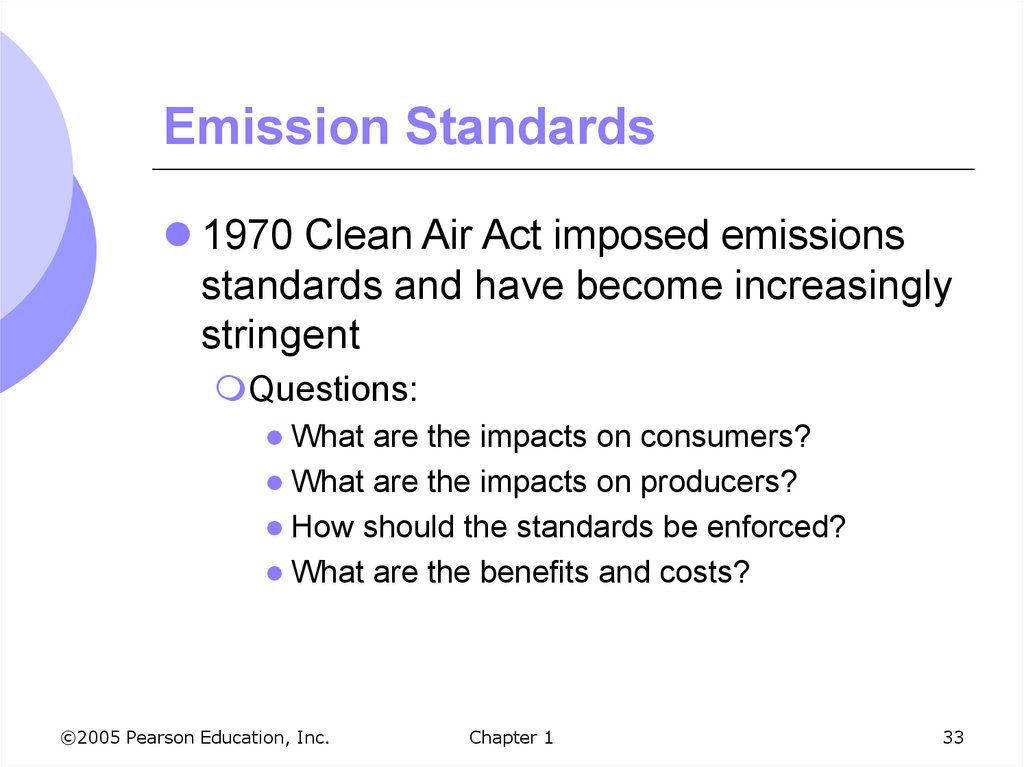
33. Emission Standards
1970 Clean Air Act imposed emissionsstandards and have become increasingly
stringent
Questions:
What are the impacts on consumers?
What are the impacts on producers?
How should the standards be enforced?
What are the benefits and costs?
©2005 Pearson Education, Inc.
Chapter 1
33