

 Электроника
Похожие презентации:








Modes of Operation
1. Modes of Operation
2. Modes of Operation
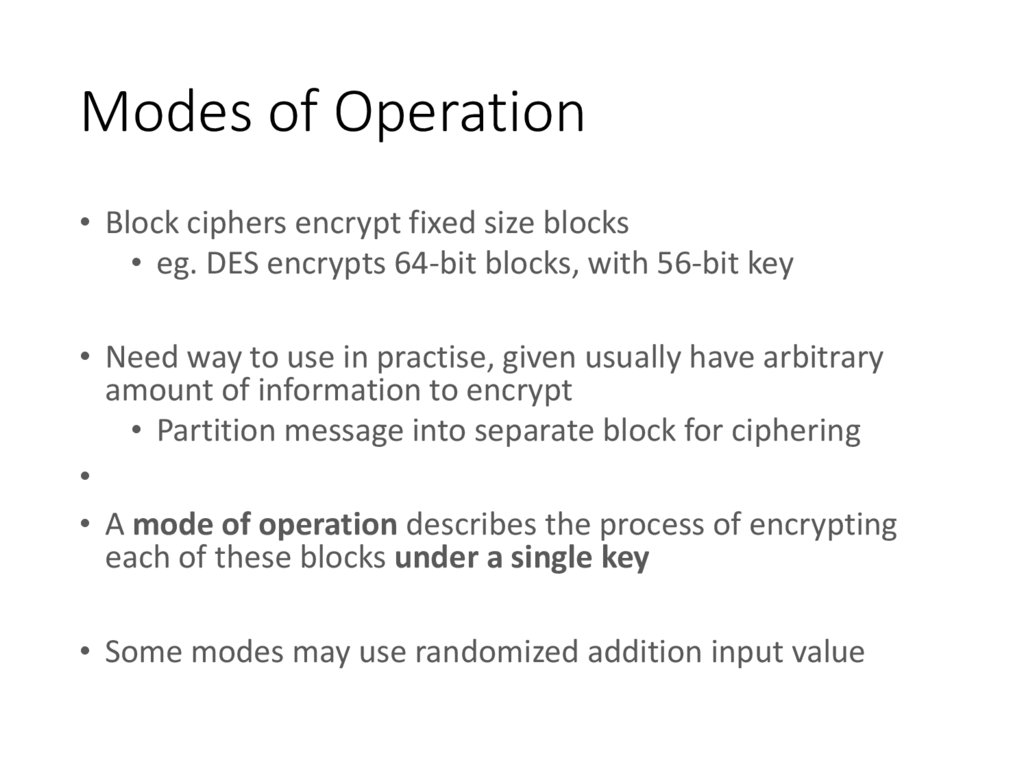
• Block ciphers encrypt fixed size blocks• eg. DES encrypts 64-bit blocks, with 56-bit key
• Need way to use in practise, given usually have arbitrary
amount of information to encrypt
• Partition message into separate block for ciphering
• A mode of operation describes the process of encrypting
each of these blocks under a single key
• Some modes may use randomized addition input value
3. Modes of Operation Taxonomy
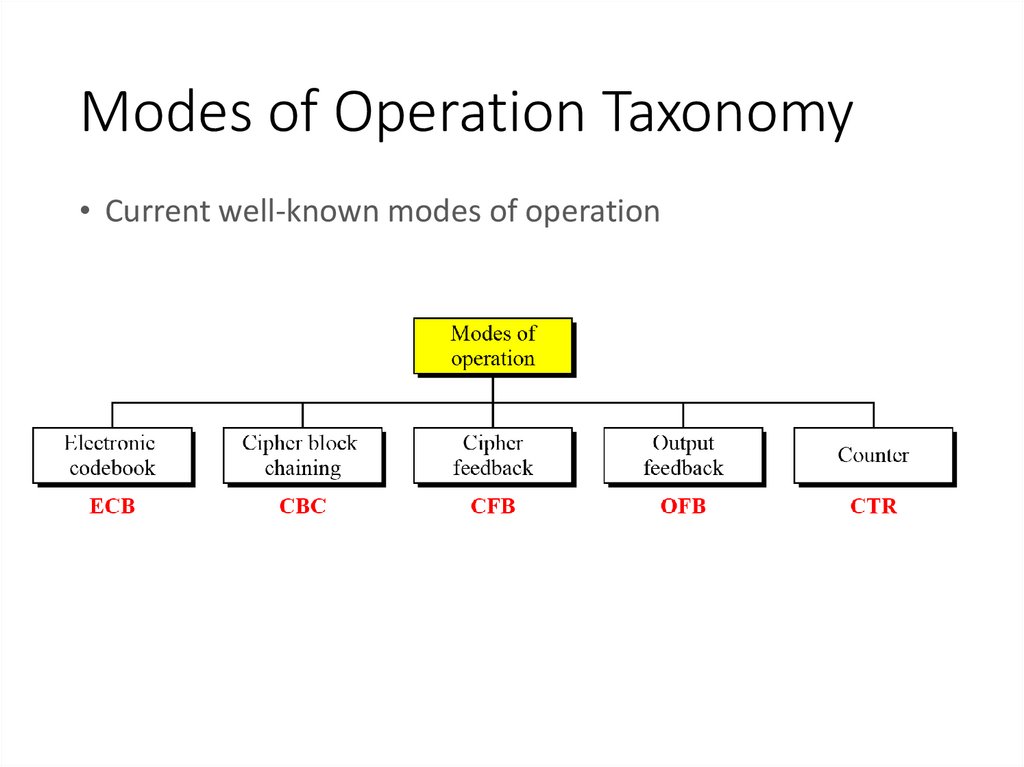
• Current well-known modes of operation4. Electronic Codebook Book (ECB)
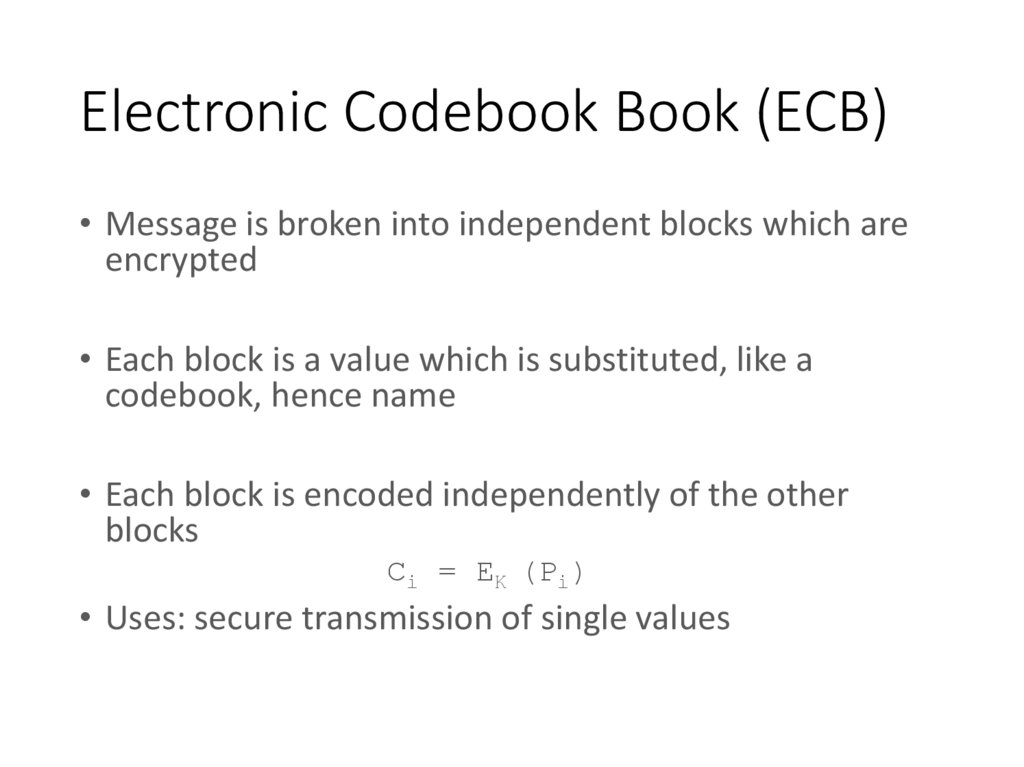
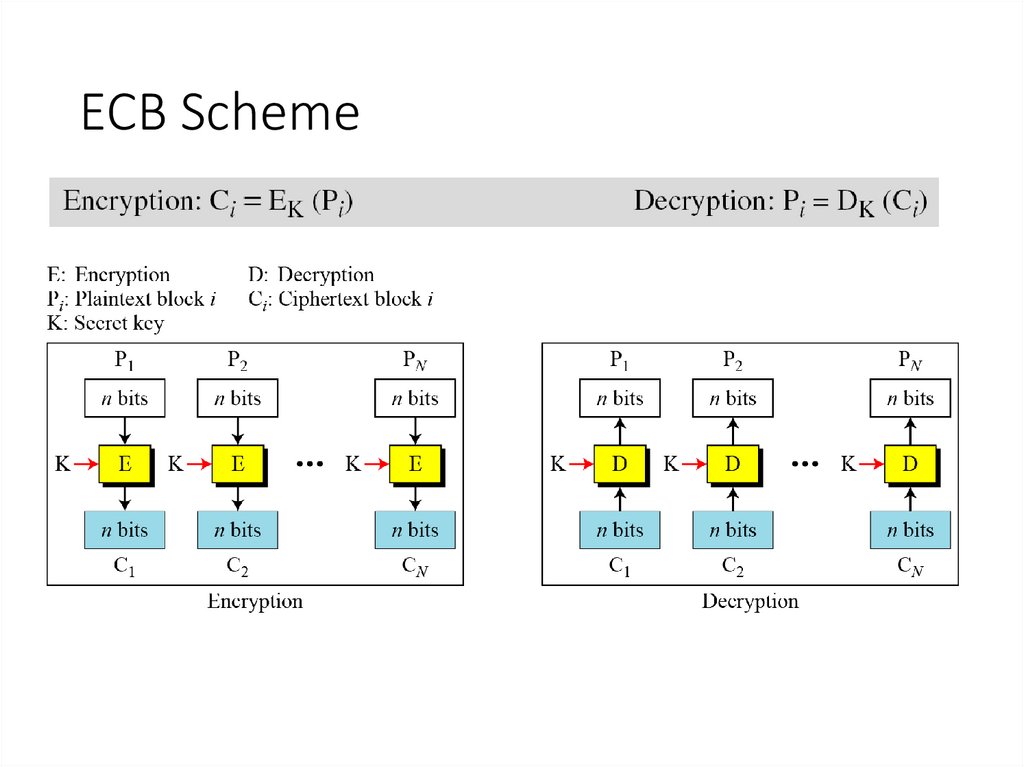
• Message is broken into independent blocks which areencrypted
• Each block is a value which is substituted, like a
codebook, hence name
• Each block is encoded independently of the other
blocks
Ci = EK (Pi)
• Uses: secure transmission of single values
5. ECB Scheme
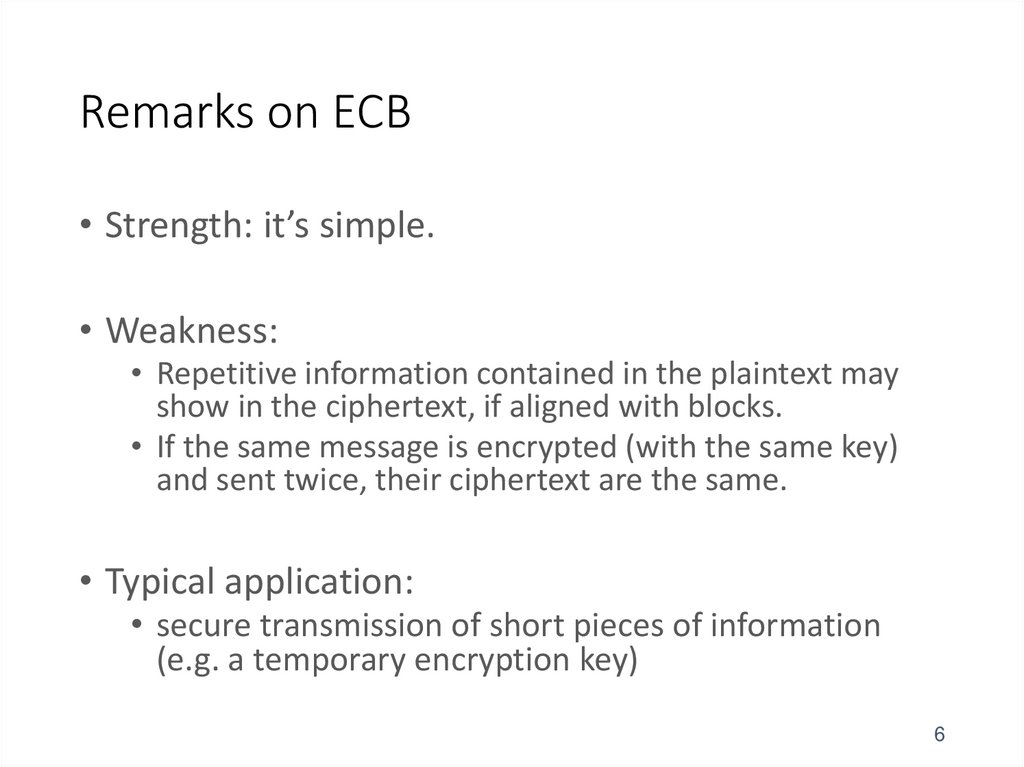
6. Remarks on ECB
• Strength: it’s simple.• Weakness:
• Repetitive information contained in the plaintext may
show in the ciphertext, if aligned with blocks.
• If the same message is encrypted (with the same key)
and sent twice, their ciphertext are the same.
• Typical application:
• secure transmission of short pieces of information
(e.g. a temporary encryption key)
6
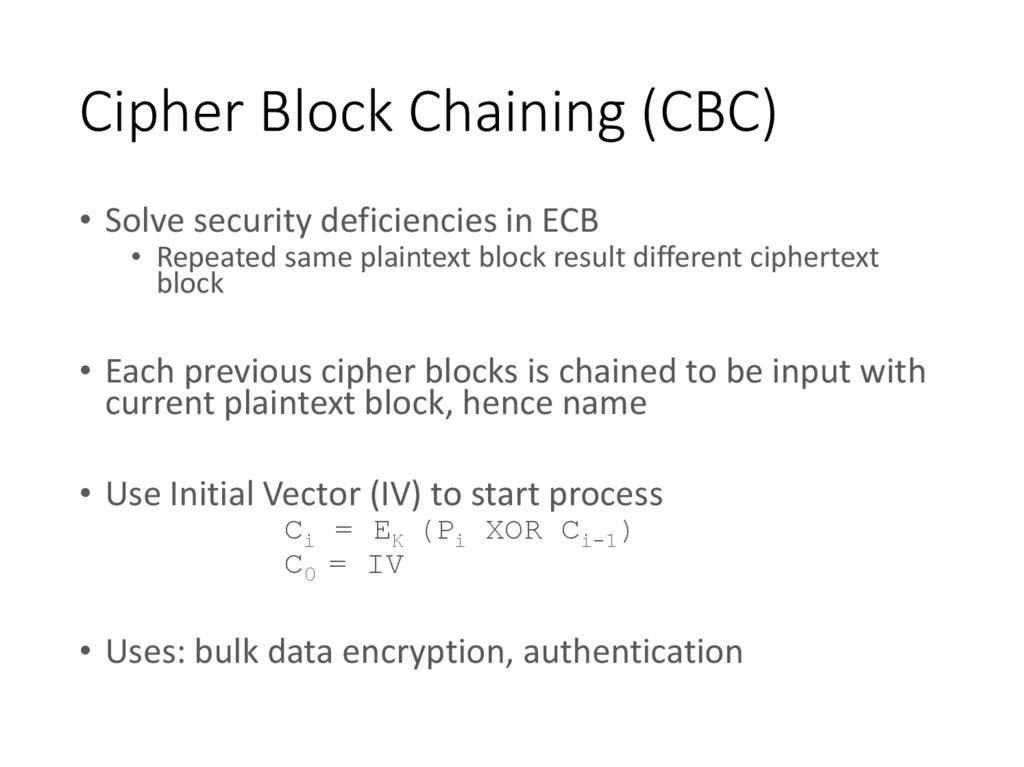
7. Cipher Block Chaining (CBC)
• Solve security deficiencies in ECB• Repeated same plaintext block result different ciphertext
block
• Each previous cipher blocks is chained to be input with
current plaintext block, hence name
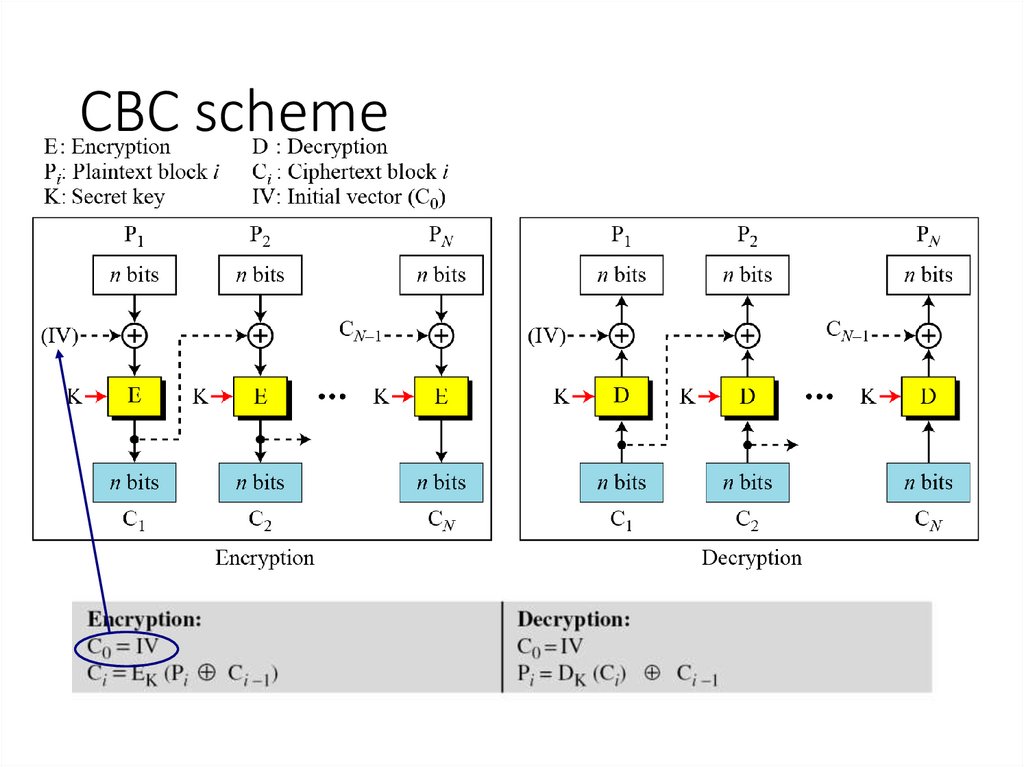
• Use Initial Vector (IV) to start process
Ci = EK (Pi XOR Ci-1)
C0 = IV
• Uses: bulk data encryption, authentication
8. CBC scheme
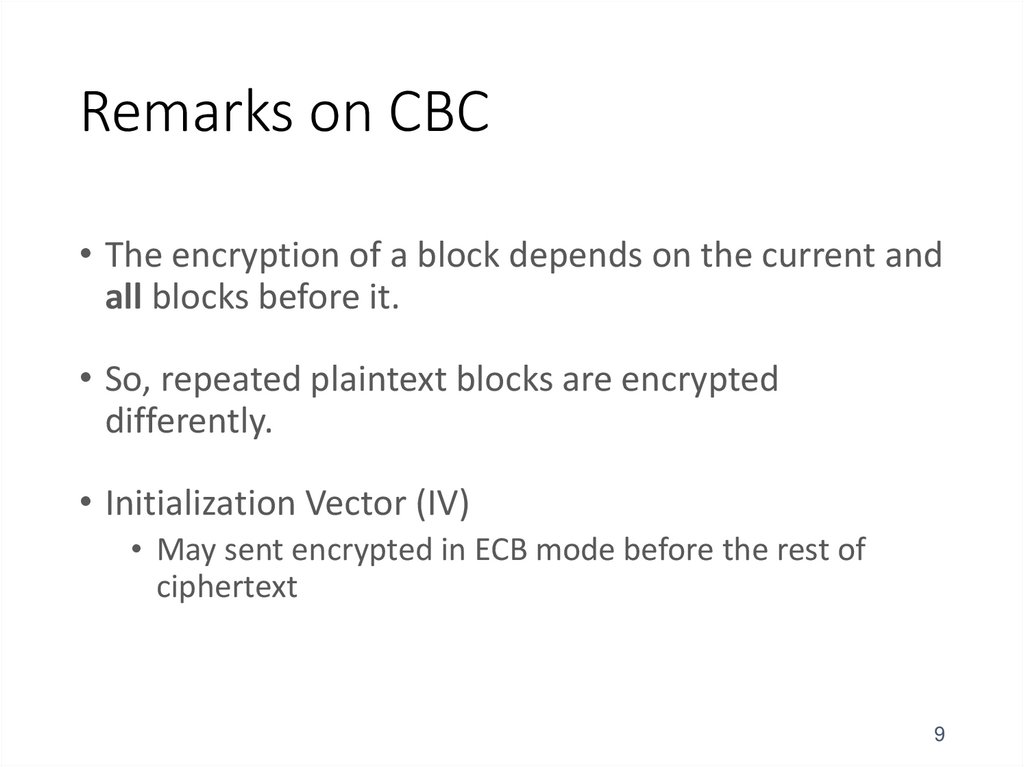
9. Remarks on CBC
• The encryption of a block depends on the current andall blocks before it.
• So, repeated plaintext blocks are encrypted
differently.
• Initialization Vector (IV)
• May sent encrypted in ECB mode before the rest of
ciphertext
9
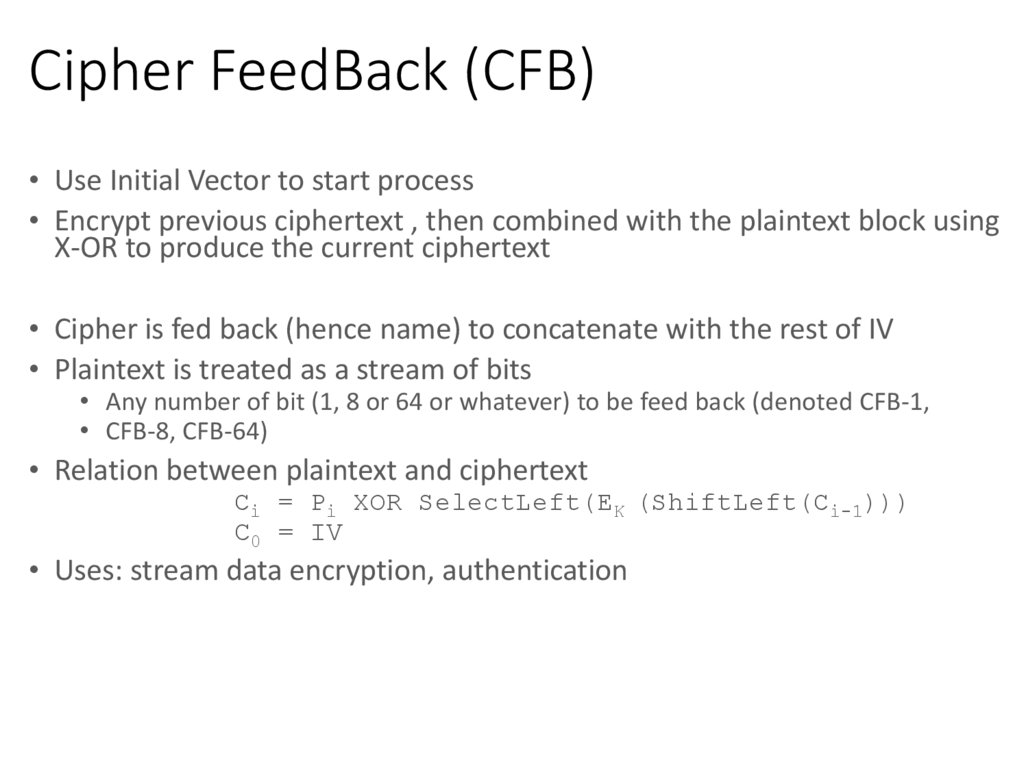
10. Cipher FeedBack (CFB)
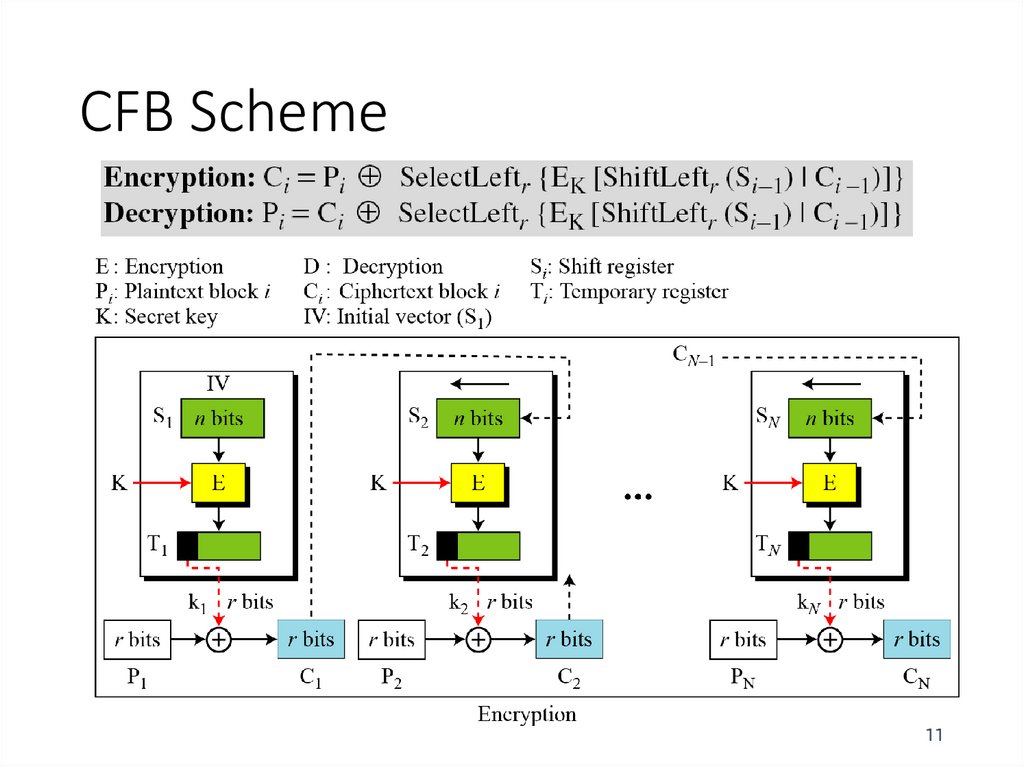
• Use Initial Vector to start process• Encrypt previous ciphertext , then combined with the plaintext block using
X-OR to produce the current ciphertext
• Cipher is fed back (hence name) to concatenate with the rest of IV
• Plaintext is treated as a stream of bits
• Any number of bit (1, 8 or 64 or whatever) to be feed back (denoted CFB-1,
• CFB-8, CFB-64)
• Relation between plaintext and ciphertext
Ci = Pi XOR SelectLeft(EK (ShiftLeft(Ci-1)))
C0 = IV
• Uses: stream data encryption, authentication
11. CFB Scheme
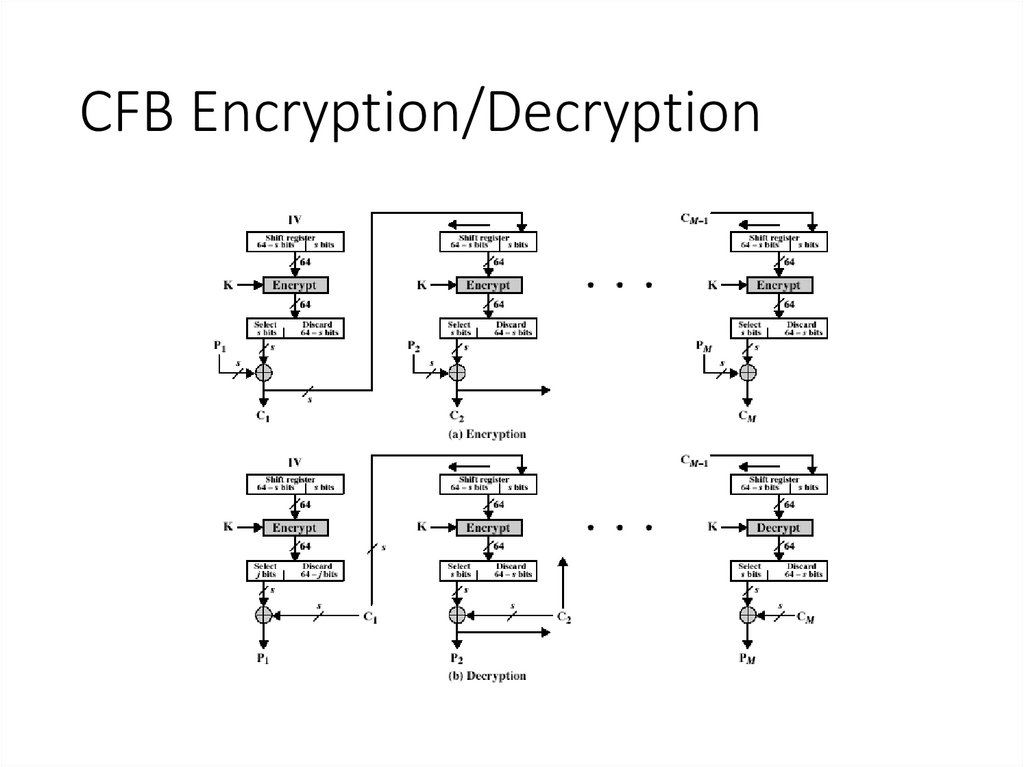
1112. CFB Encryption/Decryption
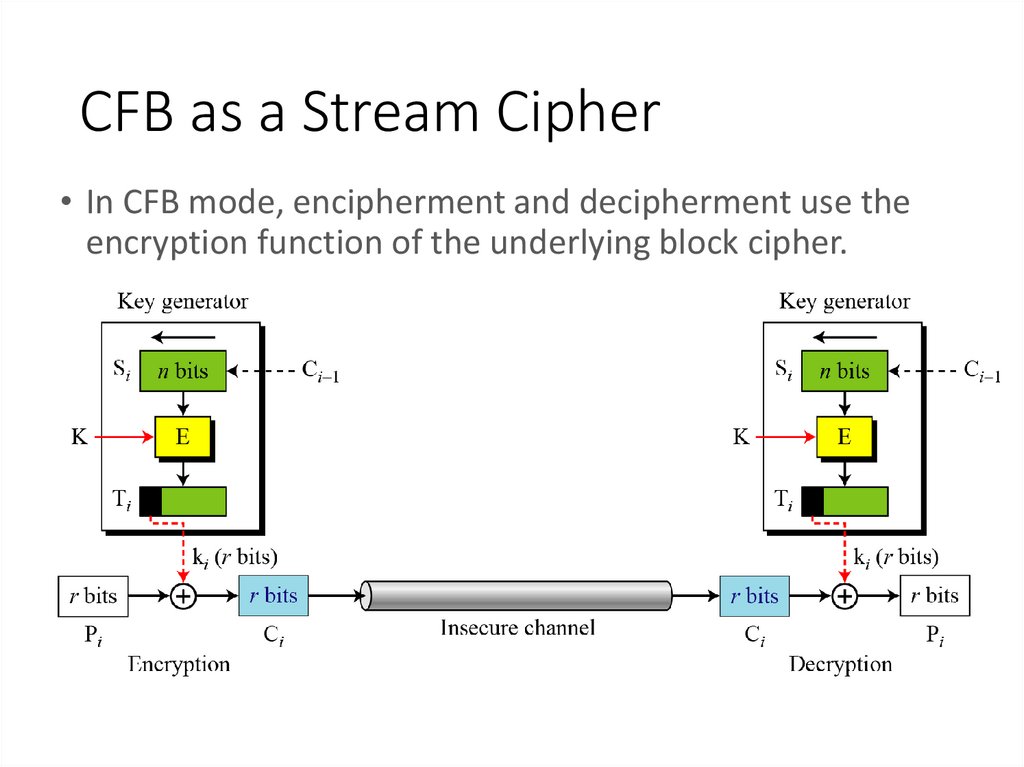
13. CFB as a Stream Cipher
• In CFB mode, encipherment and decipherment use theencryption function of the underlying block cipher.
14. Remark on CFB
• The block cipher is used as a stream cipher.• enable to encrypt any number of bits e.g. single bits or single characters
(bytes)
• S=1 : bit stream cipher
• S=8 : character stream cipher)
• A ciphertext segment depends on the current and all preceding
plaintext segments.
• A corrupted ciphertext segment during transmission will affect
the current and next several plaintext segments.
14
15. Output FeedBack (OFB)
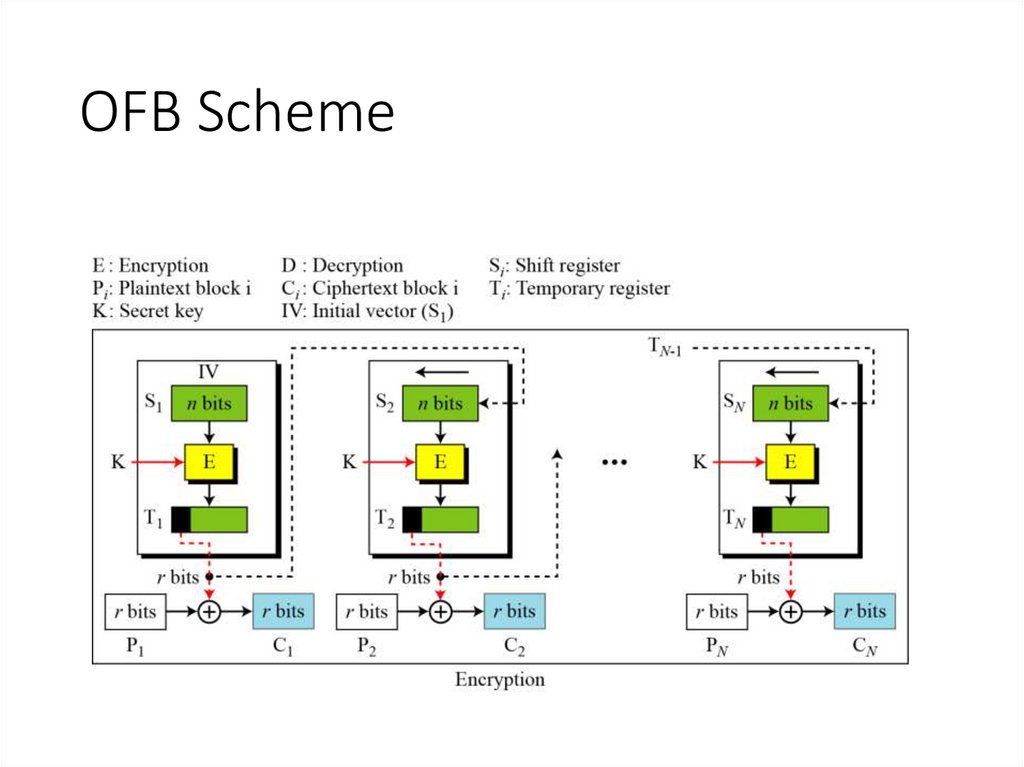
• Very similar to CFB• But output of the encryption function output of cipher is fed back
(hence name), instead of ciphertext
• Feedback is independent of message
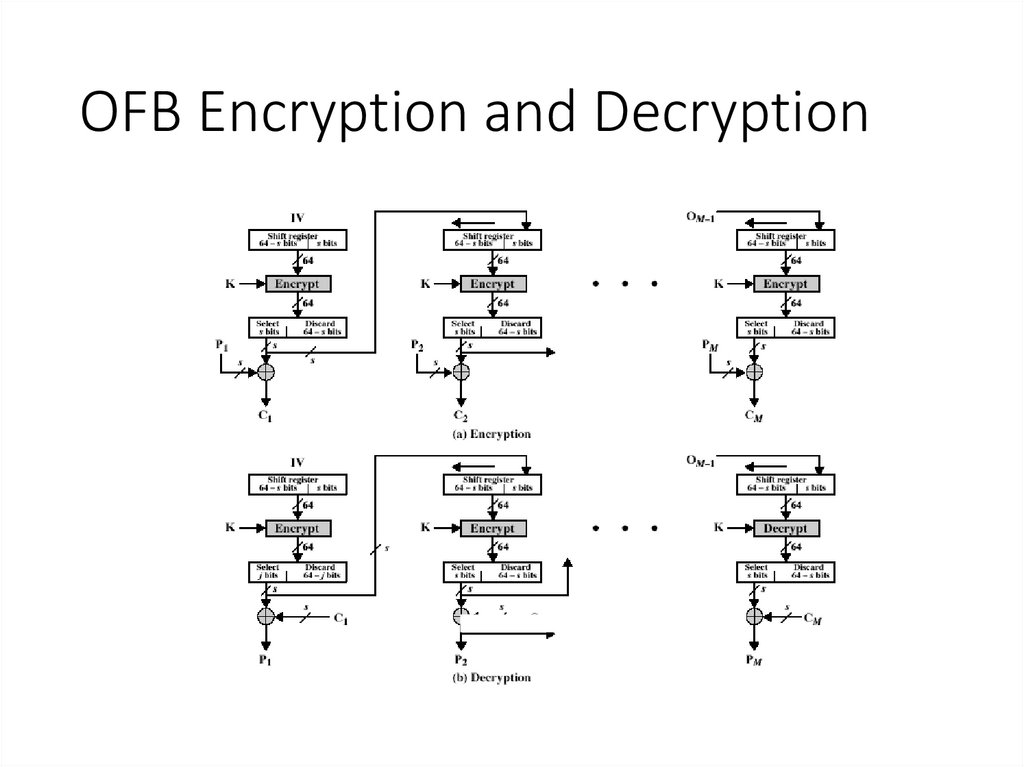
• Relation between plaintext and ciphertext
Ci = Pi XOR Oi
Oi = EK (Oi-1)
O0 = IV
• Uses: stream encryption over noisy channels
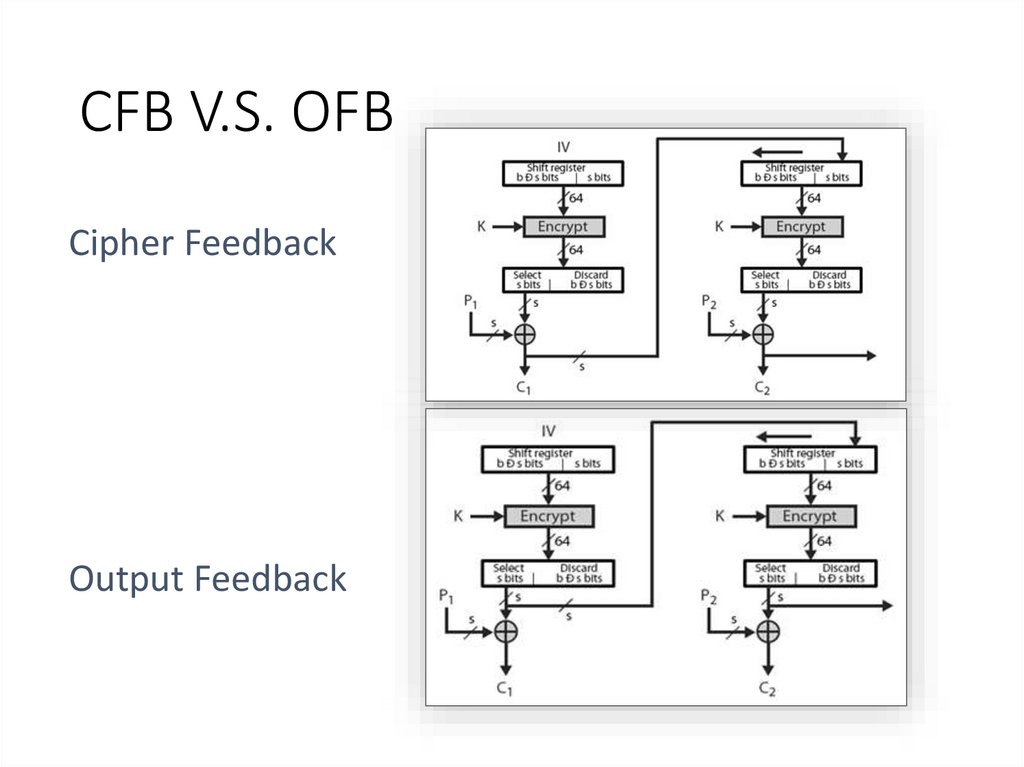
16. CFB V.S. OFB
Cipher FeedbackOutput Feedback
17. OFB Scheme
18. OFB Encryption and Decryption
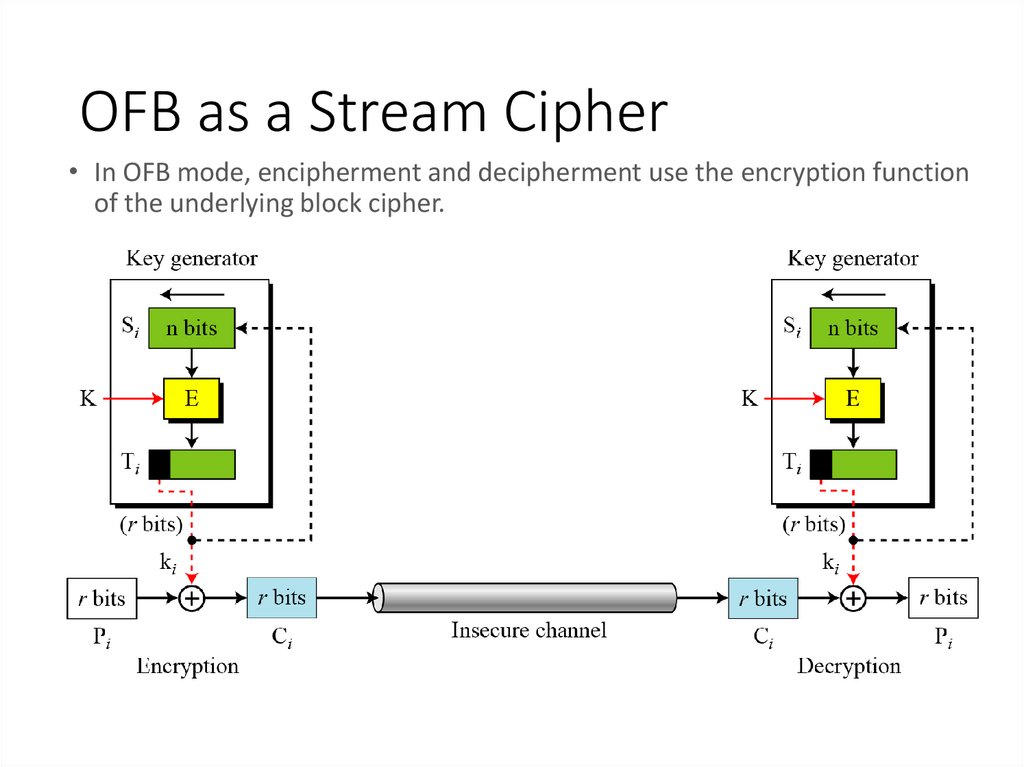
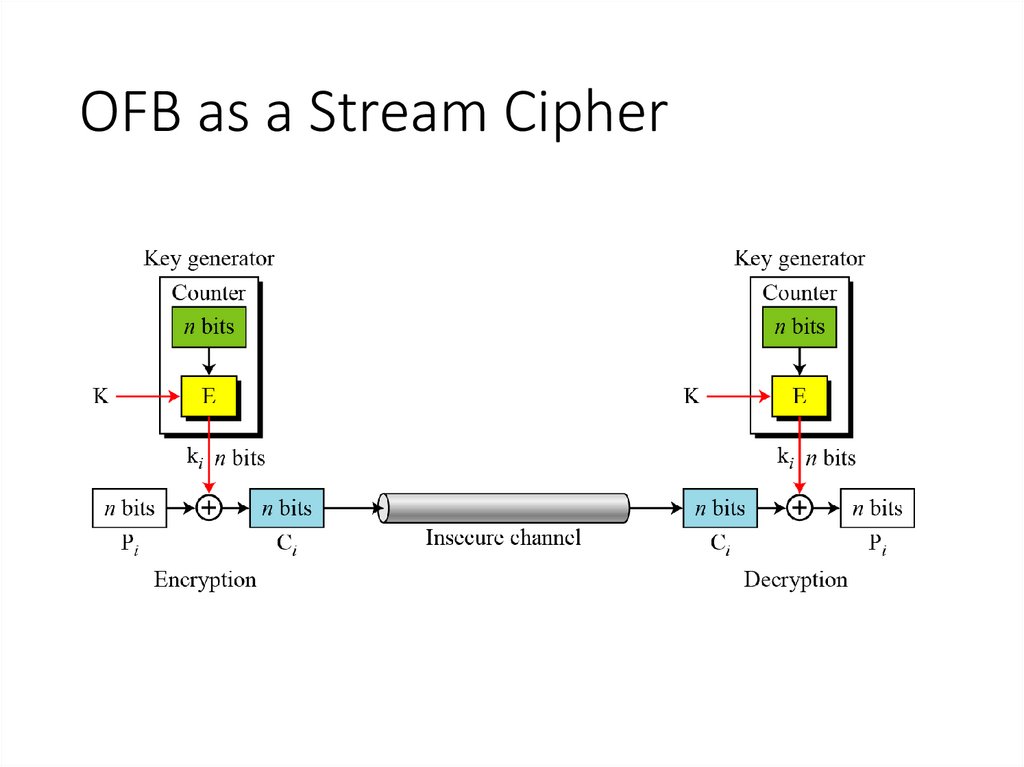
19. OFB as a Stream Cipher
• In OFB mode, encipherment and decipherment use the encryption functionof the underlying block cipher.
20. Remarks on OFB
• Each bit in the ciphertext is independent of the previous bitor bits. This avoids error propagation
• Pre-compute of forward cipher is possible
• Security issue
• when jth plaintext is known, the jth output of the forward cipher
function will be known
• Easily cover jth plaintext block of other message with the same IV
• Require that the IV is a nonce
21. Counter (CTR)
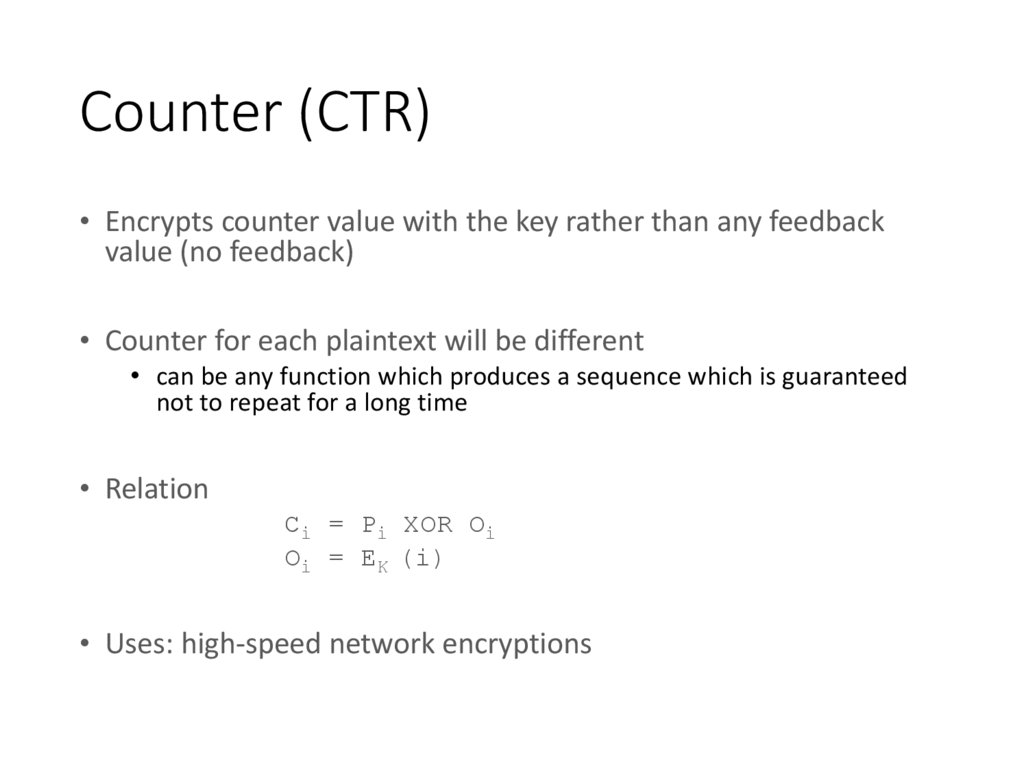
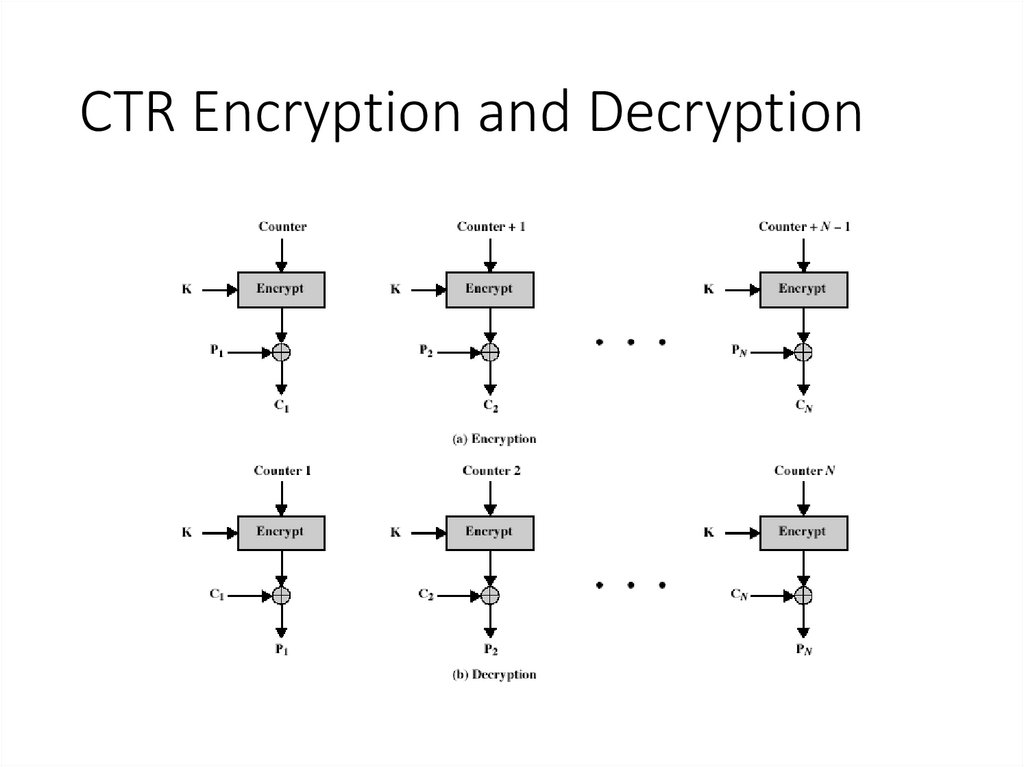
• Encrypts counter value with the key rather than any feedbackvalue (no feedback)
• Counter for each plaintext will be different
• can be any function which produces a sequence which is guaranteed
not to repeat for a long time
• Relation
Ci = Pi XOR Oi
Oi = EK (i)
• Uses: high-speed network encryptions