Похожие презентации:






Therapeutic_Exercise_The_Cornerstone_of_Physical_Rehabilitation
1.
Therapeutic Exercise: TheCornerstone of Physical
Rehabilitation
2.
Understanding Therapeutic Exercise:Definition and Core Principles
Therapeutic exercise is a systematic, planned performance of bodily movements, postures, or
physical activities. It aims to:
Restore Function
Improve strength, flexibility, balance, and coordination.
Reduce Pain
Alleviate discomfort and promote healing.
Prevent Disability
Minimize long-term impairments and complications.
Enhance Overall Health
Improve cardiovascular fitness and well-being.
3.
Classification of Therapeutic Exercises: Categories andExamples
Therapeutic exercises are broadly categorized based on their purpose and mechanics.
1
Range of Motion (ROM) Exercises
Maintain or increase joint flexibility. Example: Passive knee flexion.
2
Strengthening Exercises
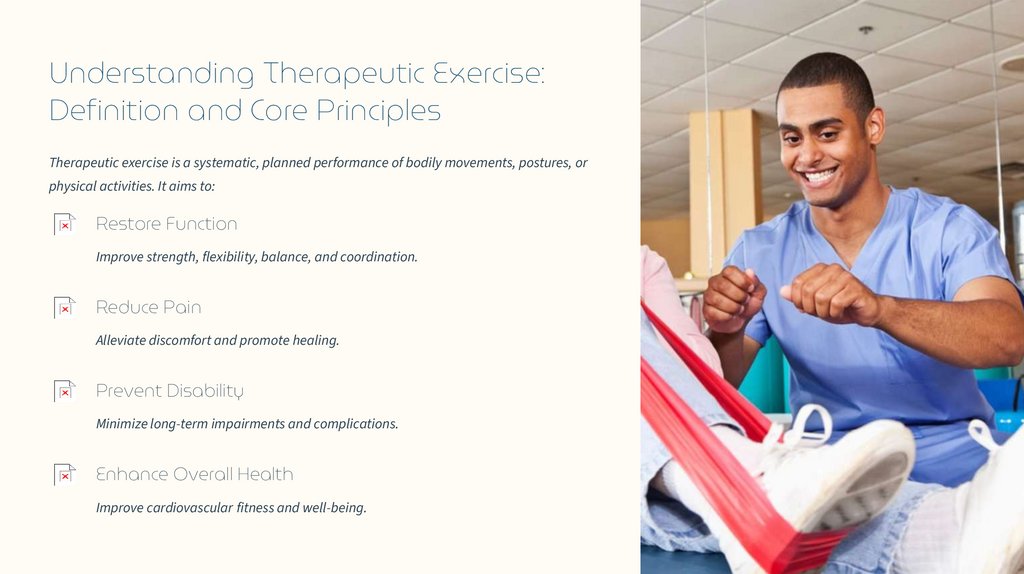
Increase muscle force production. Example: Resistance band bicep curls.
3
Balance and Proprioception
Improve stability and body awareness. Example: Single-leg stance.
4
Endurance Training
Enhance cardiovascular and muscular stamina. Example: Stationary cycling.
4.
Early Rehabilitation Period: Focus on Pain Management andGentle Mobilization
This initial phase, often immediately post-injury or surgery,
prioritizes reducing pain, minimizing swelling, and protecting the
injured tissue. Exercises are typically low intensity and focus on
restoring basic movement.
Gentle passive or active-assisted range of motion
Isometric contractions to maintain muscle activation without
joint movement
Light cardiovascular exercise (e.g., upper body ergometer if
lower limb injury)
Intensity: Very low, pain-free movements only.
5.
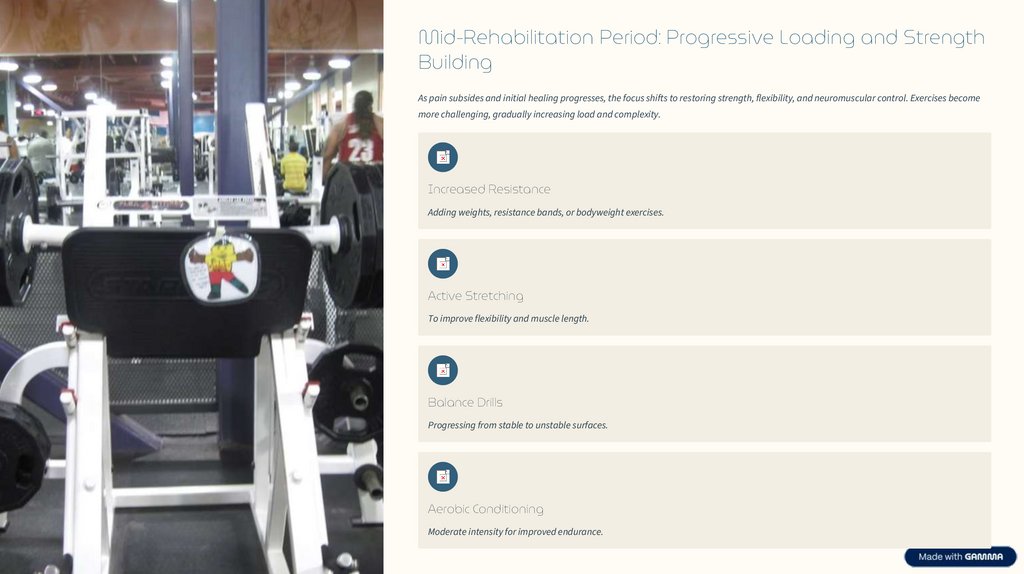
Mid-Rehabilitation Period: Progressive Loading and StrengthBuilding
As pain subsides and initial healing progresses, the focus shifts to restoring strength, flexibility, and neuromuscular control. Exercises become
more challenging, gradually increasing load and complexity.
Increased Resistance
Adding weights, resistance bands, or bodyweight exercises.
Active Stretching
To improve flexibility and muscle length.
Balance Drills
Progressing from stable to unstable surfaces.
Aerobic Conditioning
Moderate intensity for improved endurance.
6.
Late Rehabilitation Period: Return to Function and Sport-Specific TrainingThe final stage of rehabilitation prepares the individual for a full return to their desired activities, including sports or demanding occupational tasks. Exercises mimic real-world movements and require high levels of strength, power, and agility.
Plyometric exercises (jumping, hopping)
Agility drills and change of direction
Sport-specific or activity-specific simulations
Advanced balance and coordination tasks
Intensity: High, mirroring demands of target activity.
7.
Intensity Progression: Matching Exercise to Recovery StageThe intensity of therapeutic exercise must be carefully graded to optimize recovery and prevent re-injury.
Acute Phase (Early Rehab)
Low intensity, pain-free movements, focus on
protection and inflammation control.
Subacute Phase (Mid Rehab)
Moderate intensity, progressive loading,
restoring full ROM and strength.
Chronic Phase (Late Rehab)
High intensity, functional and sport-specific
training, maximizing performance.
8.
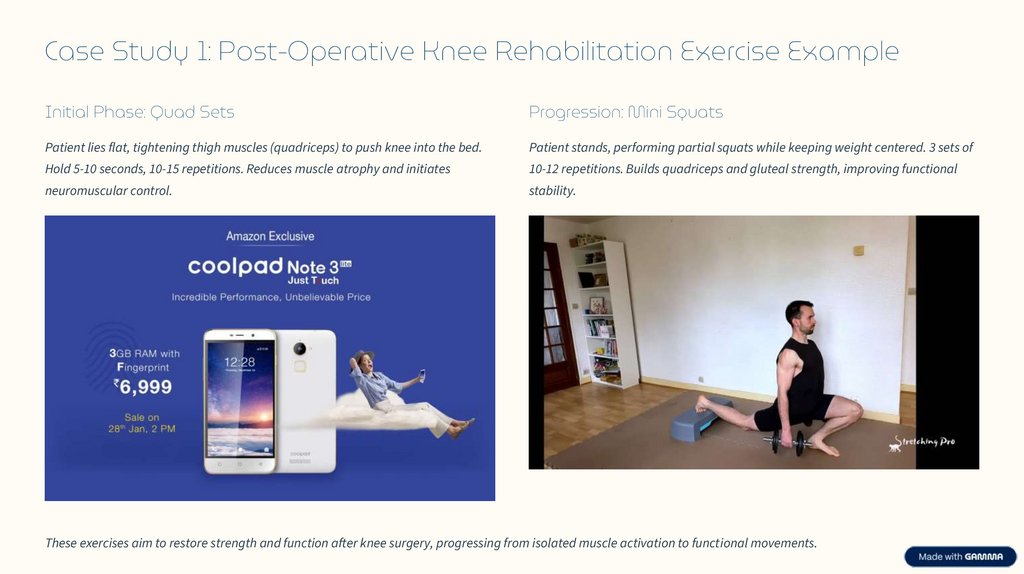
Case Study 1: Post-Operative Knee Rehabilitation Exercise ExampleInitial Phase: Quad Sets
Progression: Mini Squats
Patient lies flat, tightening thigh muscles (quadriceps) to push knee into the bed.
Patient stands, performing partial squats while keeping weight centered. 3 sets of
Hold 5-10 seconds, 10-15 repetitions. Reduces muscle atrophy and initiates
10-12 repetitions. Builds quadriceps and gluteal strength, improving functional
neuromuscular control.
stability.
These exercises aim to restore strength and function after knee surgery, progressing from isolated muscle activation to functional movements.
9.
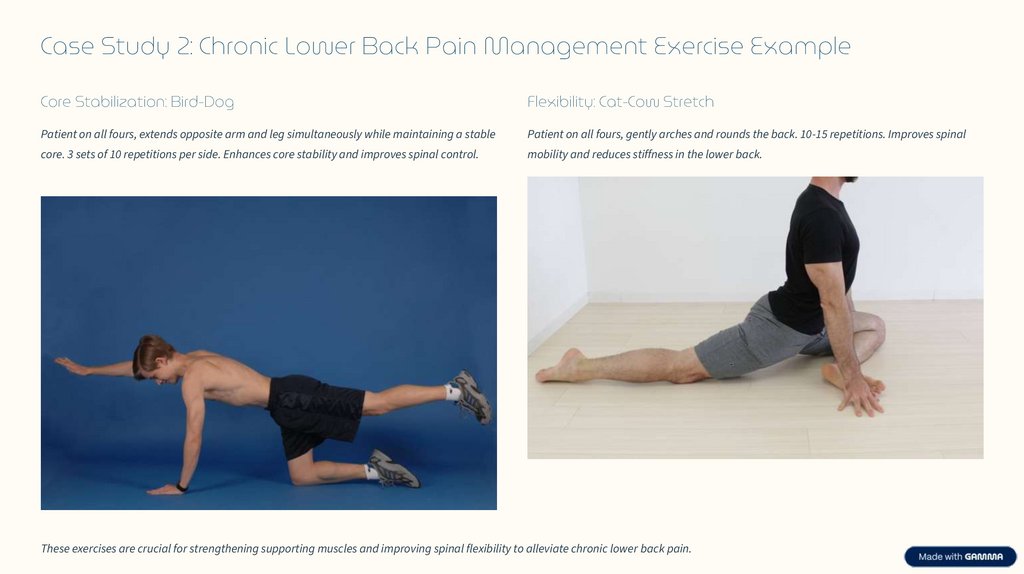
Case Study 2: Chronic Lower Back Pain Management Exercise ExampleCore Stabilization: Bird-Dog
Flexibility: Cat-Cow Stretch
Patient on all fours, extends opposite arm and leg simultaneously while maintaining a stable
Patient on all fours, gently arches and rounds the back. 10-15 repetitions. Improves spinal
core. 3 sets of 10 repetitions per side. Enhances core stability and improves spinal control.
mobility and reduces stiffness in the lower back.
These exercises are crucial for strengthening supporting muscles and improving spinal flexibility to alleviate chronic lower back pain.
10.
References: Evidence-BasedSources for Therapeutic Exercise
The principles and methods discussed are grounded in established scientific and
medical literature.
American Physical Therapy Association (APTA) - Provides clinical guidelines and
evidence-based practice resources.
Cochrane Library - A collection of databases containing high-quality,
independent evidence to inform healthcare decision-making.
Journal of Orthopaedic & Sports Physical Therapy (JOSPT) - Peer-reviewed
research on musculoskeletal rehabilitation.
Physiopedia: Therapeutic Exercise - An open-access resource for evidencebased physiotherapy knowledge.
World Health Organization (WHO) - Physical Activity - Recommendations on
physical activity for health.