 Медицина
Похожие презентации:








Parfocal
1. Parfocal
Presented by:Samokhvalova
Evgeniia
Smirnov Vladislav
Rogacheva Elisabeth
2. Abstract
Parfocal is an innovative implantable opticalsystem that completely repeats the geometry of
the human eye, but is equipped with adaptive
lenses with variable focal length and a neural
interface for controlling focusing with the
power of thought. The device is designed to
completely replace the lens and restore the
natural accommodation lost with age or due to
diseases
3. Main technical characteristics
• Dimensions: Full biomimetic compliance with thenative eye (diameter ≈24 mm, volume ≈6.5 ml).
• Optical system: Liquid crystal or hydrogel
adaptive lenses with electro-optical effect.
• Focus control: A neural interface that reads
signals from the ciliary muscle or visual
cortex.
• Power source: Built-in bioaccumulator with
wireless charging (induction technology).
• Service life: >20 years.
4. Medical aspects and problems
Possibilities:Restoration of accommodation in presbyopia («age-related hyperopia»).
Correction of ametropia (myopia, hyperopia, astigmatism) with dynamic
adjustment.
Potential integration with retinal neuroprosthetics.
Critical issues:
Biocompatibility: Risk of inflammation, fibrosis, rejection. Inert materials
(polymers, special quartz glass) are required.
Surgical implantation: Accuracy of placement, risk of damage to the lens
capsule, intraoperative infections.
Neurointerface: The need to decode focus intentions without invasive
intervention in the brain. An alternative is to read the signals of the
ciliary muscle through the BCI (brain-computer interface).
Long-term effects: The possibility of developing secondary cataracts,
disorders of the blood-ophthalmic barrier.
Tissue regeneration: The implant should not interfere with the natural
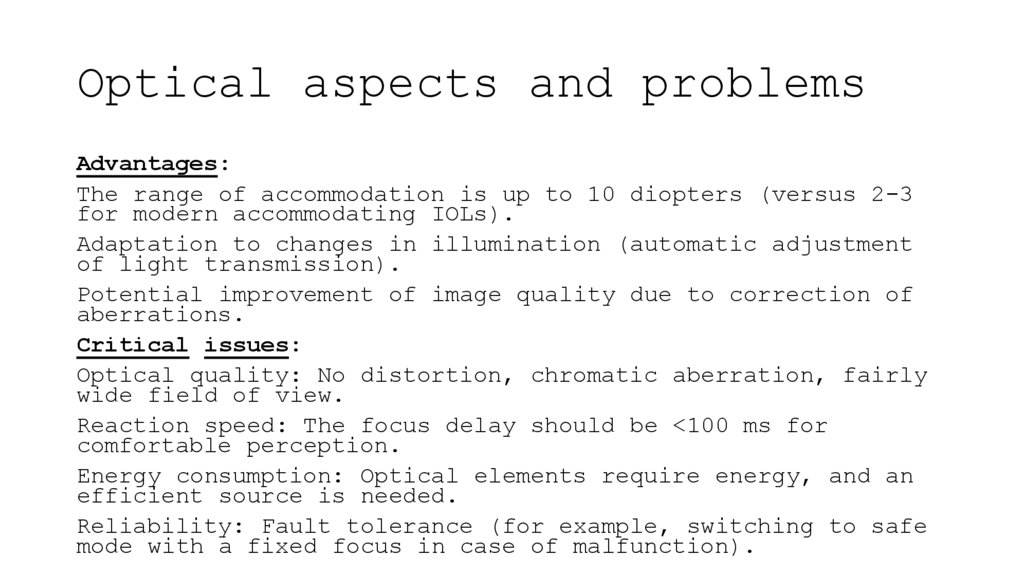
5. Optical aspects and problems
Advantages:The range of accommodation is up to 10 diopters (versus 2-3
for modern accommodating IOLs).
Adaptation to changes in illumination (automatic adjustment
of light transmission).
Potential improvement of image quality due to correction of
aberrations.
Critical issues:
Optical quality: No distortion, chromatic aberration, fairly
wide field of view.
Reaction speed: The focus delay should be <100 ms for
comfortable perception.
Energy consumption: Optical elements require energy, and an
efficient source is needed.
Reliability: Fault tolerance (for example, switching to safe
mode with a fixed focus in case of malfunction).
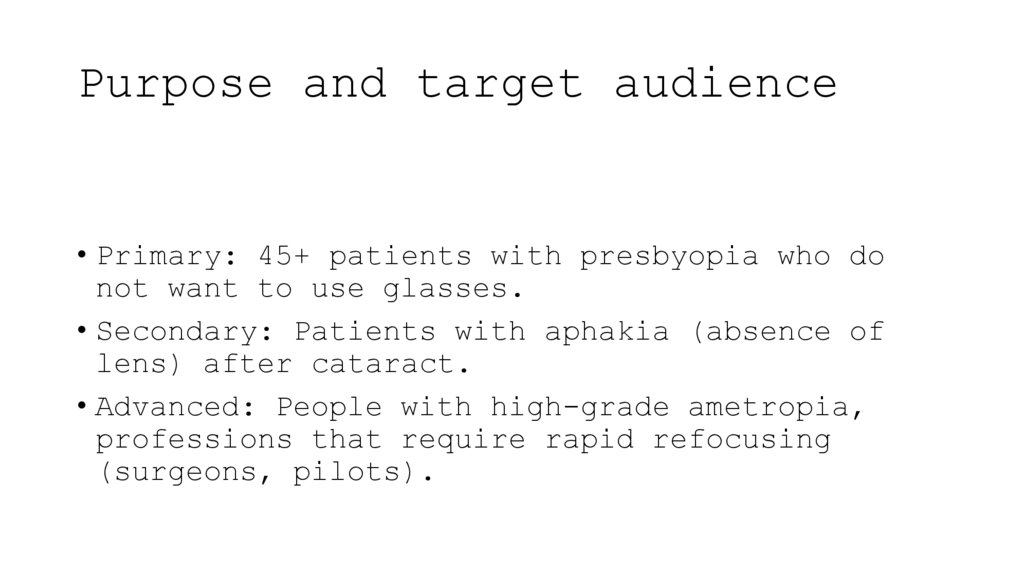
6. Purpose and target audience
• Primary: 45+ patients with presbyopia who donot want to use glasses.
• Secondary: Patients with aphakia (absence of
lens) after cataract.
• Advanced: People with high-grade ametropia,
professions that require rapid refocusing
(surgeons, pilots).
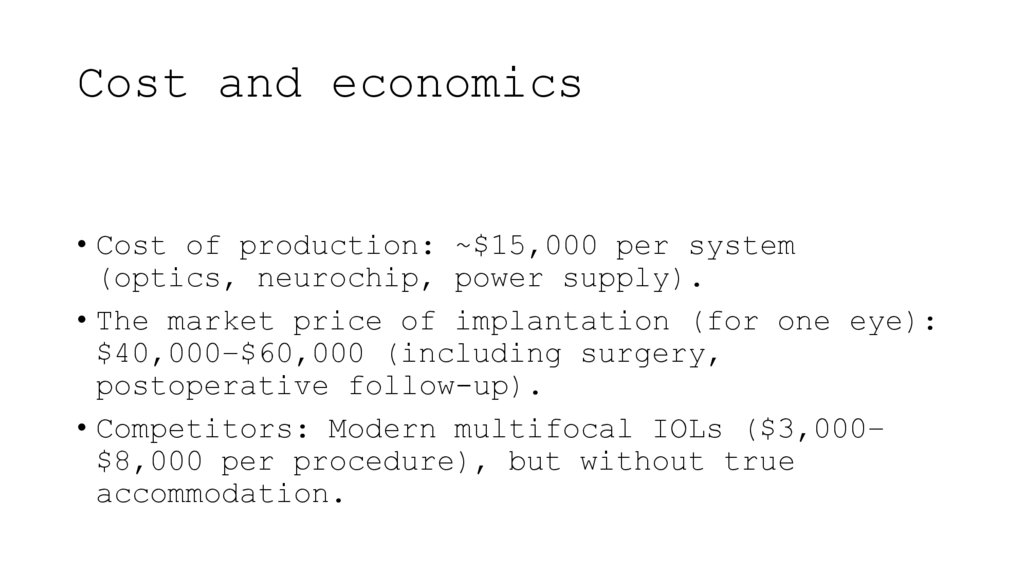
7. Cost and economics
• Cost of production: ~$15,000 per system(optics, neurochip, power supply).
• The market price of implantation (for one eye):
$40,000–$60,000 (including surgery,
postoperative follow-up).
• Competitors: Modern multifocal IOLs ($3,000–
$8,000 per procedure), but without true
accommodation.
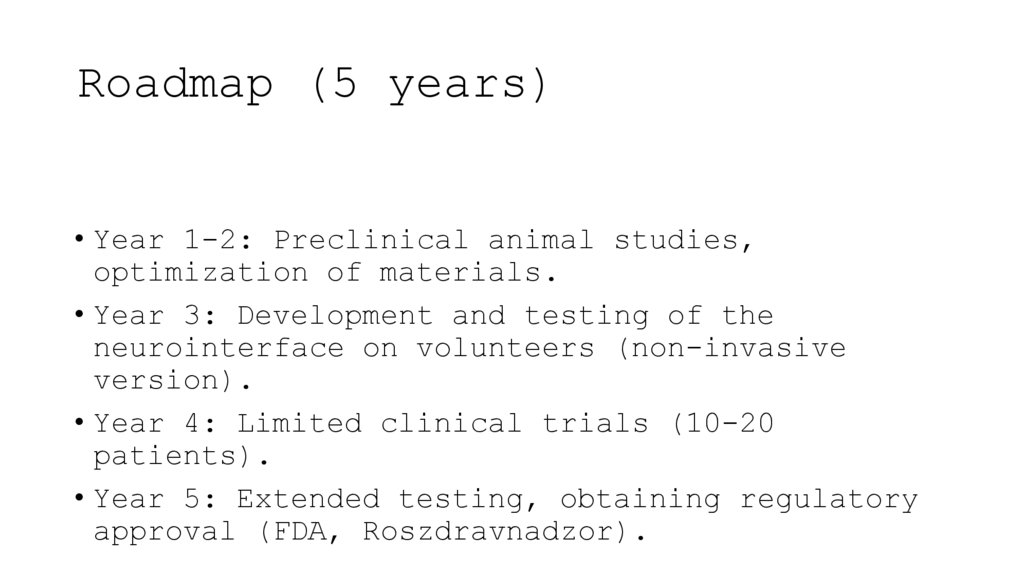
8. Roadmap (5 years)
• Year 1-2: Preclinical animal studies,optimization of materials.
• Year 3: Development and testing of the
neurointerface on volunteers (non-invasive
version).
• Year 4: Limited clinical trials (10-20
patients).
• Year 5: Extended testing, obtaining regulatory
approval (FDA, Roszdravnadzor).
9. Parfocal is a project at the intersection of ophthalmology, neurotechnology and optics, capable of revolutionizing vision
correction.Despite the serious technical and medical
challenges, the potential benefits for millions
of patients justify a thorough study of every
aspect. The success of the project depends on
interdisciplinary collaboration and strict
adherence to bioethical standards.
10. Possible questions
• Technical• Medical
• Social and ethical
• Practical