


Похожие презентации:

lecture 2- classification of phonemes
1. Lecture 2 ”Classification of phonemes”
2. Lecture 2 “Phonemes and mechanisms of speech sounds”
1) Articulatory and physiologicalmechanisms of speech sounds
2) The meaning of the phoneme
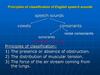
3) Classification of the phonemes
3. 1. Articulatory and physiological mechanisms of speech sounds
Wh at can n ot b e sp eechformed with ou t from
p hysiolog ical viewp oin t?
4. 4 basic speech mechanisms
Power M.Vibrator M.
Resonator M.
Obstructer M.
5. Power mechanism
Can you n ame?1
2
3
4
5 1) Diaphragm
6
[‘daiәfrǣm]
7
6. Power mechanism
Can you n ame?1
1) Diaphragm
2
[‘daiәfǣm]
3
42) Bronchi [ˈbrɒŋkaɪ]
3) Windpipe
5
6
4) Glottis
7
5) Larynx
6) Mouth cavity
7-8 Nasal cavity
7. Vibrator mechanism
Con sists of vocal cord sWh at are th e vocal cord s?
Vocal cord s are two h orizon tal fold s
of elastic tissu e (Leon tieva )
8. What is the average cord vibration per second for the man and women?
a) 130 – man, 230- womanb) 230-man, 130- woman
c) 250-man, 150- woman
d) 150-man, 250-woman
9. What is the average cord vibration per second for the man and women?
a) 130 – man, 230- womanb) 230-man, 130- woman
c) 250-man, 150- woman
d) 150-man, 250-woman
10. Resonator mechanism
con sists of:th e p h aryn x,
th e laryn x,
th e mou th cavity
th e n asal cavity.
11. Resonator mechanism
12. Obstructer mechanism
con sists of th e ton gu e (blad e with th etip, fron t, b ack ):
th e lip s,
th e teeth ,
th e soft p alate with th e u vu la,
th e h ard p alate,
th e alveolar rid ge.
13. Obstructer mechanism
Match, please:-Blade with the tip of the
tongue
-Back of the tongue/dorsum
-front of the tongue
-lips
-teeth
-uvula
-soft palate
-hard palate
-alveolar ridge
14. Obstructer mechanism
Match, please:-Blade with the tip of the
tongue
-Back of the tongue/dorsum
-front of the tongue
-lips
-teeth
-uvula
-soft palate
-hard palate
-alveolar ridge
15. 2. The meaning of the phoneme
Phoneme is …16. Classical definition of the phoneme (V.A. Vassilyev)
17.
18.
Why d o we n eedp h on emes?
19. 3 articulatory criteria:
Articulatory differences between vowels,consonants and sonorants depend on the 3
articulatory criteria:
1. the presence or absence of an articulatory
obstruction to the air stream in the larynx;
2. the concentrated or diffused character of
mu scu lar ten sion ;
3. the force of exh alation .
20. 3. Classification of phonemes
VowelsConsonants
Sonorants