 Английский язык
Похожие презентации:








Language Coaching Training
1.
Language Coaching Training2.
Personal experience3.
4.
What is coaching?5.
What is language coaching?https://www.youtube.com/watch?time_continue=5&v=DDuC-tUmEWo
6.
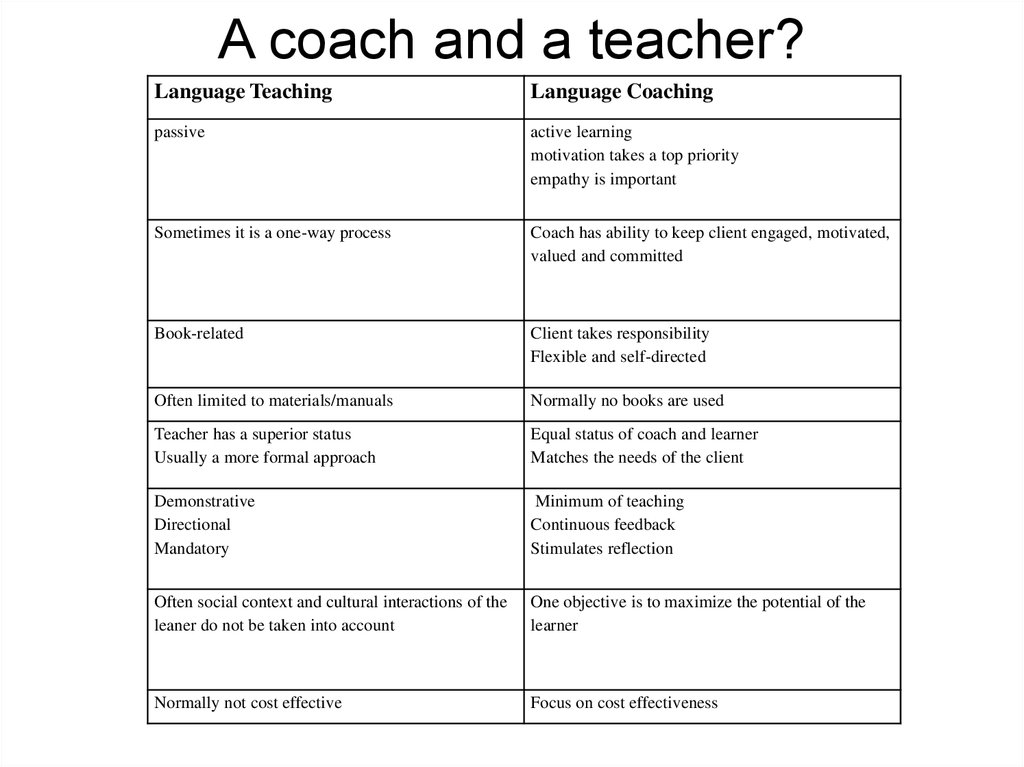
A coach and a teacher?Language Teaching
Language Coaching
passive
active learning
motivation takes a top priority
empathy is important
Sometimes it is a one-way process
Coach has ability to keep client engaged, motivated,
valued and committed
Book-related
Client takes responsibility
Flexible and self-directed
Often limited to materials/manuals
Normally no books are used
Teacher has a superior status
Usually a more formal approach
Equal status of coach and learner
Matches the needs of the client
Demonstrative
Directional
Mandatory
Minimum of teaching
Continuous feedback
Stimulates reflection
Often social context and cultural interactions of the
leaner do not be taken into account
One objective is to maximize the potential of the
learner
Normally not cost effective
Focus on cost effectiveness
7.
8.
9.
Agenda10.
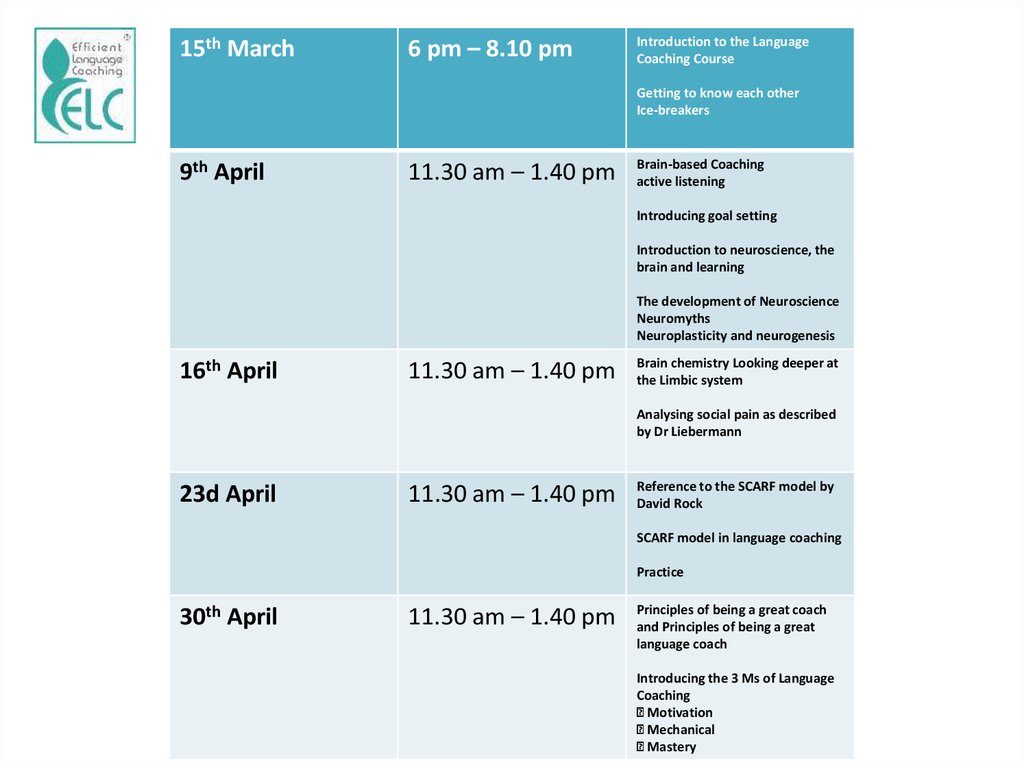
15th March6 pm – 8.10 pm
Introduction to the Language
Coaching Course
Getting to know each other
Ice-breakers
9th April
11.30 am – 1.40 pm
Brain-based Coaching
active listening
Introducing goal setting
Introduction to neuroscience, the
brain and learning
The development of Neuroscience
Neuromyths
Neuroplasticity and neurogenesis
16th April
11.30 am – 1.40 pm
Brain chemistry Looking deeper at
the Limbic system
Analysing social pain as described
by Dr Liebermann
23d April
11.30 am – 1.40 pm
Reference to the SCARF model by
David Rock
SCARF model in language coaching
Practice
30th April
11.30 am – 1.40 pm
Principles of being a great coach
and Principles of being a great
language coach
Introducing the 3 Ms of Language
Coaching
Motivation
Mechanical
Mastery