
 Промышленность
Похожие презентации:



Metallurgical processes in welding
1.
Metallurgical processes in weldingThe work was prepared by
Students of group 1-24
Kovalchuk N.A.
Ivanov A.S.
2.
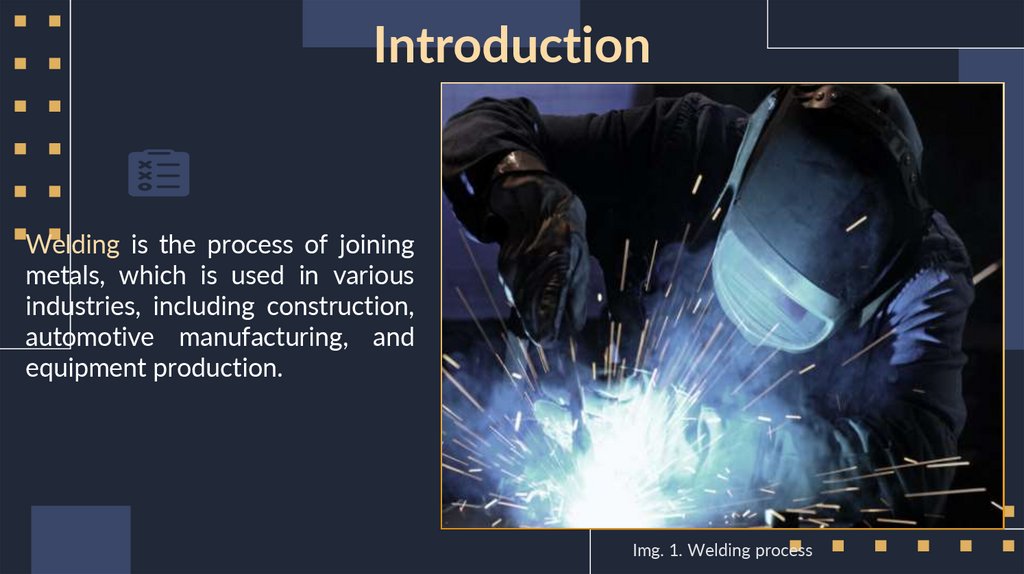
IntroductionWelding is the process of joining
metals, which is used in various
industries, including construction,
automotive manufacturing, and
equipment production.
Img. 1. Welding process
3.
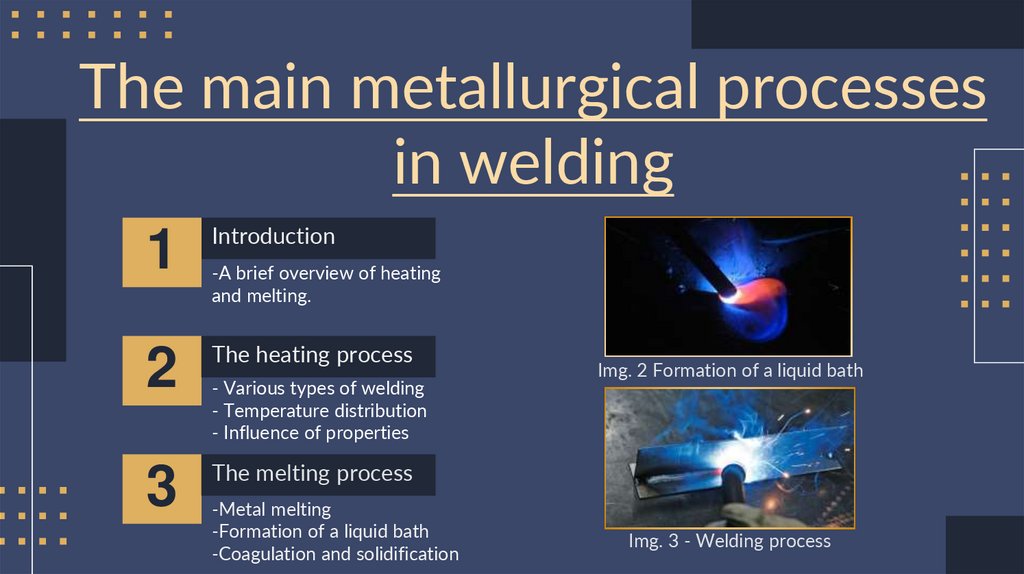
The main metallurgical processesin welding
1
Introduction
2
The heating process
3
The melting process
-A brief overview of heating
and melting.
- Various types of welding
- Temperature distribution
- Influence of properties
-Metal melting
-Formation of a liquid bath
-Coagulation and solidification
Img. 2 Formation of a liquid bath
Img. 3 - Welding process
4.
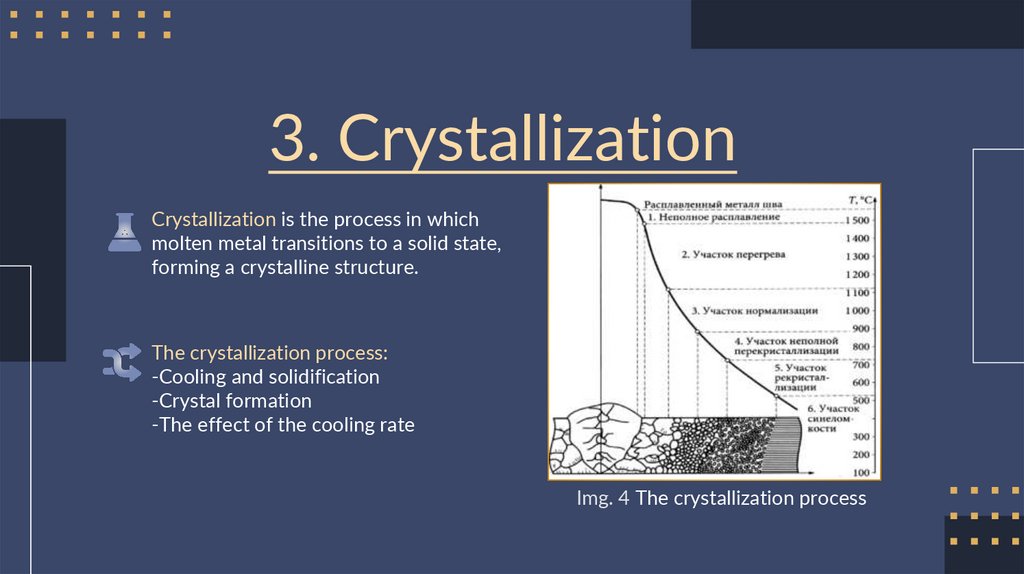
3. CrystallizationCrystallization is the process in which
molten metal transitions to a solid state,
forming a crystalline structure.
The crystallization process:
-Cooling and solidification
-Crystal formation
-The effect of the cooling rate
Img. 4 The crystallization process
5.
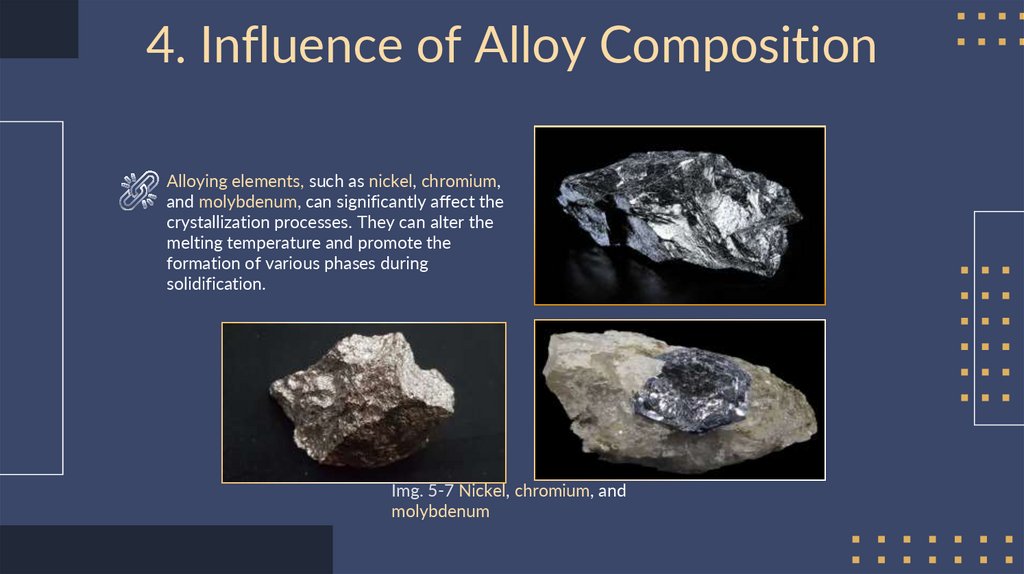
4. Influence of Alloy CompositionAlloying elements, such as nickel, chromium,
and molybdenum, can significantly affect the
crystallization processes. They can alter the
melting temperature and promote the
formation of various phases during
solidification.
Img. 5-7 Nickel, chromium, and
molybdenum
6.
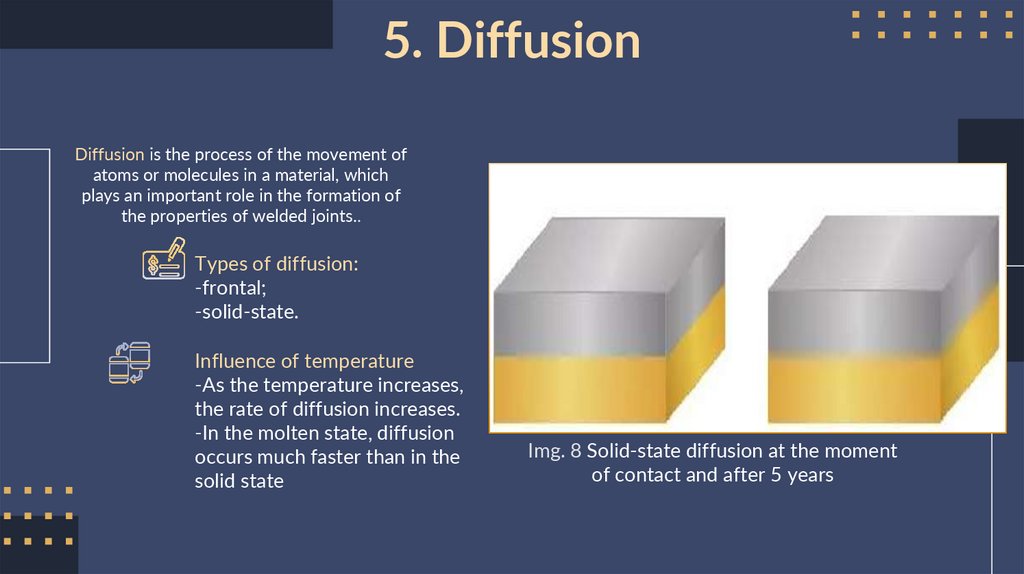
5. DiffusionDiffusion is the process of the movement of
atoms or molecules in a material, which
plays an important role in the formation of
the properties of welded joints..
Types of diffusion:
-frontal;
-solid-state.
Influence of temperature
-As the temperature increases,
the rate of diffusion increases.
-In the molten state, diffusion
occurs much faster than in the
solid state
Img. 8 Solid-state diffusion at the moment
of contact and after 5 years
7.
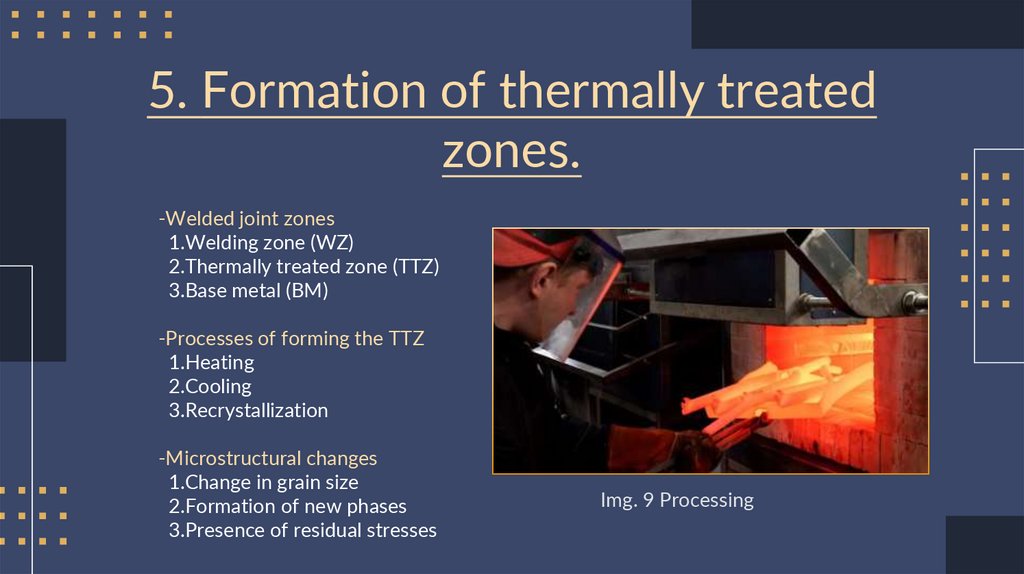
5. Formation of thermally treatedzones.
-Welded joint zones
1.Welding zone (WZ)
2.Thermally treated zone (TTZ)
3.Base metal (BM)
-Processes of forming the TTZ
1.Heating
2.Cooling
3.Recrystallization
-Microstructural changes
1.Change in grain size
2.Formation of new phases
3.Presence of residual stresses
Img. 9 Processing
8.
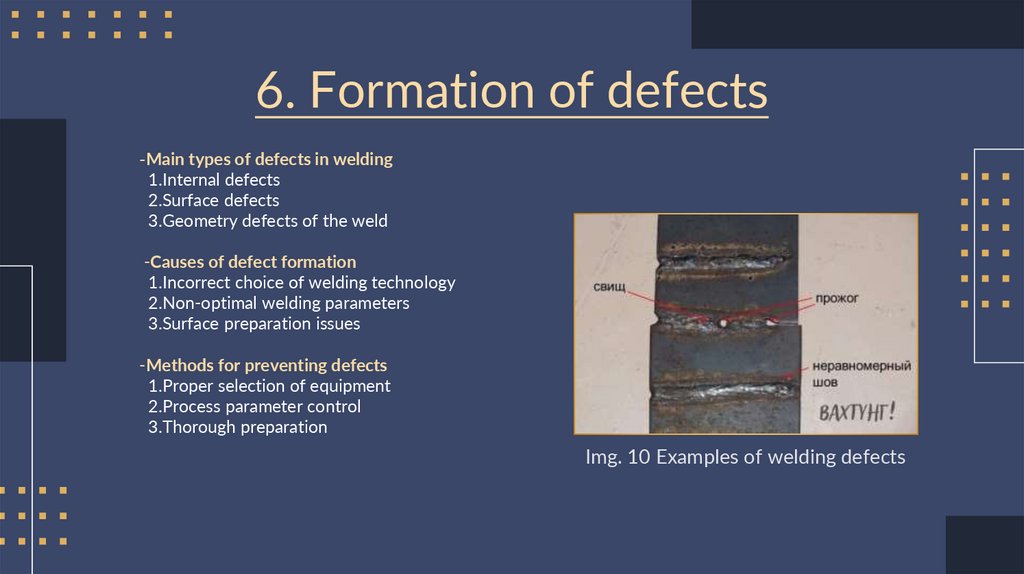
6. Formation of defects-Main types of defects in welding
1.Internal defects
2.Surface defects
3.Geometry defects of the weld
-Causes of defect formation
1.Incorrect choice of welding technology
2.Non-optimal welding parameters
3.Surface preparation issues
-Methods for preventing defects
1.Proper selection of equipment
2.Process parameter control
3.Thorough preparation
Img. 10 Examples of welding defects
9.
1. Ryabov, A. N. "Welding Metallurgy." Moscow: Metallurgia, 2015.2. Kuznetsov, V. I. "Welding Technologies." Moscow: Machine
Engineering, 2018.
3. Burtsov, S. A. "Physics and Metallurgy of Welding.«
Moscow: Nauka, 2020.
10.
List of resources1.
2.
3.
1. youtube.com/watch?v=gAOGTz6f7Osgrfg
2.Interactive Whiteboard Guide: Visual Physics. 7th Grade
3.ru.pinterest.com/pin/chromium_metal—363243526171736370
4.https://bstudy.net/606601/tehnika/strukturnye_prevrascheniya_svar
nom_okoloshovnoy_zone_gazovoy_svarke