

 Интернет
Похожие презентации:










Crime in Cyberspace. Module 3
1. Module 3. Crime in Cyberspace
Week 7 Lesson 2Speaking
2. Lesson Objectives
PRESENT ASSIGNMENT 3 IN PAIRSDEVELOP SPEAKING SKILLS.
DISCUSS AND SHARE IDEAS ABOUT CYBERCRIMES.
PRACTICE USING PASSIVE VOICE IN SPEAKING TASKS.
3. Lesson Outline
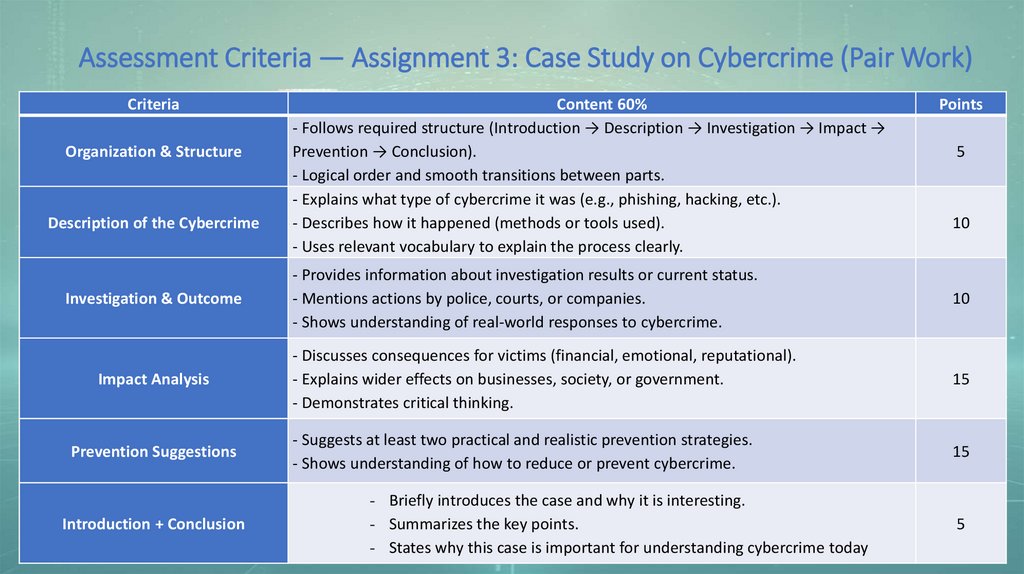
ASSIGNMENT 3 PRESENTATION. CASE STUDY4. Assessment Criteria — Assignment 3: Case Study on Cybercrime (Pair Work)
CriteriaOrganization & Structure
Description of the Cybercrime
Investigation & Outcome
Impact Analysis
Prevention Suggestions
Introduction + Conclusion
Content 60%
- Follows required structure (Introduction → Description → Investigation → Impact →
Prevention → Conclusion).
- Logical order and smooth transitions between parts.
- Explains what type of cybercrime it was (e.g., phishing, hacking, etc.).
- Describes how it happened (methods or tools used).
- Uses relevant vocabulary to explain the process clearly.
Points
5
10
- Provides information about investigation results or current status.
- Mentions actions by police, courts, or companies.
- Shows understanding of real-world responses to cybercrime.
10
- Discusses consequences for victims (financial, emotional, reputational).
- Explains wider effects on businesses, society, or government.
- Demonstrates critical thinking.
15
- Suggests at least two practical and realistic prevention strategies.
- Shows understanding of how to reduce or prevent cybercrime.
15
- Briefly introduces the case and why it is interesting.
- Summarizes the key points.
- States why this case is important for understanding cybercrime today
5
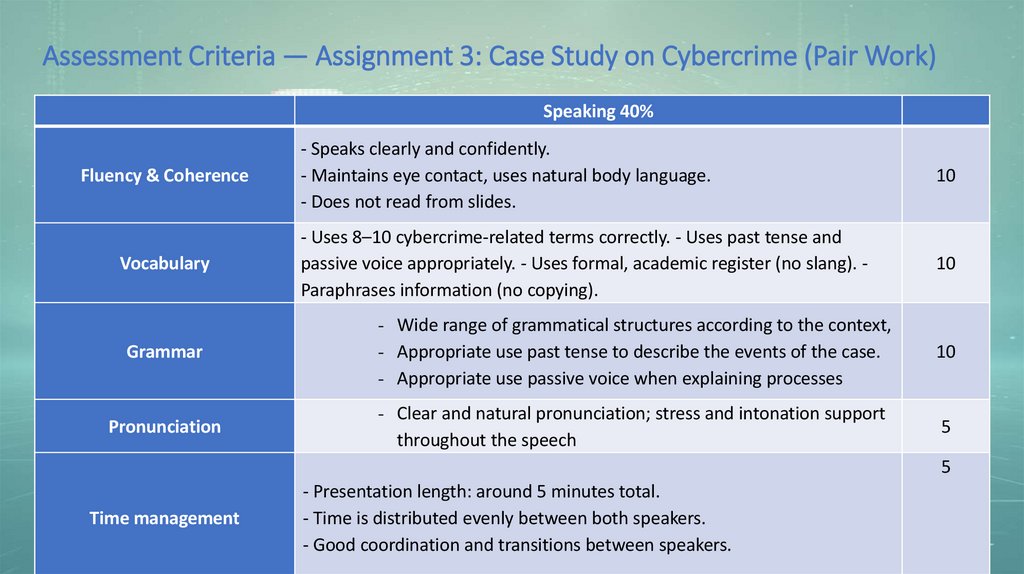
5. Assessment Criteria — Assignment 3: Case Study on Cybercrime (Pair Work)
Speaking 40%Fluency & Coherence
Vocabulary
- Speaks clearly and confidently.
- Maintains eye contact, uses natural body language.
- Does not read from slides.
10
- Uses 8–10 cybercrime-related terms correctly. - Uses past tense and
passive voice appropriately. - Uses formal, academic register (no slang). Paraphrases information (no copying).
10
Grammar
- Wide range of grammatical structures according to the context,
- Appropriate use past tense to describe the events of the case.
- Appropriate use passive voice when explaining processes
10
Pronunciation
- Clear and natural pronunciation; stress and intonation support
throughout the speech
5
5
Time management
- Presentation length: around 5 minutes total.
- Time is distributed evenly between both speakers.
- Good coordination and transitions between speakers.